
Title
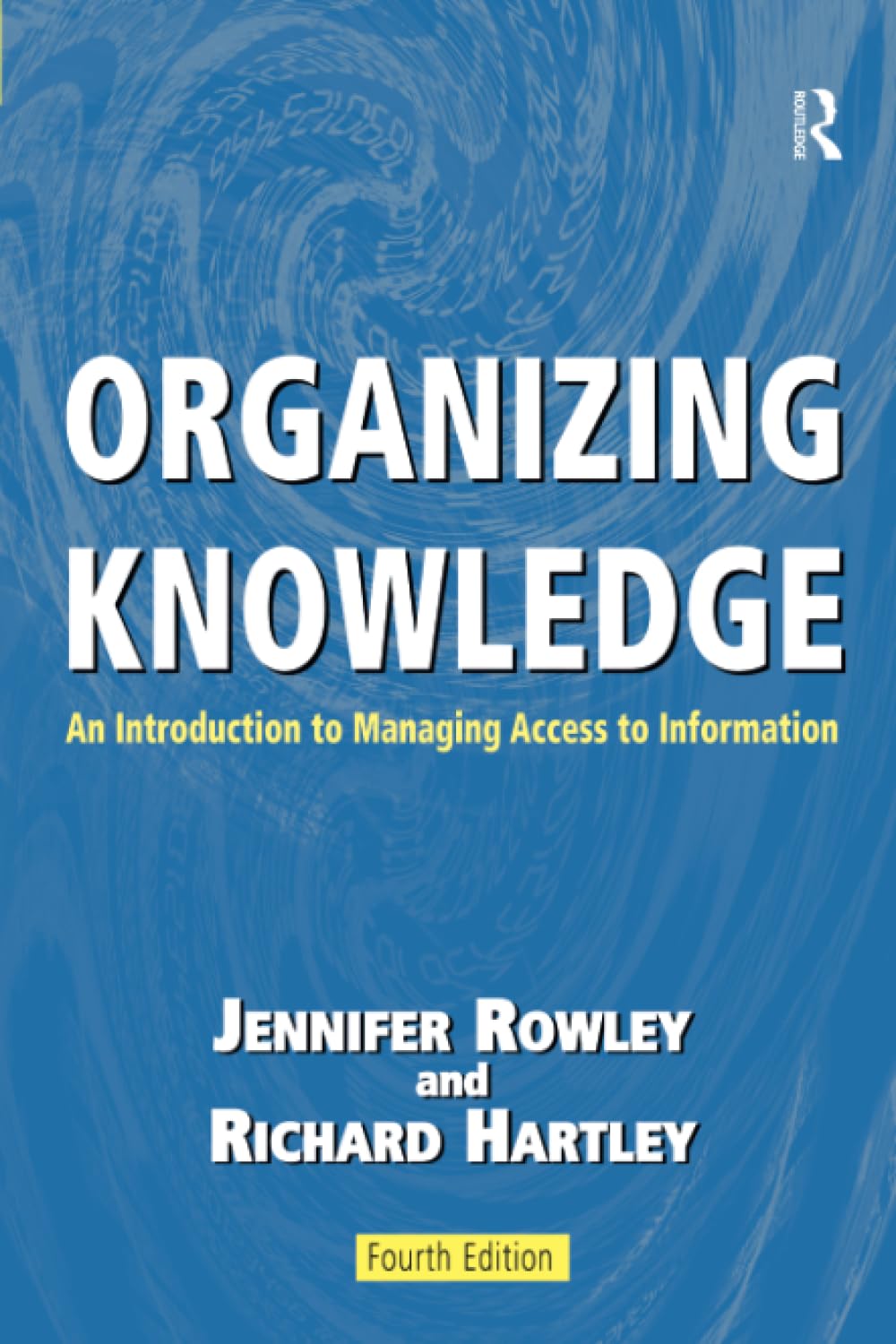
Organizing Knowledge,New
Sold by Ergodebooks, an authorized reseller.
Returns accepted within 30 days | support@ergodebooks.com
Shipping Information
- Free Standard Shipping — United States only
- Processing Time: 3–5 business days
- Estimated Delivery: 6–10 business days after dispatch
- Double-boxed, fully insured & discreetly packaged
- Tracking number sent via email once dispatched
Returns & Refund
Returns accepted within 30 days of delivery.
Damaged or Defective Item
Free return shipping + replacement or full refund
Wrong Item Received
Free return shipping + replacement or full refund
Change of Mind
Return shipping at customer's expense · 25% restocking fee applies
Payment Option

The fourth edition of this standard student text, Organizing Knowledge, incorporates extensive revisions reflecting the increasing shift towards a networked and digital information environment, and its impact on documents, information, knowledge, users and managers. Offering a broadbased overview of the approaches and tools used in the structuring and dissemination of knowledge, it is written in an accessible style and well illustrated with figures and examples. The book has been structured into three parts and twelve chapters and has been thoroughly updated throughout. Part I discusses the nature, structuring and description of knowledge. Part II, with its five chapters, lies at the core of the book focusing as it does on access to information. Part III explores different types of knowledge organization systems and considers some of the management issues associated with such systems. Each chapter includes learning objectives, a chapter summary and a list of references for further reading. This is a key introductory text for undergraduate and postgraduate students of information management.
⚠️ WARNING (California Proposition 65):
This product may contain chemicals known to the State of California to cause cancer, birth defects, or other reproductive harm.
For more information, please visit www.P65Warnings.ca.gov.
- Q: How many pages does 'Organizing Knowledge' have? A: This book has three hundred ninety-two pages. It provides a comprehensive overview of knowledge organization and management.
- Q: What is the size of the book? A: The book measures six point fourteen inches in length, nine point twenty-one inches in height, and zero point ninety-one inches in width. Its dimensions make it convenient for reading.
- Q: What type of binding does the book have? A: The book is available in paperback binding. This makes it lightweight and easy to handle.
- Q: Who is the author of 'Organizing Knowledge'? A: The author of this book is Jennifer Rowley. She is known for her expertise in information management.
- Q: What topics does 'Organizing Knowledge' cover? A: This book discusses knowledge structuring, access to information, and knowledge organization systems. It is divided into three parts with twelve chapters.
- Q: Is this book suitable for undergraduate students? A: Yes, this book is designed as a key introductory text for undergraduate and postgraduate students. It covers essential concepts in information management.
- Q: How should I take care of my copy of 'Organizing Knowledge'? A: To keep your book in good condition, store it in a dry place and avoid exposing it to direct sunlight. Regularly dust the cover and pages to maintain it.
- Q: Can this book be used for self-study? A: Yes, it includes learning objectives and chapter summaries that make it suitable for self-study. Readers can follow along at their own pace.
- Q: Does 'Organizing Knowledge' include any illustrations? A: Yes, the book is well illustrated with figures and examples. This enhances understanding of complex concepts.
- Q: Is there a list of references for further reading in the book? A: Yes, each chapter includes a list of references for further reading. This allows readers to explore topics in more depth.
- Q: What is the focus of Part II in the book? A: Part II focuses on access to information and includes five chapters. It is the core section of the book.
- Q: Is the fourth edition significantly different from previous editions? A: Yes, the fourth edition incorporates extensive revisions reflecting modern digital information environments. It addresses current trends in knowledge management.
- Q: What audience is this book primarily targeted at? A: This book is targeted at students and professionals interested in information management. It serves as an educational resource.
- Q: Does this book discuss management issues related to knowledge organization? A: Yes, Part III of the book explores management issues associated with different types of knowledge organization systems. It provides valuable insights.
- Q: Is 'Organizing Knowledge' available in other formats? A: Currently, it is available in paperback format. There may be digital versions, but it primarily features this physical edition.