If you have any questions, you are always welcome to contact us. We'll get back to you as soon as possible, withing 24 hours on weekdays.
Customer service
All questions about your order, return and delivery must be sent to our customer service team by e-mail at yourstore@yourdomain.com
Sale & Press
If you are interested in selling our products, need more information about our brand or wish to make a collaboration, please contact us at press@yourdomain.com
Help
If you have any questions, you are always welcome to contact us. We'll get back to you as soon as possible, withing 24 hours on weekdays.
Customer service
All questions about your order, return and delivery must be sent to our customer service team by e-mail at yourstore@yourdomain.com
Sale & Press
If you are interested in selling our products, need more information about our brand or wish to make a collaboration, please contact us at press@yourdomain.com
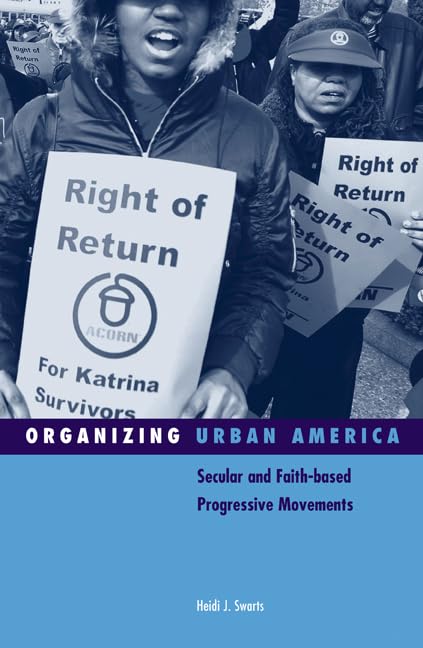
Collective action through organized social movements has long expanded American citizens rights and liberties. Recently, the Association of Community Organizations for Reform Now (ACORN) has helped win living wage initiatives in more than 130 cities across the country. Likewise, congregationbased groups have established countless health, education, and other social programs at city and state levels. Despite modest budgets, these organizationsdifferent in their approach, but at the same time working for social changehave won billions of dollars in redistributive programs.Looking closely at this phenomenon, Heidi J. Swarts explores activist groups cultural, organizational, and political strategies. Focusing on ACORN chapters and church federations in St. Louis, Missouri, and San Jose, California, Swarts demonstrates that congregationbased organizing has developed an innovative cultural strategy, combining democratic deliberation and leadership development to produce a culture of commitment among its crossclass, multiracial membership. By contrast, ACORNs more homogeneous lowincome class base has a national structure that allows it to coordinate campaigns quickly, and its seasoned staff excels in tactical innovations. By making these ofteninvisible grassroots organizers evident, Swarts sheds light on factors that constrain or enable other social movements in the United States.Heidi J. Swarts is assistant professor of political science at Rutgers University.
⚠️ WARNING (California Proposition 65):
This product may contain chemicals known to the State of California to cause cancer,
birth defects, or other reproductive harm.
For MAP (Minimum Advertised Price) violations and Intellectual Property (IP) or Trademark concerns, please contact:
support@ergodebooks.com
⚠️ California Proposition 65 Warning: Some products sold on this website may expose you to chemicals known to the State of California to cause cancer, birth defects, or other reproductive harm. For more information, visit www.P65Warnings.ca.gov.