
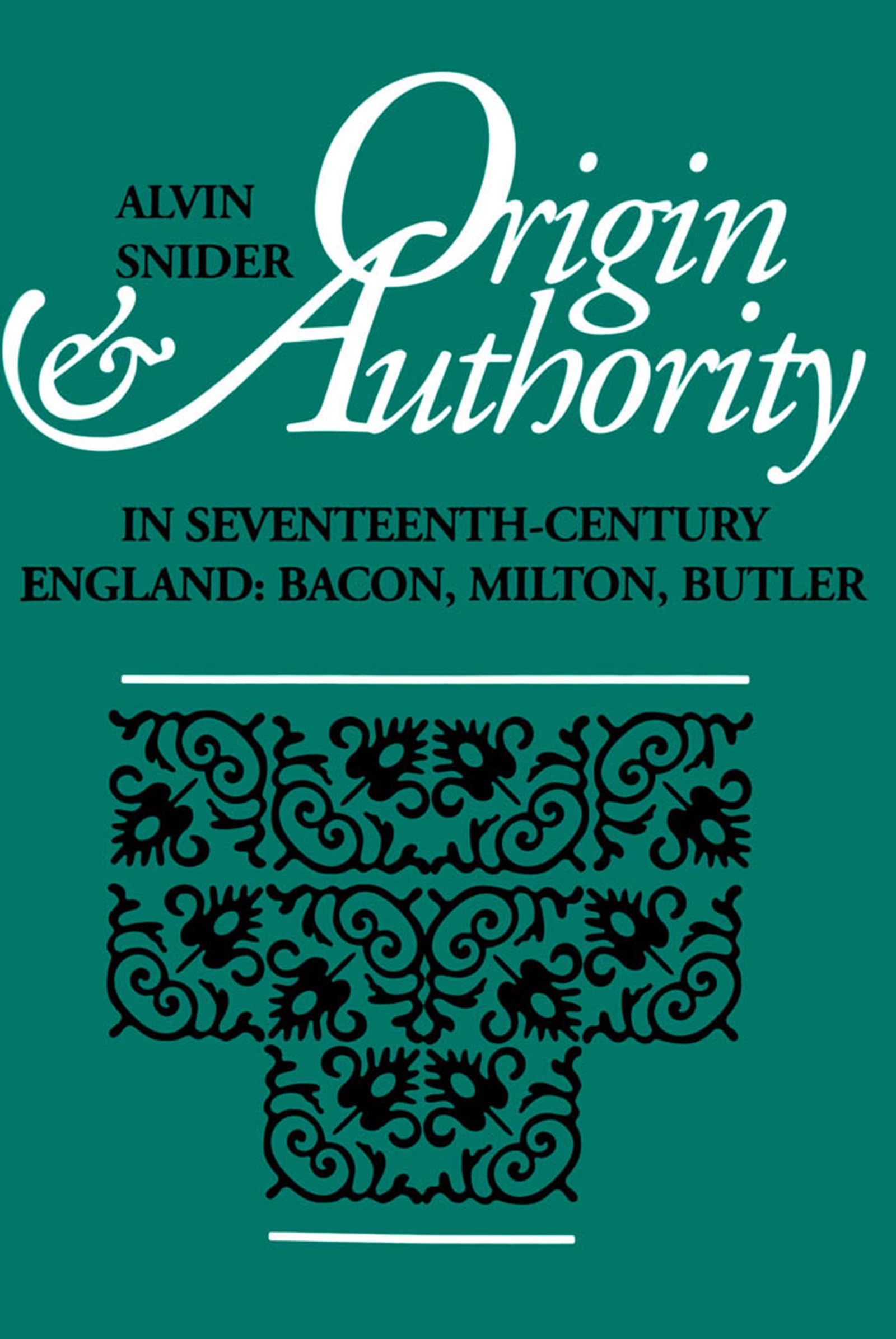
Title
Origin and Authority in SeventeenthCentury England,Used
Sold by Ergodebooks, an authorized reseller.
Returns accepted within 30 days | support@ergodebooks.com
Shipping Information
- Free Standard Shipping — United States only
- Processing Time: 3–5 business days
- Estimated Delivery: 6–10 business days after dispatch
- Double-boxed, fully insured & discreetly packaged
- Tracking number sent via email once dispatched
Returns & Refund
Returns accepted within 30 days of delivery.
Damaged or Defective Item
Free return shipping + replacement or full refund
Wrong Item Received
Free return shipping + replacement or full refund
Change of Mind
Return shipping at customer's expense · 25% restocking fee applies
Payment Option

About the Author Alvin Snider is Assistant Professor of English at the University of Iowa. Product Description Francis Bacon, John Milton, and Samuel Butler are three writers generally thought to have little in common. Yet, as Alvin Snider argues, all participated in the seventeenthcentury discourse on origins. They believed that the truth of an idea could be determined by enquiry into its genesis, and looked for authority in rudimentary and incorrupt principles. Bacon wanted to rebuild knowledge from its foundations; Milton invoked a distant past to secure a base for the present; and Butler expressed intense nostalgia for a fixed truth associated with origins. Focusing on writings by these three figures, Snider shows how an authoritative discourse on origin became an alternative to error in a time of revolution and cultural transformation, and traces its gradual disintegration as the difficulty of locating origins became increasingly evident.Snider concentrates on three texts: Bacon's Novum Organum, Milton's Paradise Lost, and Butler's Hudibras. He treats the concept of a definitive origin not just as a literary or historical trope but as a complex system of representation that informs the poetry, philosophy, and other writings of the period. Drawing on theories of ideology and attending carefully to the role of language in the production and construction of knowledge, Snider shows how Bacon's desire to abolish error through a systematic renovation of authority contributed to the formation of an ideal of scientific objectivity. He argues that the quest for an absolute beginning in Paradise Lost foregrounds the problems of representation and of making experience a reliable index of truth. Moving from the emergence of modern science early in the century to the revival of epic and monarchy after the Restoration, he considers texts from a range of disciplines. Because Bacon, Milton, and Butler all occupy a historical space where literature, philosophy, and politics converge, their writings form an ideal base for this study.Writing with economy, clarity, and verve, Snider revises the intellectual history of the seventeenth century, superimposing a new narrative of disintegrating confidence on the old one of the triumph of science over poetry.
⚠️ WARNING (California Proposition 65):
This product may contain chemicals known to the State of California to cause cancer, birth defects, or other reproductive harm.
For more information, please visit www.P65Warnings.ca.gov.