
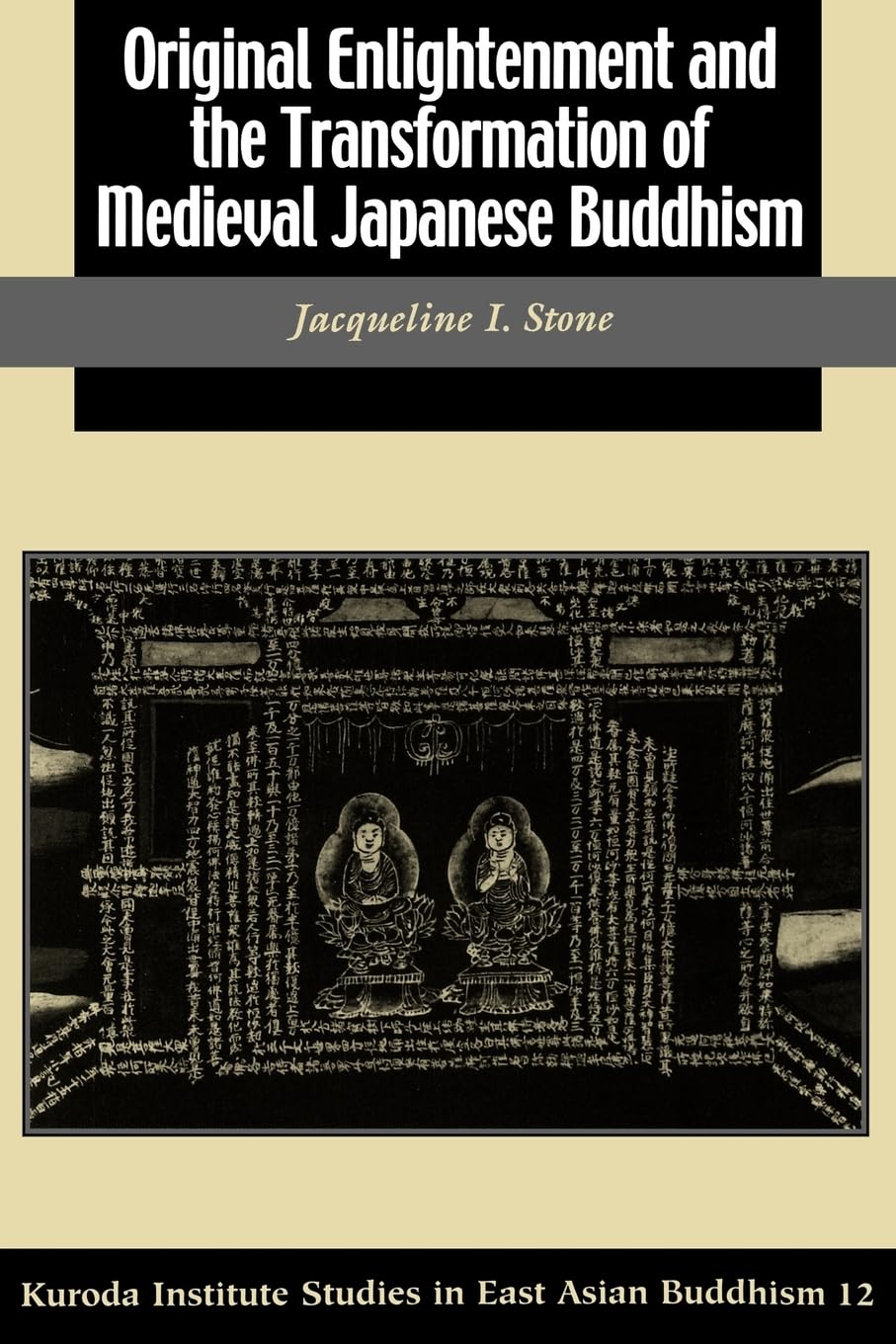
Title
Original Enlightenment And The Transformation Of Medieval Japanese Buddhism (Kuroda Studies In East Asian Buddhism, 31)
Sold by Ergodebooks, an authorized reseller.
Returns accepted within 30 days | support@ergodebooks.com
Shipping Information
- Free Standard Shipping — United States only
- Processing Time: 3–5 business days
- Estimated Delivery: 6–10 business days after dispatch
- Double-boxed, fully insured & discreetly packaged
- Tracking number sent via email once dispatched
Returns & Refund
Returns accepted within 30 days of delivery.
Damaged or Defective Item
Free return shipping + replacement or full refund
Wrong Item Received
Free return shipping + replacement or full refund
Change of Mind
Return shipping at customer's expense · 25% restocking fee applies
Payment Option

Original Enlightenment Thought (Hongaku Shiso) Dominated Buddhist Intellectual Circles Throughout Japans Medieval Period. Enlightenment, This Discourse Claims, Is Neither A Goal To Be Achieved Nor A Potential To Be Realized But The True Status Of All Things. Every Animate And Inanimate Object Manifests The Primordially Enlightened Buddha Just As It Is. Seen In Its True Aspect, Every Activity Of Daily Lifeeating, Sleeping, Even Ones Deluded Thinkingis The Buddhas Conduct. Emerging From Within The Powerful Tendai School, Ideas Of Original Enlightenment Were Appropriated By A Number Of Buddhist Traditions And Influenced Nascent Theories About The Kami (Local Deities) As Well As Medieval Aesthetics And The Literary And Performing Arts.Scholars And Commentators Have Long Recognized The Historical Importance Of Original Enlightenment Thought But Differ Heatedly Over How It Is To Be Understood. Some Tout It As The Pinnacle Of The Buddhist Philosophy Of Absolute Nondualism. Others Claim To Find In It The Paradigmatic Expression Of A Timeless Japanese Spirituality. According Other Readings, It Represents A Dangerous Antinomianism That Undermined Observance Of Moral Precepts, Precipitated A Decline In Buddhist Scholarship, And Denied The Need For Religious Discipline. Still Others Denounce It As An Authoritarian Ideology That, By Sacralizing The Given Order, Has In Effect Legitimized Hierarchy And Discriminative Social Practices. Often The Acceptance Or Rejection Of Original Enlightenment Thought Is Seen As The Fault Line Along Which Traditional Buddhist Institutions Are To Be Differentiated From The New Buddhist Movements (Zen, Pure Land, And Nichiren) That Arose During Japans Medieval Period.Jacqueline Stones Groundbreaking Study Moves Beyond The Treatment Of The Original Enlightenment Doctrine As Abstract Philosophy To Explore Its Historical Dimension. Drawing On A Wealth Of Medieval Primary Sources And Modern Japanese Scholarship, It Places This Discourse In Its Ritual, Institutional, And Social Contexts, Illuminating Its Importance To The Maintenance Of Traditions Of Lineage And The Secret Transmission Of Knowledge That Characterized Several Medieval Japanese Elite Culture. It Sheds New Light On Interpretive Strategies Employed In Premodern Japanese Buddhist Texts, An Area That Hitherto Has Received A Little Attention. Through These And Other Lines Of Investigation, Stone Problematizes Entrenched Notions Of Corruption In The Medieval Buddhist Establishment. Using The Examples Of Tendai And Nichiren Buddhism And Their Interactions Throughout The Medieval Period, She Calls Into Question Both Overly Facile Distinctions Between Old And New Buddhism And The Longstanding Scholarly Assumptions That Have Perpetuated Them. This Study Marks A Significant Contribution To Ongoing Debates Over Definitions Of Buddhism In The Kamakura Era (11851333), Long Regarded As A Formative Period In Japanese Religion And Culture. Stone Argues That Original Enlightenment Thought Represents A Substantial Rethinking Of Buddhist Enlightenment That Cuts Across The Distinction Between Old And New Institutions And Was Particularly Characteristic Of The Medieval Period.
⚠️ WARNING (California Proposition 65):
This product may contain chemicals known to the State of California to cause cancer, birth defects, or other reproductive harm.
For more information, please visit www.P65Warnings.ca.gov.
- Q: What is the page count of this book? A: This book has five hundred sixty-six pages. It provides an in-depth exploration of original enlightenment thought in medieval Japanese Buddhism.
- Q: What are the dimensions of this book? A: The book measures six inches in length, one point two six inches in width, and nine point zero two inches in height. These dimensions make it portable and easy to handle.
- Q: What type of binding does this book have? A: This book is available in paperback binding. Paperback editions are often lighter and more flexible than hardcover versions.
- Q: Who is the author of this book? A: The author is Jacqueline Stone, a recognized scholar in the field of East Asian Buddhism. Her expertise enriches the analysis presented in the text.
- Q: What is the main theme of the book? A: The main theme is the exploration of original enlightenment thought in medieval Japanese Buddhism. It addresses its historical significance and cultural impact.
- Q: What categories does this book fall under? A: This book falls under the category of Japan and East Asian Buddhism. It is part of the Kuroda Studies in East Asian Buddhism series.
- Q: How do I read this book effectively? A: To read this book effectively, take notes on key concepts and themes. Engaging with the primary sources discussed will enhance your understanding.
- Q: Is this book suitable for beginners in Buddhist studies? A: Yes, this book is suitable for beginners. It provides a comprehensive introduction to original enlightenment thought and its historical context.
- Q: Can I use this book for academic research? A: Yes, this book is an excellent resource for academic research. It includes primary sources and insights that are valuable for scholarly work.
- Q: How should I store this book? A: Store this book in a cool, dry place to avoid damage. Ensure it is kept upright on a shelf to maintain its shape.
- Q: What if the book arrives damaged? A: If the book arrives damaged, contact the retailer for a return or replacement. Most retailers have policies to handle such situations.
- Q: Is this book safe for children? A: No, this book is not specifically targeted at children. It addresses complex themes in Buddhism that may be better suited for adults.
- Q: Does this book include illustrations or images? A: No, this book does not include illustrations. It focuses on textual analysis and historical context rather than visual elements.
- Q: Are there any notable features of this book? A: One notable feature is its scholarly approach, drawing on medieval primary sources. This adds depth to the understanding of Japanese Buddhism.
- Q: How does this book compare to other texts on Buddhism? A: This book offers a unique perspective on original enlightenment thought, differentiating it from other works that may not address historical contexts as deeply.
- Q: What is the publication date of this book? A: The publication date is not specified in the provided details. However, it is part of an established scholarly series.