
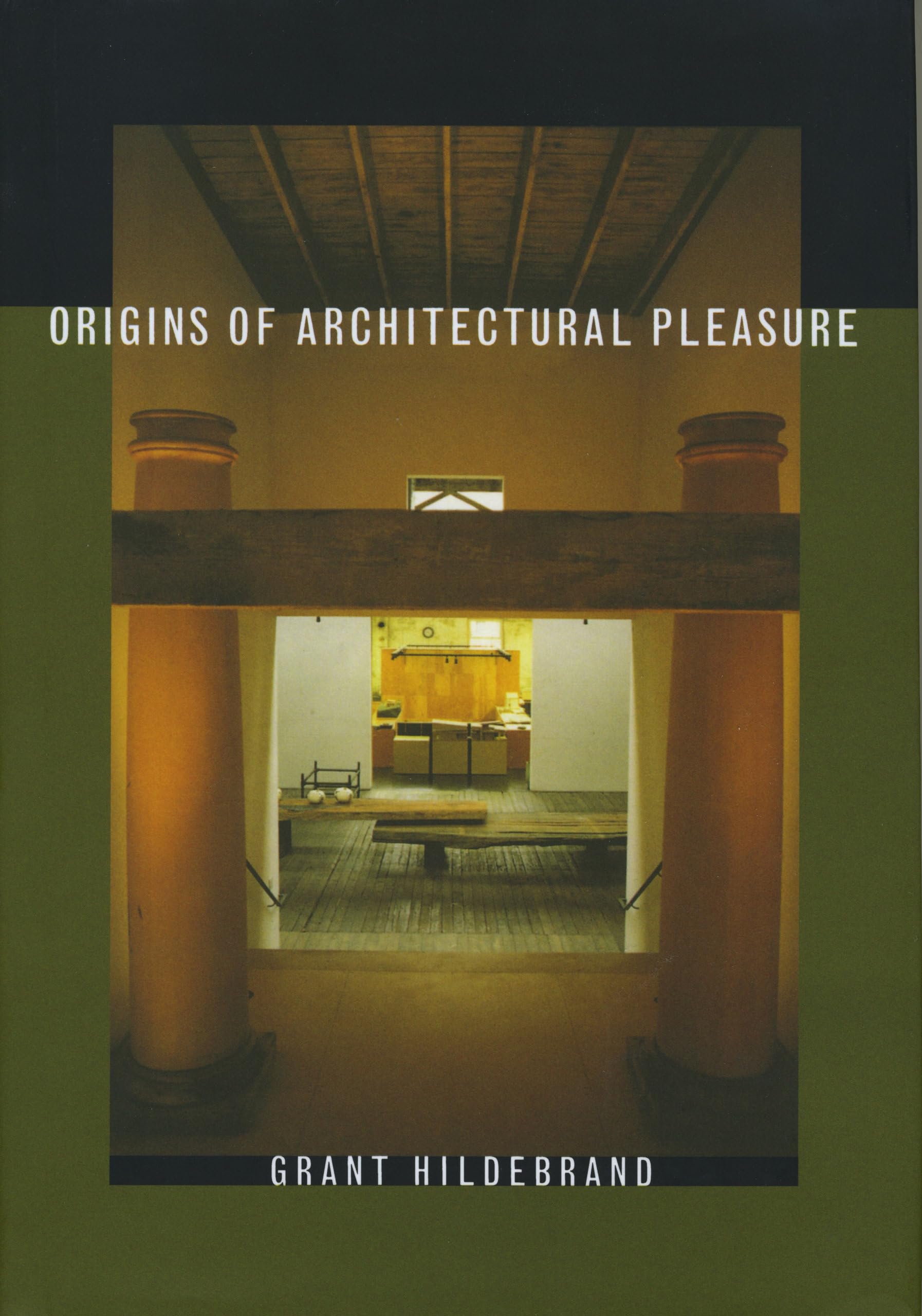
Title
Origins of Architectural Pleasure,Used
Sold by Ergodebooks, an authorized reseller.
Returns accepted within 30 days | support@ergodebooks.com
Shipping Information
- Free Standard Shipping — United States only
- Processing Time: 3–5 business days
- Estimated Delivery: 6–10 business days after dispatch
- Double-boxed, fully insured & discreetly packaged
- Tracking number sent via email once dispatched
Returns & Refund
Returns accepted within 30 days of delivery.
Damaged or Defective Item
Free return shipping + replacement or full refund
Wrong Item Received
Free return shipping + replacement or full refund
Change of Mind
Return shipping at customer's expense · 25% restocking fee applies
Payment Option

Do survival instincts have anything to do with our architectural choicesour liking for a certain room, a special stairway, a plaza in a particular city? In this engaging study Grant Hildebrand discusses ways in which architectural forms emulate some archetypal settings that humans have found appealingand useful to survivalfrom ancient times to the present.Speculating that nature has 'designed' us to prefer certain conditions and experiences, Hildebrand is interested in how the characteristics of our most satisfying built environments mesh with Darwinian selection. In examining the appeal of such survivalbased characteristics he cites architectural examples spanning five continents and five millennia. Among those included are the Palace of Minos, the Alhambra, Wells cathedral, the Shinto shrine at Ise, the Piazza San Marco, Brunelleschi's Pazzi Chapel, Frank Lloyd Wright's Fallingwater, a Seattle condominium, and recent houses by Eric Owen Moss and Arne Bystrom.Just what characteristics bestow evolutionary benefits? 'Refuge and prospect' offer a protective place of concealment close to a foraging and hunting ground. 'Enticement' invites the safe exploration of an informationrich setting where worthwhile discoveries await. 'Peril' elicits an emotion of pleasurable fear and so tests and increases our competence in the face of danger: thus the attraction of a skyscraper or a house poised over a vertiginous ravine. 'Order and complexity' tease our intuitions for sorting complex information into survivaluseful categories.Gracefully written, with excellent illustrations that complement the text, Origins of Architectural Pleasure will open the reader's eyes to new ways of seeing a home, a workplace, a vacation setting, even a particular table in a restaurant. It also suggests important design considerations for buildings with a more pressing mandate for human appeal, such as hospitals, retirement homes, and hospices.
⚠️ WARNING (California Proposition 65):
This product may contain chemicals known to the State of California to cause cancer, birth defects, or other reproductive harm.
For more information, please visit www.P65Warnings.ca.gov.
- Q: What are the dimensions of 'Origins of Architectural Pleasure'? A: The book measures seven point zero one inches in length, zero point eight inches in width, and ten inches in height.
- Q: How many pages does this book have? A: This book has one hundred seventy-four pages, providing a comprehensive exploration of architectural themes.
- Q: What type of binding does this book feature? A: The book is bound in hardcover, ensuring durability and a premium feel.
- Q: Who is the author of 'Origins of Architectural Pleasure'? A: The author is Grant Hildebrand, who offers insights into the relationship between architecture and human survival instincts.
- Q: What is the genre of this book? A: This book falls under the category of Criticism, focusing on architectural theory and human preferences.
- Q: How do I read 'Origins of Architectural Pleasure'? A: You can read this book by picking it up and exploring its chapters, each of which delves into architectural aesthetics and evolutionary benefits.
- Q: Is 'Origins of Architectural Pleasure' suitable for all age groups? A: This book is suitable for adults and older teens interested in architecture and its psychological implications.
- Q: What themes does this book explore? A: The book explores themes such as survival instincts, architectural appeal, and the emotional connection between humans and built environments.
- Q: Can 'Origins of Architectural Pleasure' be used as a textbook? A: Yes, it can serve as a supplemental textbook for courses in architecture, design, or psychology.
- Q: How should I store this book to keep it in good condition? A: Store the book upright on a shelf away from direct sunlight to prevent fading and damage.
- Q: Is there any special care needed for this hardcover book? A: To maintain its condition, keep it clean and avoid exposing it to moisture or extreme temperatures.
- Q: Can I return 'Origins of Architectural Pleasure' if I'm not satisfied? A: Yes, you can return the book within the specified return period set by the retailer.
- Q: What if the book arrives damaged? A: If the book arrives damaged, contact customer service for assistance with a return or replacement.
- Q: Does this book offer any illustrations? A: Yes, 'Origins of Architectural Pleasure' includes excellent illustrations that complement the text and enhance understanding.
- Q: Is this book recommended for professionals in architecture? A: Yes, professionals in architecture will find valuable insights that relate evolutionary benefits to architectural design.
- Q: What can I learn from reading this book? A: You can learn how architectural choices are influenced by survival instincts and what characteristics make environments appealing.