
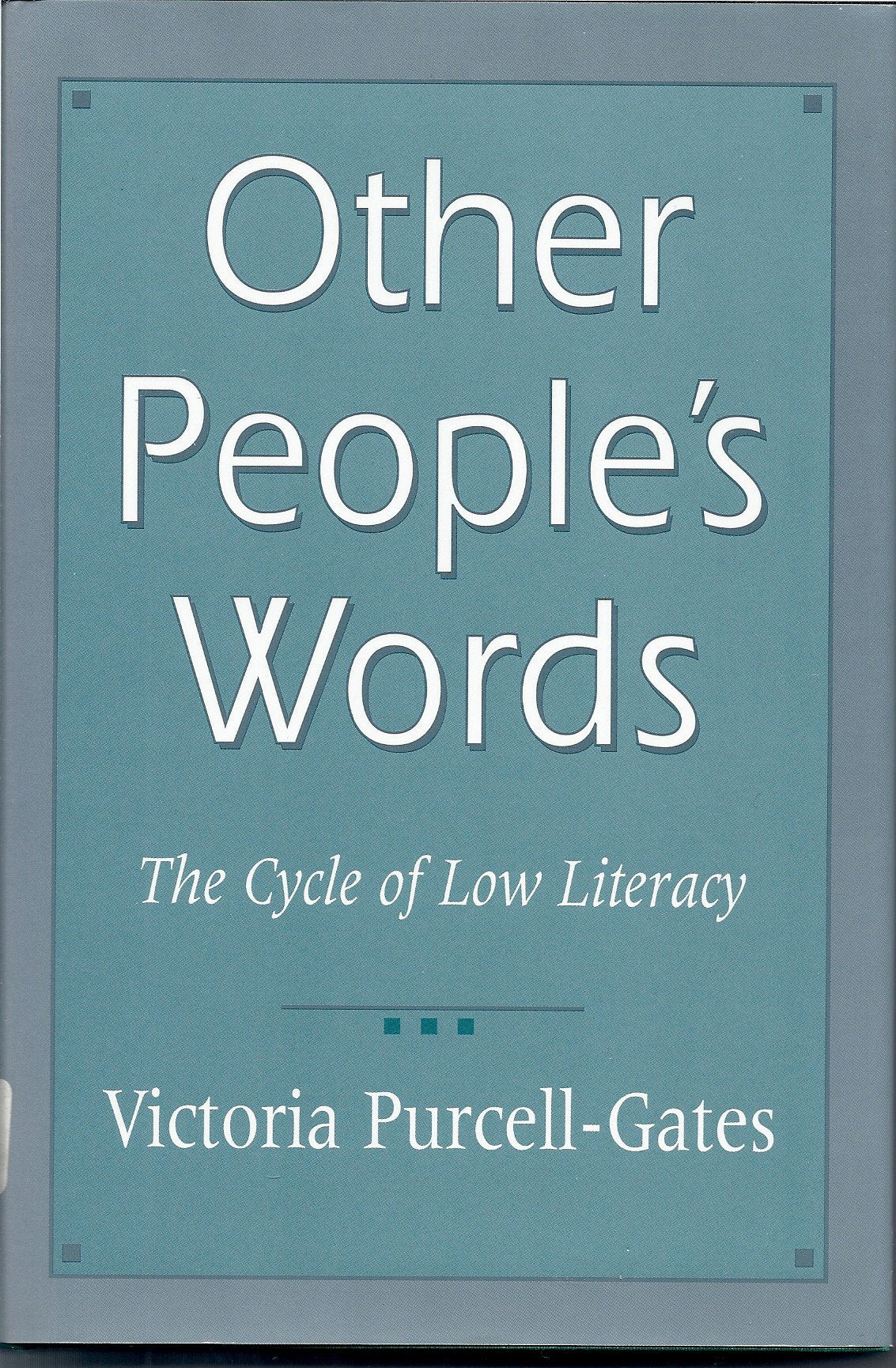
Title
Other People's Words: The Cycle of Low Literacy,New
Sold by Ergodebooks, an authorized reseller.
Returns accepted within 30 days | support@ergodebooks.com
Shipping Information
- Free Standard Shipping — United States only
- Processing Time: 3–5 business days
- Estimated Delivery: 6–10 business days after dispatch
- Double-boxed, fully insured & discreetly packaged
- Tracking number sent via email once dispatched
Returns & Refund
Returns accepted within 30 days of delivery.
Damaged or Defective Item
Free return shipping + replacement or full refund
Wrong Item Received
Free return shipping + replacement or full refund
Change of Mind
Return shipping at customer's expense · 25% restocking fee applies
Payment Option

If asked to identify which children rank lowest in relation to national educational norms, have higher school dropout and absence rates, and more commonly experience learning problems, few of us would know the answer: white, urban Appalachian children. These are the children and grandchildren of Appalachian families who migrated to northern cities in the 1950s to look for work. They make up this largely 'invisible' urban group, a minority that represents a significant portion of the urban poor. Literacy researchers have rarely studied urban Appalachians, yet, as Victoria PurcellGates demonstrates in Other People's Words, their often severe literacy problems provide a unique perspective on literacy and the relationship between print and culture.A compelling case study details the author's work with one such family. The parents, who attended school off and on through the seventh grade, are unable to use public transportation, shop easily, or understand the homework their elementaryschoolage son brings home because neither of them can read. But the family is not so much illiterate as low literatethe world they inhabit is an oral one, their heritage one where print had no inherent use and no inherent meaning. They have as much to learn about the culture of literacy as about written language itself.PurcellGates shows how access to literacy has been blocked by a confluence of factors: negative cultural stereotypes, cultural and linguistic elitism, and pedagogical obtuseness. She calls for the recruitment and training of 'proactive' teachers who can assess and encourage children's progress and outlines specific intervention strategies.
⚠️ WARNING (California Proposition 65):
This product may contain chemicals known to the State of California to cause cancer, birth defects, or other reproductive harm.
For more information, please visit www.P65Warnings.ca.gov.
- Q: How many pages does the book have? A: The book has two hundred fifty-six pages. This length allows for an in-depth exploration of the topics related to literacy and culture.
- Q: What is the binding type of this book? A: This book is a hardcover edition. Hardcover bindings are known for their durability and protection of the pages.
- Q: What are the dimensions of the book? A: The book measures six inches in length, one inch in width, and eight point seventy-five inches in height. These dimensions make it a standard size for easy handling.
- Q: How do I use this book for educational purposes? A: You can use this book to enhance understanding of literacy issues in urban Appalachian communities. It's suitable for educators and researchers focusing on literacy and cultural studies.
- Q: Is this book appropriate for all age groups? A: While not explicitly stated, the book addresses complex themes that are better suited for adults and older students. It is recommended for those studying social sciences.
- Q: Can this book be used in a classroom setting? A: Yes, this book can be effectively used in classroom discussions about literacy and cultural diversity. It provides valuable insights for both teachers and students.
- Q: How do I keep this book in good condition? A: To maintain the book's condition, store it upright in a dry place away from direct sunlight. Avoid exposing it to moisture to prevent damage.
- Q: Is this book safe for children? A: Yes, the book's content is safe but may be complex for younger readers. It's recommended for older students or adults who can grasp the subject matter.
- Q: What should I do if the book arrives damaged? A: If the book arrives damaged, you should contact the seller for a return or exchange. Most sellers offer policies for damaged goods.
- Q: Does this book contain any illustrations? A: No, this book does not contain illustrations. It focuses on text-based analysis and case studies regarding literacy issues.
- Q: How does this book compare to other literacy studies? A: This book provides a unique perspective on low literacy among urban Appalachians, distinguishing it from other literacy studies that may not focus on this demographic.
- Q: Who is the author of the book? A: The author of the book is Victoria Purcell-Gates. She is known for her research in literacy and education, particularly among marginalized groups.
- Q: What is the main theme of this book? A: The main theme of the book revolves around the challenges of low literacy and its socio-cultural implications. It emphasizes the importance of understanding cultural contexts in literacy education.
- Q: Is this book part of a series? A: No, this book is not part of a series. It stands alone as a comprehensive study of literacy issues in a specific cultural context.
- Q: Can this book be used for research purposes? A: Yes, this book is suitable for research. It offers valuable insights and case studies that can support academic work in literacy and social sciences.