
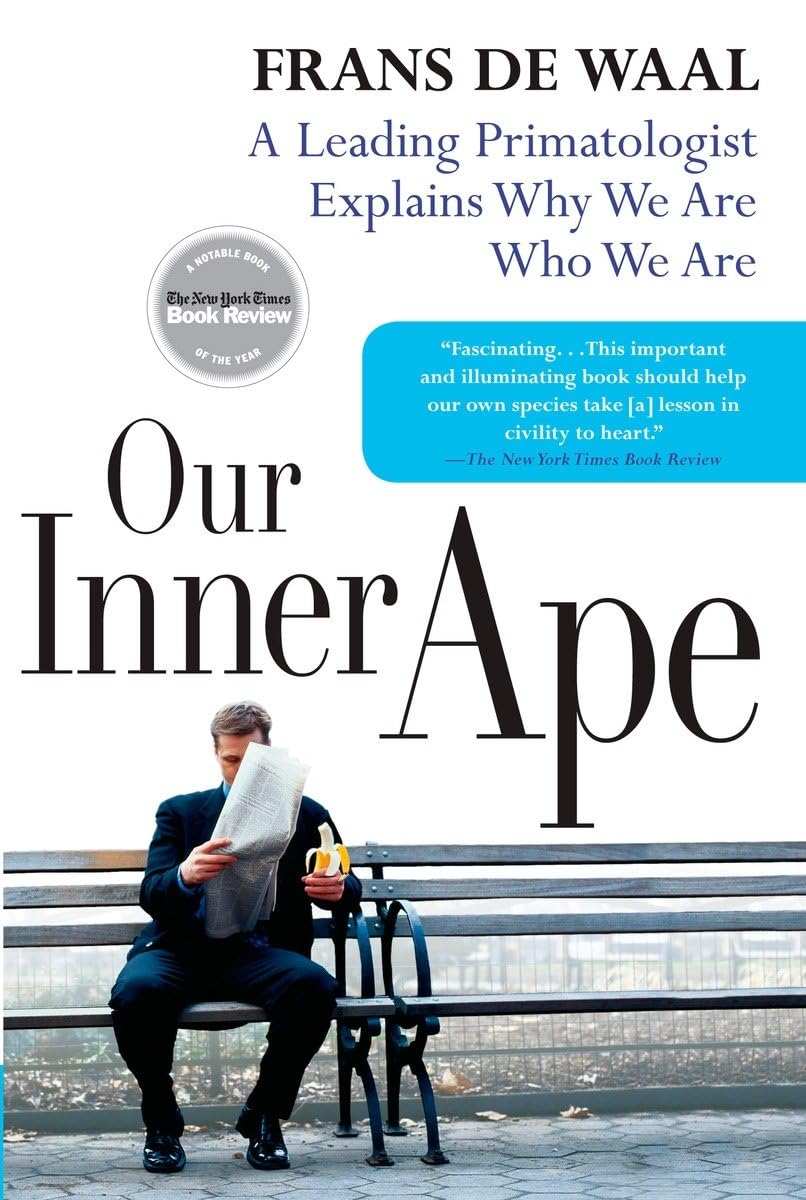
Title
Our Inner Ape: A Leading Primatologist Explains Why We Are Who We Are
Sold by Ergodebooks, an authorized reseller.
Returns accepted within 30 days | support@ergodebooks.com
Shipping Information
- Free Standard Shipping — United States only
- Processing Time: 3–5 business days
- Estimated Delivery: 6–10 business days after dispatch
- Double-boxed, fully insured & discreetly packaged
- Tracking number sent via email once dispatched
Returns & Refund
Returns accepted within 30 days of delivery.
Damaged or Defective Item
Free return shipping + replacement or full refund
Wrong Item Received
Free return shipping + replacement or full refund
Change of Mind
Return shipping at customer's expense · 25% restocking fee applies
Payment Option

Visit The Author'S Web Site At Www.Ourinnerape.Comits No Secret That Humans And Apes Share A Host Of Traits, From The Tribal Communities We Form To Our Irrepressible Curiosity. We Have A Common Ancestor, Scientists Tell Us, So Its Natural That We Act Alike. But Not All Of These Parallels Are So Appealing: The Chimpanzee, For Example, Can Be As Vicious And Manipulative As Any Human.Yet Theres More To Our Shared Primate Heritage Than Just Our Violent Streak. In Our Inner Ape, Frans De Waal, One Of The Worlds Great Primatologists And A Renowned Expert On Social Behavior In Apes, Presents The Provocative Idea That Our Noblest Qualitiesgenerosity, Kindness, Altruismare As Much A Part Of Our Nature As Are Our Baser Instincts. After All, We Share Them With Another Primate: The Lesserknown Bonobo. As Genetically Similar To Man As The Chimpanzee, The Bonobo Has A Temperament And A Lifestyle Vastly Different From Those Of Its Genetic Cousin. Where Chimps Are Aggressive, Territorial, And Hierarchical, Bonobos Are Gentle, Loving, And Erotic (Sex For Bonobos Is As Much About Pleasure And Social Bonding As It Is About Reproduction).While The Parallels Between Chimp Brutality And Human Brutality Are Easy To See, De Waal Suggests That The Conciliatory Bonobo Is Just As Legitimate A Model To Study When We Explore Our Primate Heritage. He Even Connects Humanitys Desire For Fairness And Its Morality With Primate Behavior, Offering A View Of Society That Contrasts Markedly With The Caricature People Have Of Darwinian Evolution. Its Plain That Our Finest Qualities Run Deeper In Our Dna Than Experts Have Previously Thought.Frans De Waal Has Spent The Last Two Decades Studying Our Closest Primate Relations, And His Observations Of Each Species In Our Inner Ape Encompass The Spectrum Of Human Behavior. This Is An Audacious Book, An Engrossing Discourse That Proposes Thoughtprovoking And Sometimes Shocking Connections Among Chimps, Bonobos, And Those Most Paradoxical Of Apes, Human Beings.
⚠️ WARNING (California Proposition 65):
This product may contain chemicals known to the State of California to cause cancer, birth defects, or other reproductive harm.
For more information, please visit www.P65Warnings.ca.gov.
- Q: How many pages does 'Our Inner Ape' have? A: This book has three hundred twelve pages. It provides an in-depth exploration of human and primate behavior.
- Q: What is the binding type of 'Our Inner Ape'? A: The book is available in paperback binding. This makes it lightweight and easy to carry.
- Q: What are the dimensions of 'Our Inner Ape'? A: The book measures five point five one inches long, eight point two seven inches tall, and zero point seven nine inches thick. These dimensions make it a convenient size for reading.
- Q: Who is the author of 'Our Inner Ape'? A: The author is Frans de Waal, a renowned primatologist. He is known for his expertise in animal behavior and social dynamics.
- Q: What genre does 'Our Inner Ape' belong to? A: The book falls under the genre of Evolutionary Psychology. It delves into the connections between human behavior and primate behavior.
- Q: Is 'Our Inner Ape' suitable for young readers? A: Yes, it is suitable for older teens and adults due to its complex themes. The book discusses human nature and primate behavior in an accessible way.
- Q: How can I best engage with 'Our Inner Ape'? A: You can read it at your own pace, taking notes on the comparisons between humans and primates. Discussing it with others can enhance understanding.
- Q: What themes are explored in 'Our Inner Ape'? A: The book explores themes of social behavior, morality, and the duality of human instincts. It highlights both our aggressive and altruistic traits.
- Q: Is there a website for 'Our Inner Ape'? A: Yes, the author has a dedicated website at www.ourinnerape.com. It offers additional resources and information about the book.
- Q: How should I store 'Our Inner Ape' to keep it in good condition? A: Store the book in a cool, dry place away from direct sunlight. This will help maintain its quality over time.
- Q: Can I return 'Our Inner Ape' if I don’t like it? A: Yes, most retailers offer a return policy for unsatisfied customers. Check the specific return policy of the store where you purchased it.
- Q: What if 'Our Inner Ape' arrives damaged? A: You should contact the seller immediately for a resolution. Most sellers will offer a replacement or refund for damaged items.
- Q: How can I clean 'Our Inner Ape' if needed? A: To clean the book, gently wipe the cover with a dry cloth. Avoid using liquids, as they can damage the paper.
- Q: Is 'Our Inner Ape' based on scientific research? A: Yes, it is based on extensive research by Frans de Waal. The book incorporates findings from his two decades of studying primates.
- Q: Does 'Our Inner Ape' include illustrations or photographs? A: No, the book does not include illustrations or photographs. It focuses on text and the author's insights on primate behavior.