
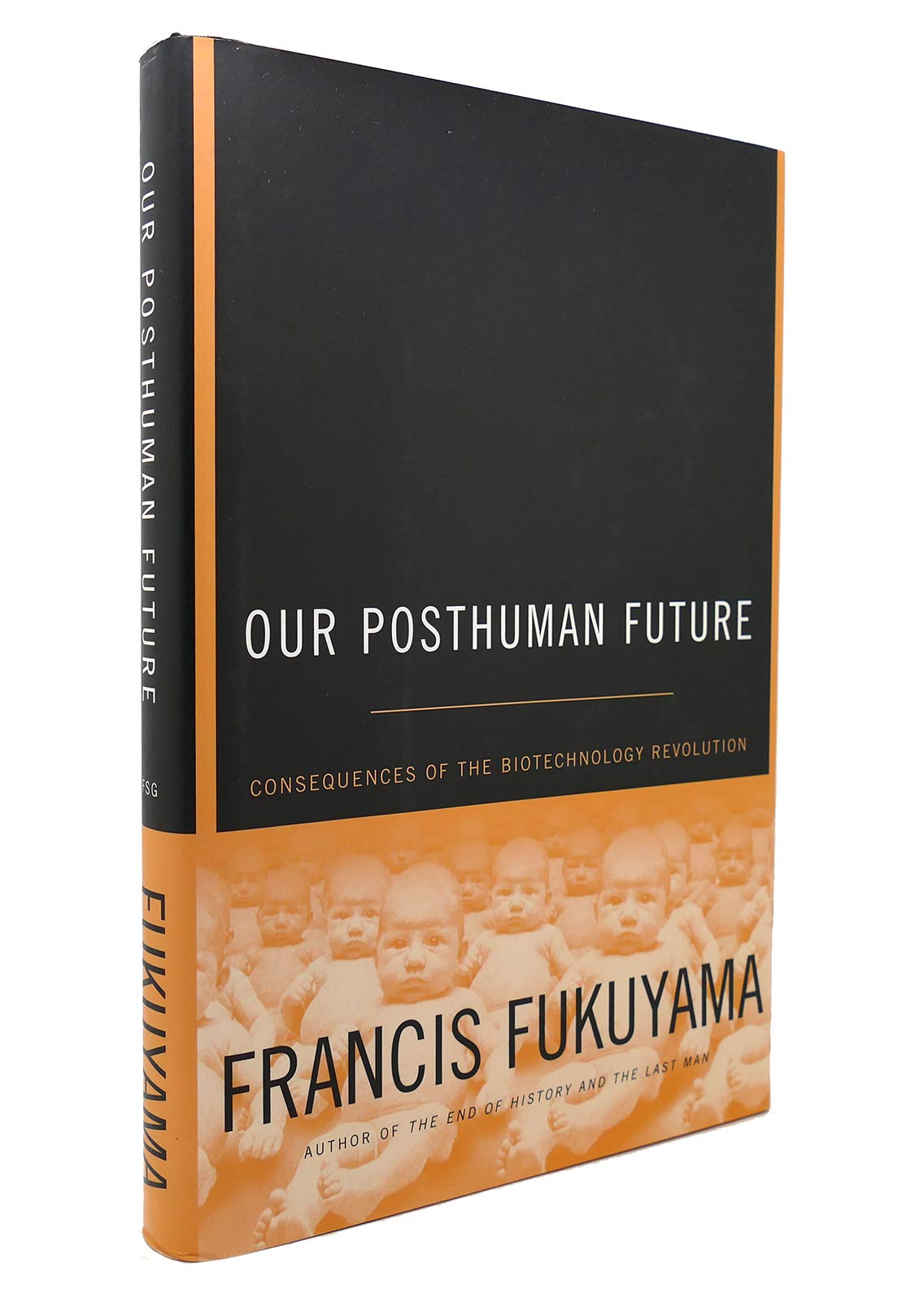
Title
Our Posthuman Future: Consequences Of The Biotechnology Revolution-new
Sold by Ergodebooks, an authorized reseller.
Returns accepted within 30 days | support@ergodebooks.com
Shipping Information
- Free Standard Shipping — United States only
- Processing Time: 3–5 business days
- Estimated Delivery: 6–10 business days after dispatch
- Double-boxed, fully insured & discreetly packaged
- Tracking number sent via email once dispatched
Returns & Refund
Returns accepted within 30 days of delivery.
Damaged or Defective Item
Free return shipping + replacement or full refund
Wrong Item Received
Free return shipping + replacement or full refund
Change of Mind
Return shipping at customer's expense · 25% restocking fee applies
Payment Option

In 1989, Francis Fukuyama Made His Nowfamous Pronouncement That Because 'The Major Alternatives To Liberal Democracy Had Exhausted Themselves,' History As We Knew It Had Reached Its End. Ten Years Later, He Revised His Argument: We Hadnt Reached The End Of History, He Wrote, Because We Hadnt Yet Reached The End Of Science. Arguing That Our Greatest Advances Still To Come Will Be In The Life Sciences, Fukuyama Now Asks How The Ability To Modify Human Behavior Will Affect Liberal Democracy.To Reorient Contemporary Debate, Fukuyama Underlines Mans Changing Understanding Of Human Nature Through History: From Plato And Aristotles Belief That Man Had 'Natural Ends,' To The Ideals Of Utopians And Dictators Of The Modern Age Who Sought To Remake Mankind For Ideological Ends. Fukuyama Persuasively Argues That The Ultimate Prize Of The Biotechnology Revolutionintervention In The 'Germline,' The Ability To Manipulate The Dna Of All Of One Persons Descendentswill Have Profound, And Potentially Terrible, Consequences For Our Political Order, Even If Undertaken By Ordinary Parents Seeking To 'Improve' Their Children.In Our Posthuman Future, Our Greatest Social Philosopher Begins To Describe The Potential Effects Of Exploration On The Foundation Of Liberal Democracy: The Belief That Human Beings Are Equal By Nature.Francis Fukuyama Is Bernard Schwartz Professor Of International Political Economy At The Paul H. Nitze School Of Advanced International Studies, The Johns Hopkins University. In 2002, He Was Appointed To The Presidents Council On Bioethics. He Is The Author Of The Great Disruption: Human Nature And The Reconstitution Of Social Order, Trust: The Social Virtues And The Creation Of Prosperity, And The End Of History And The Last Man, Among Other Works. He Lives In Mclean, Virginia.A New York Times Notable Booka Los Angeles Times Best Booka Choice Outstanding Academic Titlein Our Posthuman Future, Fukuyama Describes The Potential Effects Of The Biotechnology Revolution On The Foundation Of Liberal Democracy: The Belief That Human Beings Are Equal By Nature. In 1989, He Made His Nowfamous Pronouncement That Because The Major Alternatives To Liberal Democracy Had Exhausted Themselves, History As We Knew It Had Reached Its End. Ten Years Later, He Revised His Argument: We Hadnt Reached The End Of History, He Wrote, Because We Hadnt Yet Reached The End Of Science. Arguing That Our Greatest Advances Still To Come Will Be In The Life Sciences, Fukuyama Now Asks How The Ability To Modify Human Behavior Will Affect Liberal Democracy.To Reorient Contemporary Debate, Fukuyama Underlines Mans Changing Understanding Of Human Nature Through History: From Plato And Aristotles Belief That Man Had 'Natural Ends' To The Ideals Of Utopians And Dictators Of The Modern Age Who Sought To Remake Mankind For Ideological Ends. Fukuyama Persuasively Argues That The Ultimate Prize Of The Biotechnology Revolutionintervention In The 'Germline,' The Ability To Manipulate The Dna Of All Of One Persons Descendentswill Have Profound, And Potentially Terrible, Consequences For Our Political Order, Even If Undertaken By Ordinary Parents Seeking To 'Improve' Their Children.'Fukuyama Has Written An Invaluable Prescription For Government Regulation. Rarely Has Someone Entering The Policy Arena So Eloquently And Precisely Laid Out The Case For Political Control Of Emerging Technology.'Robert Lee Hotz, Los Angeles Times Book Review'Fukuyama Has Written An Invaluable Prescription For Government Regulation. Rarely Has Someone Entering The Policy Arena So Eloquently And Precisely Laid Out The Case For Political Control Of Emerging Technology.'Robert Lee Hotz, Los Angeles Times Book Review'Fukuyama Gives A Fascinating Tour Of The Posthuman Sciences And Their Implications, Free Of The Dogma From Both Sides Of The Political Spectrum That Has Accumulated Around These Breakthroughs. Fukuyama Accepts The Premise That Lifeprolonging Technologi
⚠️ WARNING (California Proposition 65):
This product may contain chemicals known to the State of California to cause cancer, birth defects, or other reproductive harm.
For more information, please visit www.P65Warnings.ca.gov.
- Q: What is the page count of 'Our Posthuman Future'? A: The book has two hundred seventy-two pages. This length provides a comprehensive exploration of the biotechnology revolution and its implications.
- Q: What are the dimensions of 'Our Posthuman Future'? A: The book measures six and a half inches in length, three-quarters of an inch in width, and nine and a half inches in height. These dimensions make it a convenient size for reading.
- Q: What type of binding does 'Our Posthuman Future' have? A: The book is bound in hardcover. This binding type offers durability and a premium feel.
- Q: How do I read 'Our Posthuman Future' effectively? A: To read this book effectively, set aside dedicated time in a quiet space. Take notes on key concepts to enhance understanding of the biotechnology revolution.
- Q: Is 'Our Posthuman Future' suitable for all ages? A: No, this book is intended for an adult audience. The themes discussed are complex and may not be appropriate for younger readers.
- Q: How should I store 'Our Posthuman Future' to keep it in good condition? A: Store the book upright on a shelf away from direct sunlight. This will help preserve the binding and prevent fading of the cover.
- Q: Can I clean 'Our Posthuman Future' if it gets dirty? A: Yes, you can clean it gently. Use a soft, dry cloth to wipe the cover without applying excessive pressure.
- Q: What is the recommended way to handle 'Our Posthuman Future'? A: Handle the book carefully by holding it from the spine. Avoid bending the cover back too far to prevent damage.
- Q: How does 'Our Posthuman Future' compare to other books on biotechnology? A: This book stands out for its philosophical approach to biotechnology's implications on democracy. Unlike many technical texts, it debates ethical concerns and societal impacts.
- Q: Is 'Our Posthuman Future' a good choice for someone new to biotechnology? A: Yes, it is a great introduction. Fukuyama's writing is accessible and thought-provoking, making complex subjects understandable.
- Q: What should I do if 'Our Posthuman Future' arrives damaged? A: If the book arrives damaged, contact the seller immediately for a return or exchange policy. Most sellers offer a satisfaction guarantee.
- Q: What is the return policy for 'Our Posthuman Future'? A: The return policy typically allows returns within thirty days of purchase. Check the specific seller's policy for details.
- Q: Can I find a digital version of 'Our Posthuman Future'? A: Yes, a digital version is available. You can find it through major eBook retailers, allowing for easier access.
- Q: Are there any notable accolades for 'Our Posthuman Future'? A: Yes, it is a New York Times Notable Book, a Los Angeles Times Best Book, and a Choice Outstanding Academic Title.
- Q: What themes are explored in 'Our Posthuman Future'? A: The book explores themes of biotechnology, human nature, and the implications of genetic modification on society and democracy.