
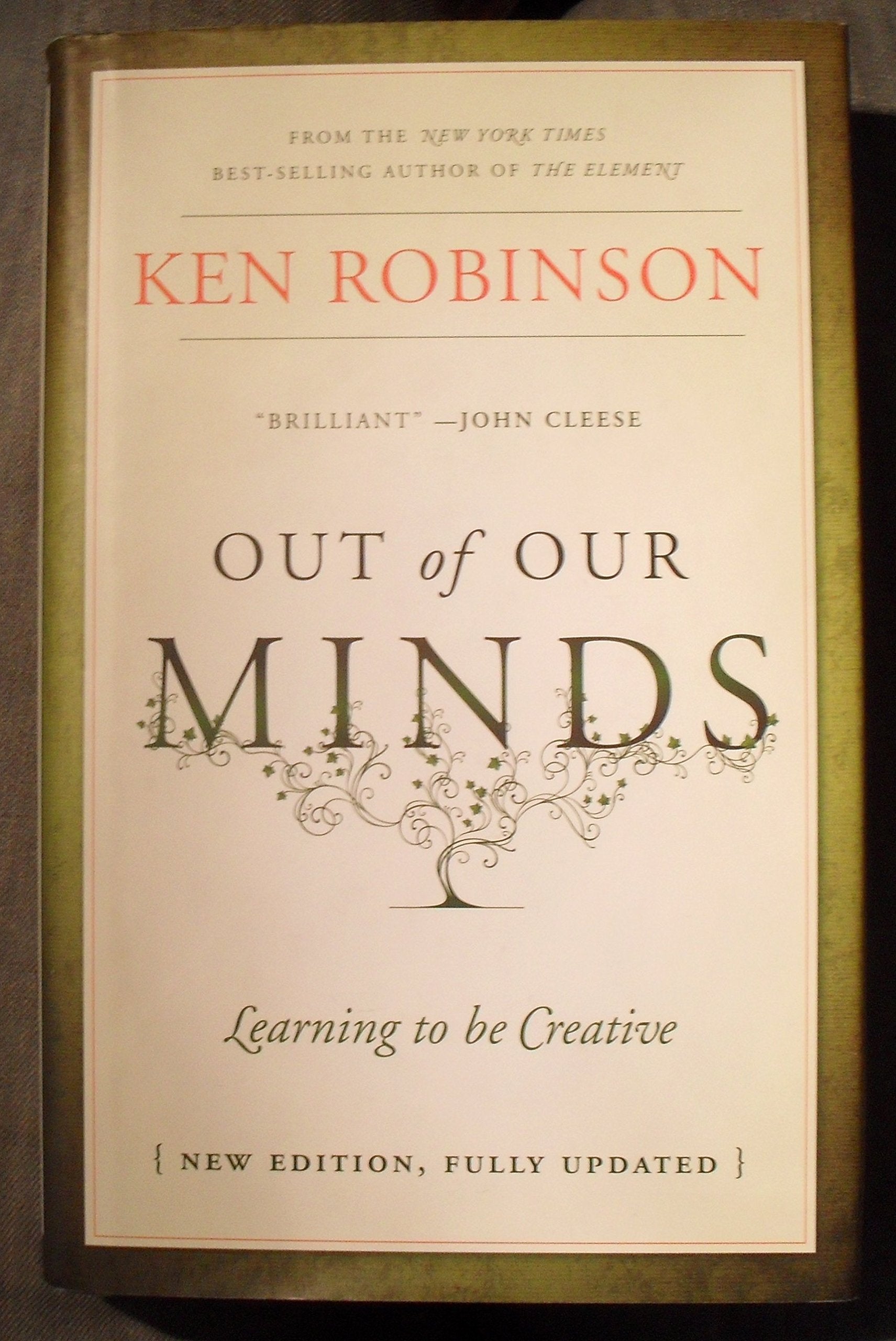
Title
Out of Our Minds: Learning to Be Creative,New
Sold by Ergodebooks, an authorized reseller.
Returns accepted within 30 days | support@ergodebooks.com
Shipping Information
- Free Standard Shipping — United States only
- Processing Time: 3–5 business days
- Estimated Delivery: 6–10 business days after dispatch
- Double-boxed, fully insured & discreetly packaged
- Tracking number sent via email once dispatched
Returns & Refund
Returns accepted within 30 days of delivery.
Damaged or Defective Item
Free return shipping + replacement or full refund
Wrong Item Received
Free return shipping + replacement or full refund
Change of Mind
Return shipping at customer's expense · 25% restocking fee applies
Payment Option

It is often said that education and training are the keys to the future. They are, but a key can be turned in two directions. Turn it one way andyou lock resources away, even from those they belong to. Turn it the otherway and you release resources and give people back to themselves. To realizeour true creative potentialin our organizations, in our schools and in our communitieswe need to think differently about ourselves and to actdifferently towards each other. We must learn to be creative.'Ken RobinsonPRAISE FOR OUT OF OUR MINDS'Ken Robinson writes brilliantly about the different ways in which creativity is undervalued and ignored . . . especially in our educational systems.'John Cleese'Out of Our Minds explains why being creative in today'sworld is a vital necessity. This book is not to be missed.'Ken Blanchard, coauthor of The Oneminute Manager and The Secret'If ever there was a time when creativity was necessary for the survival andgrowth of any organization, it is now. This book, more than any other I know, providesimportant insights on how leaders can evoke and sustain those creative juices.'Warren Bennis, Distinguished Professor of Business, University of Southern California; Thomas S. Murphy Distinguished Rresearch Fellow, Harvard Business School; Bestselling Author, Geeks and Geezers'All corporate leaders should read this book.'Richard Scase, Author and Business Forecaster'This really is a remarkable book. It does for human resources what Rachel Carson's Silent Spring did for the environment.'Wally Olins, Founder, Wolffolins'Books about creativity are not always creative. Ken Robinson's is a welcome exception'Mihaly Csikszentmihalyi, c.s. and d.j. Davidson Professor of Psychology, Claremont Graduate University; Director, Quality of Life Research Center; Bestselling Author, Flow'The best analysis I've seen of the disjunction between the kinds of intelligence that we have traditionally honored in schools and the kinds ofcreativity that we need today in our organizations and our society.'Howard Gardner, a. hobbs professor in cognition and education, Harvard Graduate School of Education, Bestselling Author, Frames of MindQ&A with Sir Ken RobinsonAuthor Sir Ken Robinson What has changed since the first edition of Out of Our Minds was published in 2001 that has prompted you to write this new edition?One of the core themes of the book is the rate and nature of change in the modern world. The last ten years have offered dramatic demonstrations of this theme. Just think of the breathtaking innovations in technology and digital culture. Ten years ago, Google was still a novelty; there were no smart phones, no IPods or IPads; no Twitter or Facebook or any of the social media that are transforming life and work today. Then think of the increasing pace of population growth, the growing strains on the environment and the effects of all of these on peoples lives and future prospects and the fact is that the world is becoming more complex and unpredictable than ever. Ten years on, I wanted to refresh and update the information in the book and to show that these revolutionary changes make the arguments of Out of Our Minds even more urgent in 2011 than they were in 2001. Ive also spent the last ten years travelling the world presenting and debating the ideas in the book. In this new edition, I also wanted to present the arguments in a fresh way and to include new examples of the strategies that are needed to make them a practical reality.Why do you think this book is important for business and industry leaders as well as educationalists?In the last ten years, Ive worked with business of all sorts all around the world. For all of them, cultivating creativity is a bottom line issue. Last fall, IBM published a report on the challenges facing business in 2011 and beyond. The report was based on survey of 3000 CEOs. It showed that the top priority for CEOs everywhere is to promote creativity syst
⚠️ WARNING (California Proposition 65):
This product may contain chemicals known to the State of California to cause cancer, birth defects, or other reproductive harm.
For more information, please visit www.P65Warnings.ca.gov.
- Q: How many pages does the book have? A: This book has three hundred twenty-six pages. It offers a comprehensive exploration of creativity and its impact on education and business.
- Q: What is the binding type of this book? A: The binding type is hardcover. This ensures durability and a professional appearance, making it suitable for display.
- Q: What are the dimensions of the book? A: The book measures five point seventy-five inches in length, one point twenty-six inches in width, and eight point seventy-five inches in height. These dimensions make it easy to handle and store.
- Q: How can I apply the concepts from this book in my organization? A: You can implement the concepts by encouraging a culture of creativity and innovation. Foster open communication and provide opportunities for brainstorming and collaboration among team members.
- Q: Is this book suitable for educators? A: Yes, this book is particularly suited for educators. It addresses the importance of creativity in teaching and provides insights on how to cultivate creative thinking in students.
- Q: What age group is this book intended for? A: This book is intended for adults, particularly educators and business leaders. It discusses complex ideas about creativity and innovation relevant to these audiences.
- Q: How should I care for this hardcover book? A: To care for the hardcover book, keep it in a dry, cool place and avoid exposing it to direct sunlight. Regularly dust the cover and store it upright to prevent damage.
- Q: Can I read this book in a group setting? A: Yes, this book is ideal for group discussions. Its themes about creativity can spark engaging conversations and collaborative learning among participants.
- Q: Is there a warranty or return policy for this book? A: Typically, books do not come with a warranty. However, check the retailer's return policy for details on returns or exchanges if the book is damaged.
- Q: What if the book arrives damaged? A: If the book arrives damaged, contact the retailer immediately. Most places will offer a replacement or refund if you provide evidence of the damage.
- Q: How does this book compare to other creativity books? A: This book stands out for its in-depth analysis of creativity in both educational and professional settings. Unlike others, it combines theory with practical insights from well-known thinkers.
- Q: Is this book relevant for business leaders? A: Yes, this book is highly relevant for business leaders. It emphasizes the need for fostering creativity to remain competitive in rapidly changing markets.
- Q: What strategies does the author suggest for enhancing creativity? A: The author suggests cultivating a culture that encourages risk-taking and supports innovation. This includes providing resources and time for creative exploration.
- Q: Does this book include real-life examples? A: Yes, the book includes various real-life examples and case studies that illustrate the principles of creativity in action within organizations.
- Q: What topics are covered in this book? A: The book covers topics such as the nature of creativity, its importance in education, and techniques to foster a creative environment in various settings.