If you have any questions, you are always welcome to contact us. We'll get back to you as soon as possible, withing 24 hours on weekdays.
Customer service
All questions about your order, return and delivery must be sent to our customer service team by e-mail at yourstore@yourdomain.com
Sale & Press
If you are interested in selling our products, need more information about our brand or wish to make a collaboration, please contact us at press@yourdomain.com
Help
If you have any questions, you are always welcome to contact us. We'll get back to you as soon as possible, withing 24 hours on weekdays.
Customer service
All questions about your order, return and delivery must be sent to our customer service team by e-mail at yourstore@yourdomain.com
Sale & Press
If you are interested in selling our products, need more information about our brand or wish to make a collaboration, please contact us at press@yourdomain.com
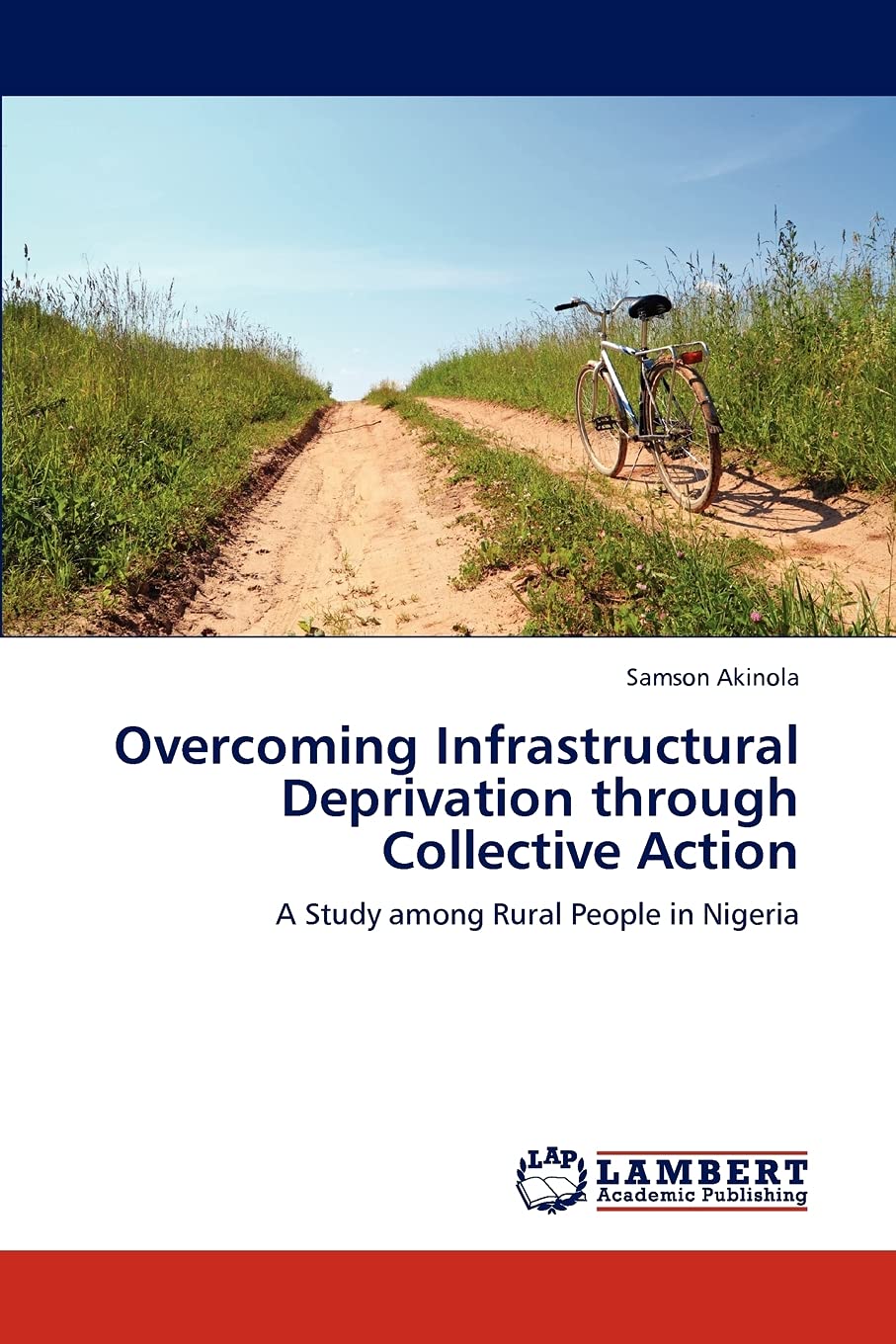
Infrastructural facilities are necessary incentives for, and prerequisites of development, good quality of life and community cohesion. Whereas the majority of Nigerians live in rural areas, the rural dwellers have no voice in decision making on matters that concerned their lives. Consequently, the rural area is characterised by low accessibility, high degree of socioeconomic and infrastructural deprivation that accelerate urbanisation. This infrastructural deprivation occasioned by official inadequacy in the rural sector gives rooms for rural populace to adopt collective action to solve problems of daily life. Thus, this book brings to the fore, through empirical analysis, how people in rural areas collectively respond to the problem of infrastructural deprivation through shared strategies and problemsolving interdependencies, relying on the principles of equity, fairness and mutual behavioural expectations they derive from their tradition. In order to overcome the problem of infrastructural deprivation, problemsolving models that are anchored on collective action, associational life, mutual trust, reciprocity, and common understanding are proposed for adoption.
⚠️ WARNING (California Proposition 65):
This product may contain chemicals known to the State of California to cause cancer,
birth defects, or other reproductive harm.
For MAP (Minimum Advertised Price) violations and Intellectual Property (IP) or Trademark concerns, please contact:
support@ergodebooks.com
⚠️ California Proposition 65 Warning: Some products sold on this website may expose you to chemicals known to the State of California to cause cancer, birth defects, or other reproductive harm. For more information, visit www.P65Warnings.ca.gov.