
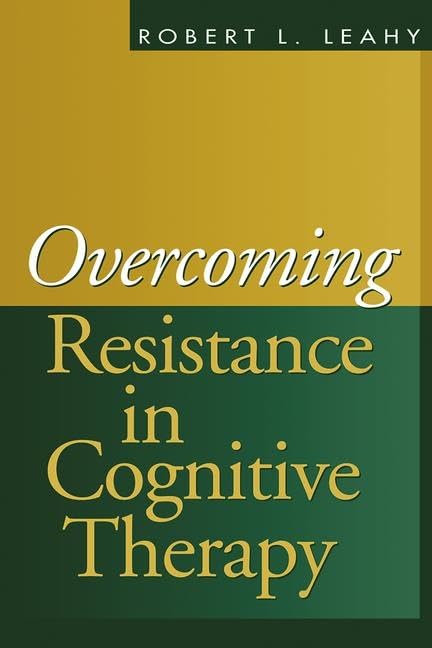
Title
Overcoming Resistance In Cognitive Therapy,Used
Sold by Ergodebooks, an authorized reseller.
Returns accepted within 30 days | support@ergodebooks.com
Shipping Information
- Free Standard Shipping — United States only
- Processing Time: 3–5 business days
- Estimated Delivery: 6–10 business days after dispatch
- Double-boxed, fully insured & discreetly packaged
- Tracking number sent via email once dispatched
Returns & Refund
Returns accepted within 30 days of delivery.
Damaged or Defective Item
Free return shipping + replacement or full refund
Wrong Item Received
Free return shipping + replacement or full refund
Change of Mind
Return shipping at customer's expense · 25% restocking fee applies
Payment Option

This Practical Guide Presents Leahy'S Multidimensional Model Of Resistance In Cognitive Therapy. Richly Illustrated With Case Examples And Session Vignettes, The Book Addresses A Variety Of Ways That Clients May Resist Basic Therapeutic Procedures: Noncompliance With Agenda Setting And Homework Assignments, Splitting Transference With Other Therapists, Inappropriate Behavior, And Premature Termination. Underlying Processes Of Resistance Are Explored, From The Desire For Validation To Risk Aversion And Selfhandicapping. Also Highlighted Are Ways That The Therapist'S Own Responses May Inadvertently Impede Change. Provided Are Innovative Tools For Getting Treatment Back On Track, Including Targeted Interventions, Insession 'Experiments,' And Questionnaires And Graphic Models To Share With Clients.
⚠️ WARNING (California Proposition 65):
This product may contain chemicals known to the State of California to cause cancer, birth defects, or other reproductive harm.
For more information, please visit www.P65Warnings.ca.gov.
- Q: How many pages are in 'Overcoming Resistance in Cognitive Therapy'? A: This book contains three hundred nine pages. It provides an in-depth exploration of resistance in cognitive therapy.
- Q: What is the binding type of this book? A: The book is available in paperback binding. This makes it lightweight and easy to handle for readers.
- Q: Who is the author of 'Overcoming Resistance in Cognitive Therapy'? A: The author is Robert L. Leahy. He is known for his expertise in cognitive therapy and resistance.
- Q: What topics does this book cover? A: This book addresses various aspects of resistance in cognitive therapy. It includes case examples and therapeutic procedures.
- Q: Is this book suitable for beginners in therapy? A: Yes, it is suitable for both beginners and experienced therapists. It offers practical tools and insights for all levels.
- Q: How can therapists use this book in practice? A: Therapists can use the innovative tools and interventions provided in the book. It includes questionnaires and in-session experiments.
- Q: What are the innovative tools mentioned in the book? A: The book provides targeted interventions and graphic models. These can be shared with clients to facilitate understanding.
- Q: Does the book address the therapist's own responses to resistance? A: Yes, it explores how a therapist's responses can impede change. This insight is crucial for effective therapy.
- Q: Are there any case examples included in the book? A: Yes, the book includes richly illustrated case examples. These enhance understanding of resistance in therapy.
- Q: How should I store this book to keep it in good condition? A: Store the book in a cool, dry place away from direct sunlight. This will help maintain its quality over time.
- Q: Can I find this book in a digital format? A: The book is primarily available in paperback. Check with retailers for any digital editions.
- Q: What is the main focus of the book? A: The main focus is to explore resistance in cognitive therapy. It provides insights on managing client resistance effectively.
- Q: Is this book appropriate for use in academic settings? A: Yes, it is appropriate for academic settings. It serves as a valuable resource for students and professionals alike.
- Q: What kind of resistance does the book discuss? A: It discusses various types of resistance including noncompliance and premature termination. Understanding these can enhance therapeutic effectiveness.
- Q: Does the book provide any questionnaires for clients? A: Yes, it includes questionnaires designed for clients. These tools facilitate better engagement in therapy.