If you have any questions, you are always welcome to contact us. We'll get back to you as soon as possible, withing 24 hours on weekdays.
Customer service
All questions about your order, return and delivery must be sent to our customer service team by e-mail at yourstore@yourdomain.com
Sale & Press
If you are interested in selling our products, need more information about our brand or wish to make a collaboration, please contact us at press@yourdomain.com
Help
If you have any questions, you are always welcome to contact us. We'll get back to you as soon as possible, withing 24 hours on weekdays.
Customer service
All questions about your order, return and delivery must be sent to our customer service team by e-mail at yourstore@yourdomain.com
Sale & Press
If you are interested in selling our products, need more information about our brand or wish to make a collaboration, please contact us at press@yourdomain.com
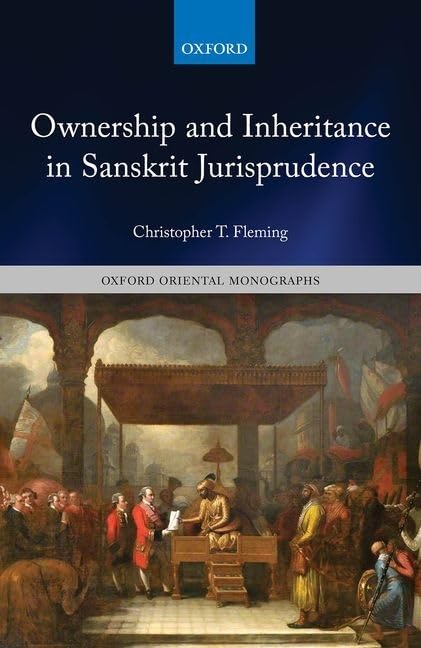
Ownership and Inheritance in Sanskrit Jurisprudence provides an account of various theories of ownership (svatva) and inheritance (daya) in Sanskrit jurisprudential literature (Dharmasastra). It examines the evolution of different juridical models of inheritancein which families held property in trusts or in tenanciesincommonagainst the backdrop of related developments in the philosophical understanding of ownership in the Sanskrit texttraditions of hermeneutics (Mima?sa) and logic (Nyaya) respectively.Christopher T. Fleming reconstructs medieval Sanskrit theories of property and traces the emergence of various competing schools of Sanskrit jurisprudence during the early modern period (roughly fifteenthnineteenth centuries) in Bihar, Bengal, and Varanasi. Fleming attends to the ways in which ideas from these schools of jurisprudence shaped the codification of AngloHindu personal law by administrators of the British East India Company during the late eighteenth and early nineteenth centuries. While acknowledging the limitations of colonial conceptions of Dharmasastra as positive law, this study argues for far greater continuity between precolonial and colonial Sanskrit jurisprudence than accepted previously. It charts the transformation of the Hindu law of inheritancethrough precedent and statuteover the late nineteenth, twentieth, and early twentyfirst centuries.
⚠️ WARNING (California Proposition 65):
This product may contain chemicals known to the State of California to cause cancer,
birth defects, or other reproductive harm.
For MAP (Minimum Advertised Price) violations and Intellectual Property (IP) or Trademark concerns, please contact:
support@ergodebooks.com
⚠️ California Proposition 65 Warning: Some products sold on this website may expose you to chemicals known to the State of California to cause cancer, birth defects, or other reproductive harm. For more information, visit www.P65Warnings.ca.gov.