If you have any questions, you are always welcome to contact us. We'll get back to you as soon as possible, withing 24 hours on weekdays.
Customer service
All questions about your order, return and delivery must be sent to our customer service team by e-mail at yourstore@yourdomain.com
Sale & Press
If you are interested in selling our products, need more information about our brand or wish to make a collaboration, please contact us at press@yourdomain.com
Help
If you have any questions, you are always welcome to contact us. We'll get back to you as soon as possible, withing 24 hours on weekdays.
Customer service
All questions about your order, return and delivery must be sent to our customer service team by e-mail at yourstore@yourdomain.com
Sale & Press
If you are interested in selling our products, need more information about our brand or wish to make a collaboration, please contact us at press@yourdomain.com
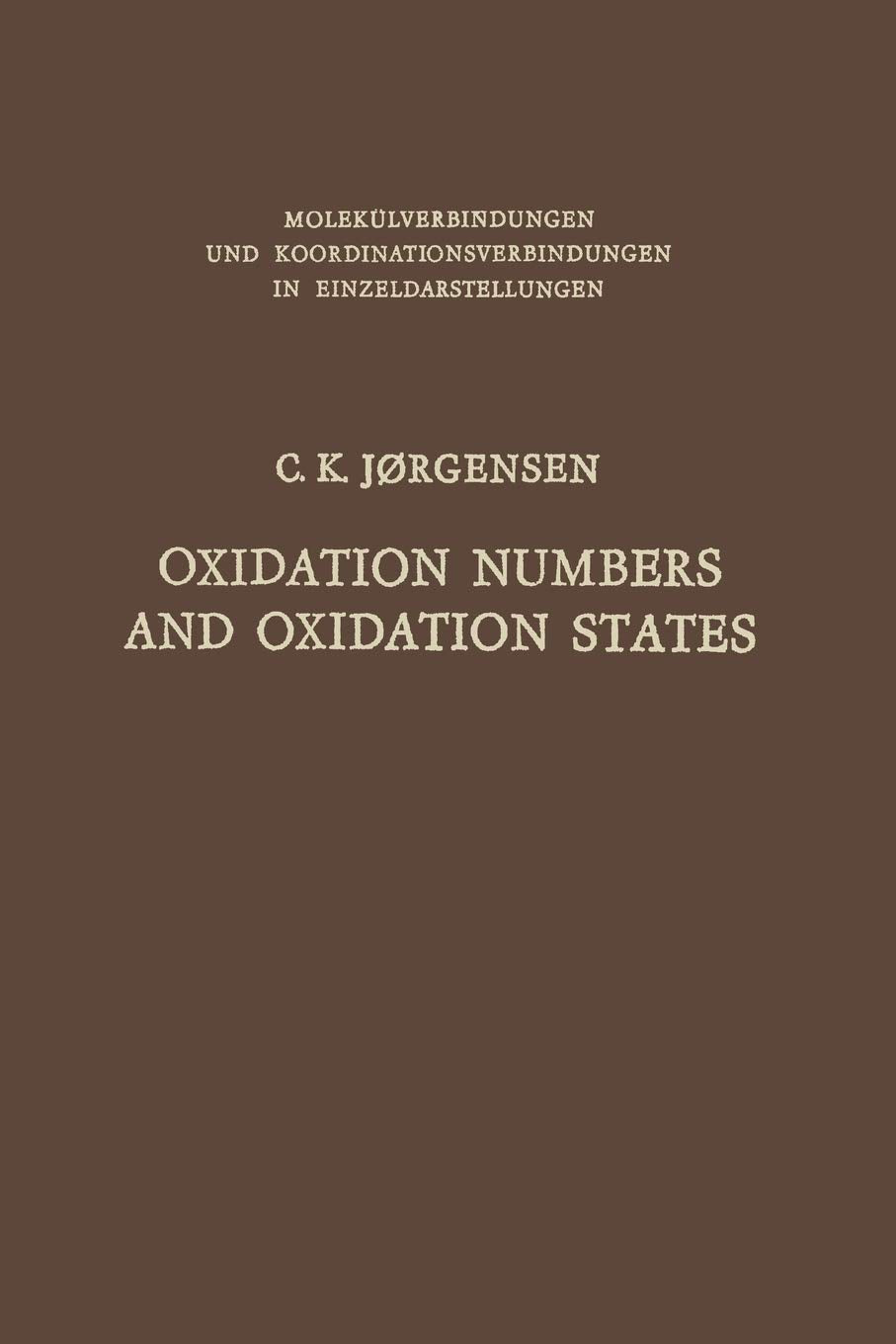
The correlation of spectroscopic and chemical investigations in recent years has been highly beneficial of many reasons. Around 1950, no valid explanation was available of the colours of compounds of the five tran sition groups. Later, it was possible to identify the excited levels with those expected for an electron configuration with adefinite number of electrons in the partly filled shell. I t is not generally recognized that this is equivalent to determining spectroscopic oxidation states related to the preponderant electron configuration and not to estimates of the fractional atomic charges. This brings in an entirely different type of description than the formal oxidation numbers used for characterizing compounds and reaction schemes. However, it must be realized that collectively oxidized ligands, formation of clustercomplexes and catenation may prevent the oxidation state from being welldefined. The writer would like to express his gratitude to many, but first of all to DR. CLAUS SCHFFER, University of Copenhagen, who is the most efficient grouptheoretical engineer known to the writer; his comments and discussions have been highly valuable. The writer's colleague, Pro fessor FAUSTO CALDERAZZO (now going to the University of Pisa) has been most helpful in metalloorganic questions. Thanks are also due to Professors E. RANcKEMADsEN and K. A. JENSEN for correspondence and conversations about formal oxidation numbers.
⚠️ WARNING (California Proposition 65):
This product may contain chemicals known to the State of California to cause cancer,
birth defects, or other reproductive harm.
For MAP (Minimum Advertised Price) violations and Intellectual Property (IP) or Trademark concerns, please contact:
support@ergodebooks.com
⚠️ California Proposition 65 Warning: Some products sold on this website may expose you to chemicals known to the State of California to cause cancer, birth defects, or other reproductive harm. For more information, visit www.P65Warnings.ca.gov.