
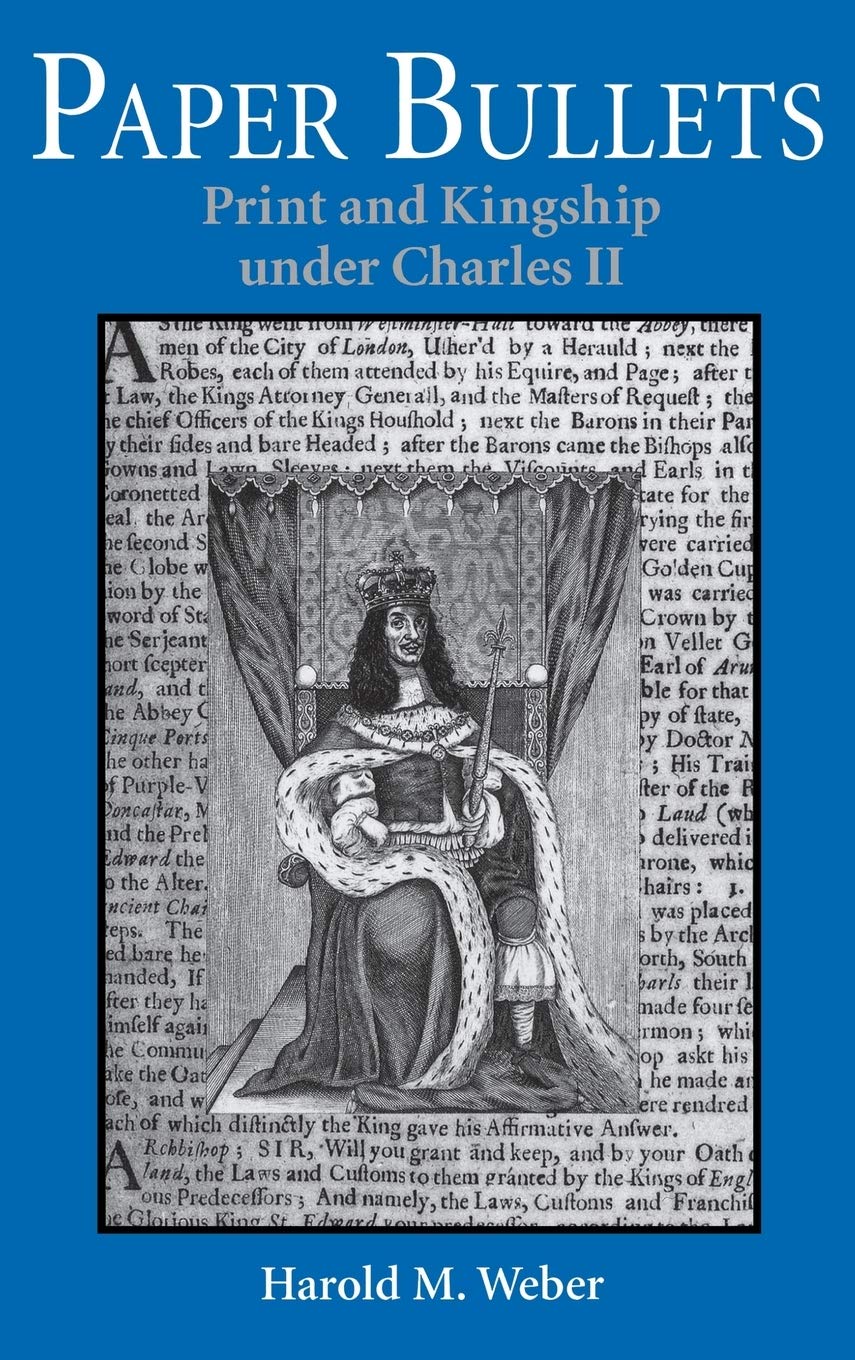
Title
Paper Bullets: Print and Kingship under Charles II,Used
Sold by Ergodebooks, an authorized reseller.
Returns accepted within 30 days | support@ergodebooks.com
Shipping Information
- Free Standard Shipping — United States only
- Processing Time: 3–5 business days
- Estimated Delivery: 6–10 business days after dispatch
- Double-boxed, fully insured & discreetly packaged
- Tracking number sent via email once dispatched
Returns & Refund
Returns accepted within 30 days of delivery.
Damaged or Defective Item
Free return shipping + replacement or full refund
Wrong Item Received
Free return shipping + replacement or full refund
Change of Mind
Return shipping at customer's expense · 25% restocking fee applies
Payment Option

The calculated use of media by those in power is a phenomenon dating back at least to the seventeenth century, as Harold Weber demonstrates in this illuminating study of the relation of print culture to kingship under England's Charles II. Seventeenthcentury London witnessed an enormous expansion of the print trade, and with this expansion came a revolutionary change in the relation between political authorityespecially the monarchyand the printed word.Weber argues that Charles' reign was characterized by a particularly fluid relationship between print and power. The press helped bring about both the deconsecration of divine monarchy and the formation of a new public sphere, but these processes did not result in the progressive decay of royal authority. Charles fashioned his own semiotics of power out of the political transformations that had turned his world upside down.By linking diverse and unusual topicsthe escape of Charles from Worcester, the royal ability to heal scrofula, the sexual escapades of the 'merry monarch,' and the trial and execution of Stephen CollegeWeber reveals the means by which Charles took advantage of a print industry instrumental to the creation of a new dispensation of power, one in which the state dominates the individual through the supplementary relationship between signs and violence.Weber's study brings into sharp relief the conflicts involving public authority and printed discourse, social hierarchy and print culture, and authorial identity and responsibilityconflicts that helped shape the modern state.
⚠️ WARNING (California Proposition 65):
This product may contain chemicals known to the State of California to cause cancer, birth defects, or other reproductive harm.
For more information, please visit www.P65Warnings.ca.gov.
- Q: What is the main subject of 'Paper Bullets: Print and Kingship under Charles II'? A: The book examines the relationship between print culture and political authority during the reign of Charles II, highlighting how media was used by those in power.
- Q: Who is the author of this book? A: The author is Harold M. Weber.
- Q: What is the publication date of this book? A: The book was published on November 2, 1995.
- Q: What is the format of 'Paper Bullets: Print and Kingship under Charles II'? A: This book is available in hardcover format.
- Q: How many pages does the book have? A: The book contains 304 pages.
- Q: Is this book a new or used copy? A: This listing is for a new copy of the book.
- Q: What themes are explored in this book? A: The book explores themes such as the deconsecration of divine monarchy, the formation of a public sphere, and the interplay between print culture and social hierarchy.
- Q: Can this book help me understand the historical context of Charles II's reign? A: Yes, it provides insights into the political and cultural dynamics of seventeenth-century England.
- Q: Is 'Paper Bullets' suitable for academic research? A: Yes, it is a scholarly work that offers valuable analysis for those studying history, political communication, and media studies.
- Q: What makes this book unique compared to other historical studies? A: The book uniquely links diverse topics, such as royal healing practices and political transformations, to illustrate Charles II's use of print as a tool of power.