
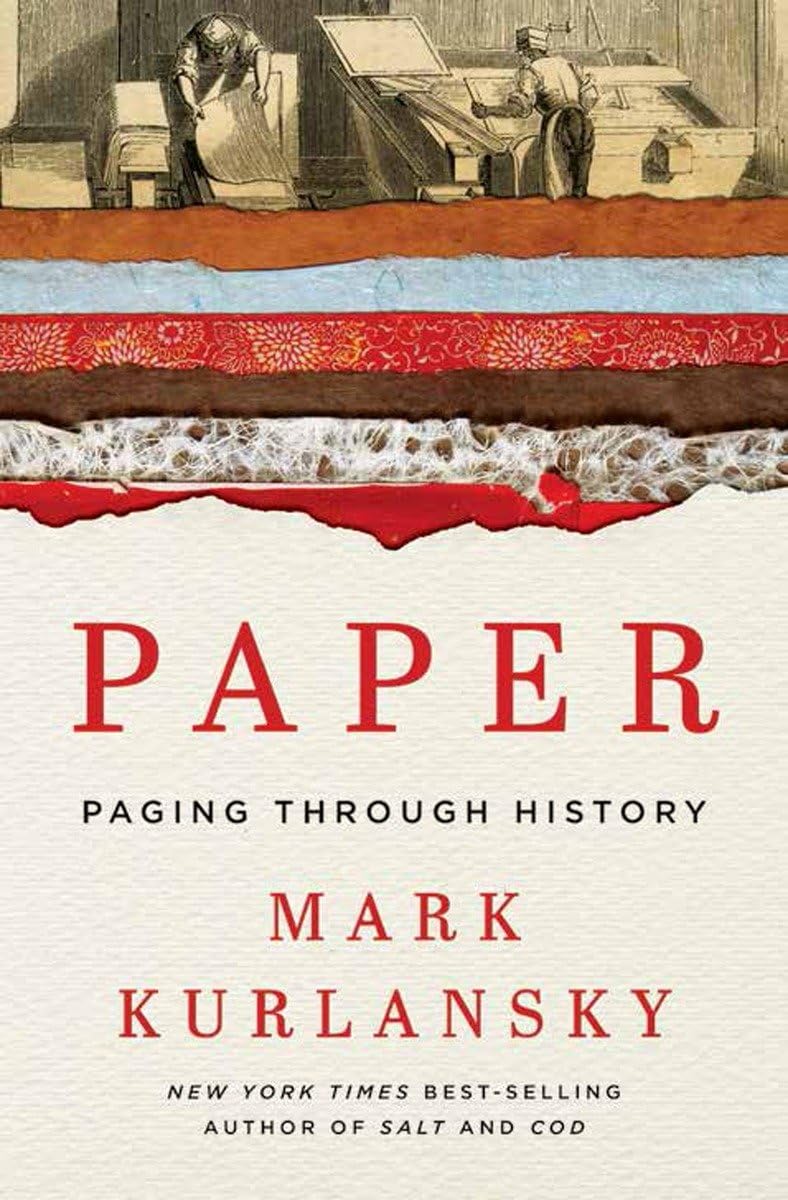
Title
Paper: Paging Through History,Used
Sold by Ergodebooks, an authorized reseller.
Returns accepted within 30 days | support@ergodebooks.com
Shipping Information
- Free Standard Shipping — United States only
- Processing Time: 3–5 business days
- Estimated Delivery: 6–10 business days after dispatch
- Double-boxed, fully insured & discreetly packaged
- Tracking number sent via email once dispatched
Returns & Refund
Returns accepted within 30 days of delivery.
Damaged or Defective Item
Free return shipping + replacement or full refund
Wrong Item Received
Free return shipping + replacement or full refund
Change of Mind
Return shipping at customer's expense · 25% restocking fee applies
Payment Option

From the New York Times bestselling author of Cod and Salt, a definitive history of paper and the astonishing ways it has shaped todays world.Paper is one of the simplest and most essential pieces of human technology. For the past two millennia, the ability to produce it in ever more efficient ways has supported the proliferation of literacy, media, religion, education, commerce, and art; it has formed the foundation of civilizations, promoting revolutions and restoring stability. One has only to look at historys greatest press run, which produced 6.5 billion copies of Mo zhux yul, Quotations from Chairman Mao Tsetung (Zedong)which doesnt include editions in 37 foreign languages and in brailleto appreciate the range and influence of a single publication, in paper. Or take the fact that one of historys most revered artists, Leonardo da Vinci, left behind only 15 paintings but 4,000 works on paper. And though the colonies were at the time calling for a boycott of all British goods, the one exception they made speaks to the essentiality of the material; they penned the Declaration of Independence on British paper.Now, amid discussion of going paperlessand as speculation about the effects of a digitally dependent society grows rampantweve come to a worldhistoric juncture. Thousands of years ago, Socrates and Plato warned that written language would be the end of true knowledge, replacing the need to exercise memory and think through complex questions. Similar arguments were made about the switch from handwritten to printed books, and today about the role of computer technology. By tracing papers evolution from antiquity to the present, with an emphasis on the contributions made in Asia and the Middle East, Mark Kurlansky challenges common assumptions about technologys influence, affirming that paper is here to stay. Paper will be the commodity history that guides us forward in the twentyfirst century and illuminates our times. 24 illustrations
⚠️ WARNING (California Proposition 65):
This product may contain chemicals known to the State of California to cause cancer, birth defects, or other reproductive harm.
For more information, please visit www.P65Warnings.ca.gov.