
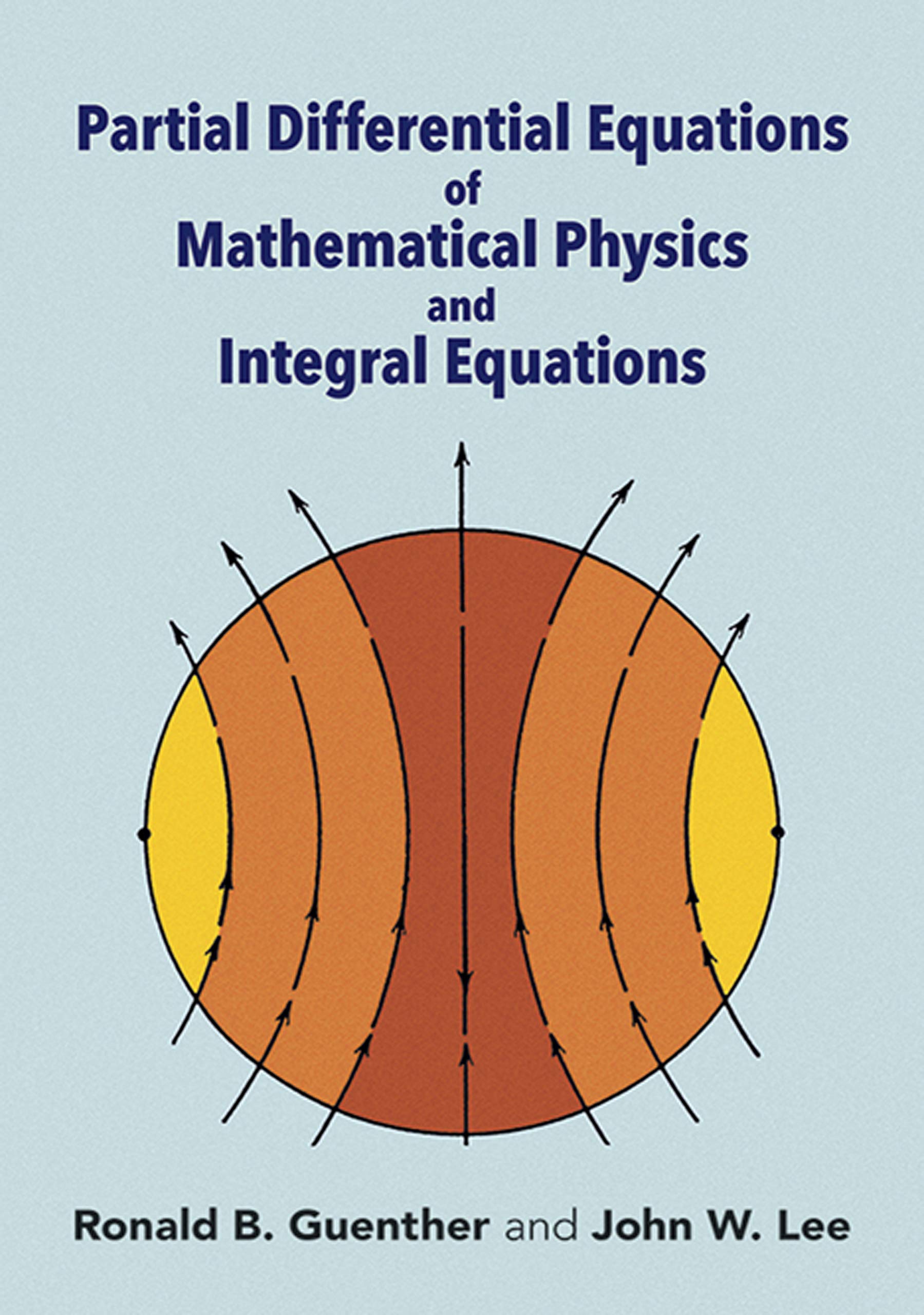
Title
Partial Differential Equations Of Mathematical Physics And Integral Equations (Dover Books On Mathematics),Used
Sold by Ergodebooks, an authorized reseller.
Returns accepted within 30 days | support@ergodebooks.com
Shipping Information
- Free Standard Shipping — United States only
- Processing Time: 3–5 business days
- Estimated Delivery: 6–10 business days after dispatch
- Double-boxed, fully insured & discreetly packaged
- Tracking number sent via email once dispatched
Returns & Refund
Returns accepted within 30 days of delivery.
Damaged or Defective Item
Free return shipping + replacement or full refund
Wrong Item Received
Free return shipping + replacement or full refund
Change of Mind
Return shipping at customer's expense · 25% restocking fee applies
Payment Option

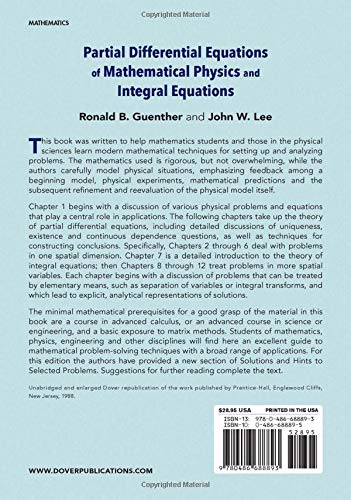
This Book Was Written To Help Mathematics Students And Those In The Physical Sciences Learn Modern Mathematical Techniques For Setting Up And Analyzing Problems. The Mathematics Used Is Rigorous, But Not Overwhelming, While The Authors Carefully Model Physical Situations, Emphasizing Feedback Among A Beginning Model, Physical Experiments, Mathematical Predictions, And The Subsequent Refinement And Reevaluation Of The Physical Model Itself.Chapter 1 Begins With A Discussion Of Various Physical Problems And Equations That Play A Central Role In Applications. The Following Chapters Take Up The Theory Of Partial Differential Equations, Including Detailed Discussions Of Uniqueness, Existence, And Continuous Dependence Questions, As Well As Techniques For Constructing Conclusions. Specifically, Chapters 2 Through 6 Deal With Problems In One Spatial Dimension. Chapter 7 Is A Detailed Introduction To The Theory Of Integral Equations; Then Chapters 8 Through 12 Treat Problems In More Spatial Variables. Each Chapter Begins With A Discussion Of Problems That Can Be Treated By Elementary Means, Such As Separation Of Variables Or Integral Transforms, And Which Lead To Explicit, Analytical Representations Of Solutions. The Minimal Mathematical Prerequisites For A Good Grasp Of The Material In This Book Are A Course In Advanced Calculus, Or An Advanced Course In Science Or Engineering, And A Basic Exposure To Matrix Methods. Students Of Mathematics, Physics, Engineering, And Other Disciplines Will Find Here An Excellent Guide To Mathematical Problemsolving Techniques With A Broad Range Of Applications. For This Edition The Authors Have Provided A New Section Of Solutions And Hints To Selected Problems. Suggestions For Further Reading Complete The Text.
⚠️ WARNING (California Proposition 65):
This product may contain chemicals known to the State of California to cause cancer, birth defects, or other reproductive harm.
For more information, please visit www.P65Warnings.ca.gov.
- Q: How many pages does this book have? A: This book has five hundred seventy-six pages. It offers in-depth coverage of mathematical physics and integral equations.
- Q: What is the binding type of this book? A: This book is available in paperback binding. This makes it accessible and easy to handle for students and professionals alike.
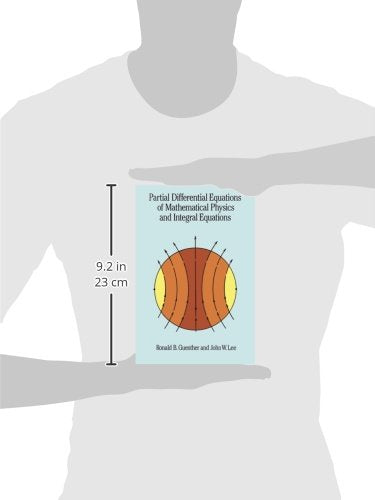
- Q: What are the dimensions of this book? A: The book measures six and a half inches in length, one inch in width, and nine and a half inches in height. These dimensions make it a manageable size for reading and reference.
- Q: Who is the author of this book? A: The author of this book is Ronald B. Guenther. He is well-regarded in the field of mathematics and physics.
- Q: What is the main topic of this book? A: The main topic is partial differential equations and integral equations. It is designed to assist students in mathematics and the physical sciences.
- Q: What reading level is suitable for this book? A: This book is suitable for advanced high school students and college undergraduates. A background in advanced calculus is recommended for best comprehension.
- Q: How do I use this book for studying? A: You can use this book as a textbook for courses in mathematics and physics. It includes exercises and solutions that enhance learning.
- Q: Is this book suitable for self-study? A: Yes, this book is suitable for self-study. It provides clear explanations and a section of solutions to aid independent learners.
- Q: What prior knowledge do I need to understand this book? A: A course in advanced calculus is recommended. Familiarity with basic matrix methods is also beneficial for understanding the material.
- Q: How should I care for this book? A: To care for this book, store it upright in a cool, dry place. Avoid exposure to direct sunlight to preserve its quality.
- Q: Can I loan this book to others? A: Yes, you can loan this book to others. Just ensure they handle it carefully to prevent damage.
- Q: Is there a glossary or index in this book? A: Yes, the book includes an index. This helps readers quickly find topics and equations of interest.
- Q: What if the book arrives damaged? A: If the book arrives damaged, you should contact the seller for a return or replacement. Most sellers have a return policy for such cases.
- Q: Are there other books similar to this one? A: Yes, there are other books on differential equations and mathematical physics. Look for titles by other reputable authors in mathematics.
- Q: Is this book widely used in universities? A: Yes, this book is widely used in universities. It's a recommended text in many mathematics and physics courses.