
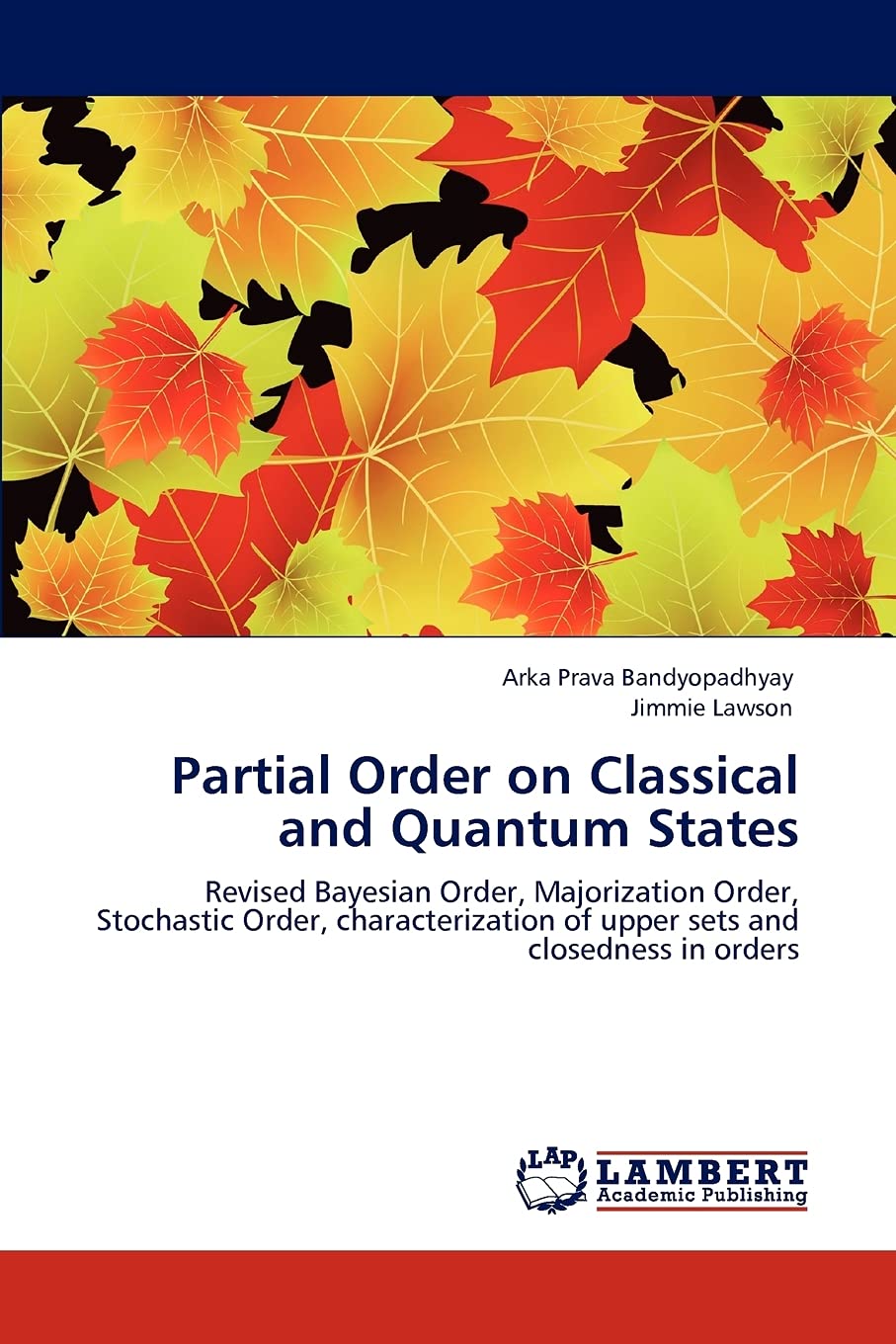
Title
Partial Order on Classical and Quantum States: Revised Bayesian Order, Majorization Order, Stochastic Order, characterization of,Used
Sold by Ergodebooks, an authorized reseller.
Returns accepted within 30 days | support@ergodebooks.com
Shipping Information
- Free Standard Shipping — United States only
- Processing Time: 3–5 business days
- Estimated Delivery: 6–10 business days after dispatch
- Double-boxed, fully insured & discreetly packaged
- Tracking number sent via email once dispatched
Returns & Refund
Returns accepted within 30 days of delivery.
Damaged or Defective Item
Free return shipping + replacement or full refund
Wrong Item Received
Free return shipping + replacement or full refund
Change of Mind
Return shipping at customer's expense · 25% restocking fee applies
Payment Option

In this work we extend the work done by Bob Coecke and Keye Martin in their paper "Partial Order on Classical States and Quantum States (2003)". We review basic notions involving elementary domain theory, the set of probability measures on a finite set {a1, a2, . . . , an}, which we identify with the standard (n1)simplex? n and Shannon Entropy. We consider partial orders on? n, which have the Entropy Reversal Property (ERP) : elements lower in the order have higher (Shannon) entropy or equivalently less information. The ERP property is important because of its applications in quantum information theory. We define a new partial order on? n, called Stochastic Order, using the wellknown concept of majorization order and show that it has the ERP property and is also a continuous domain. In contrast, the bayesian order on? n defined by Coecke and Martin has the ERP property but is not continuous.
⚠️ WARNING (California Proposition 65):
This product may contain chemicals known to the State of California to cause cancer, birth defects, or other reproductive harm.
For more information, please visit www.P65Warnings.ca.gov.