If you have any questions, you are always welcome to contact us. We'll get back to you as soon as possible, withing 24 hours on weekdays.
Customer service
All questions about your order, return and delivery must be sent to our customer service team by e-mail at yourstore@yourdomain.com
Sale & Press
If you are interested in selling our products, need more information about our brand or wish to make a collaboration, please contact us at press@yourdomain.com
Help
If you have any questions, you are always welcome to contact us. We'll get back to you as soon as possible, withing 24 hours on weekdays.
Customer service
All questions about your order, return and delivery must be sent to our customer service team by e-mail at yourstore@yourdomain.com
Sale & Press
If you are interested in selling our products, need more information about our brand or wish to make a collaboration, please contact us at press@yourdomain.com
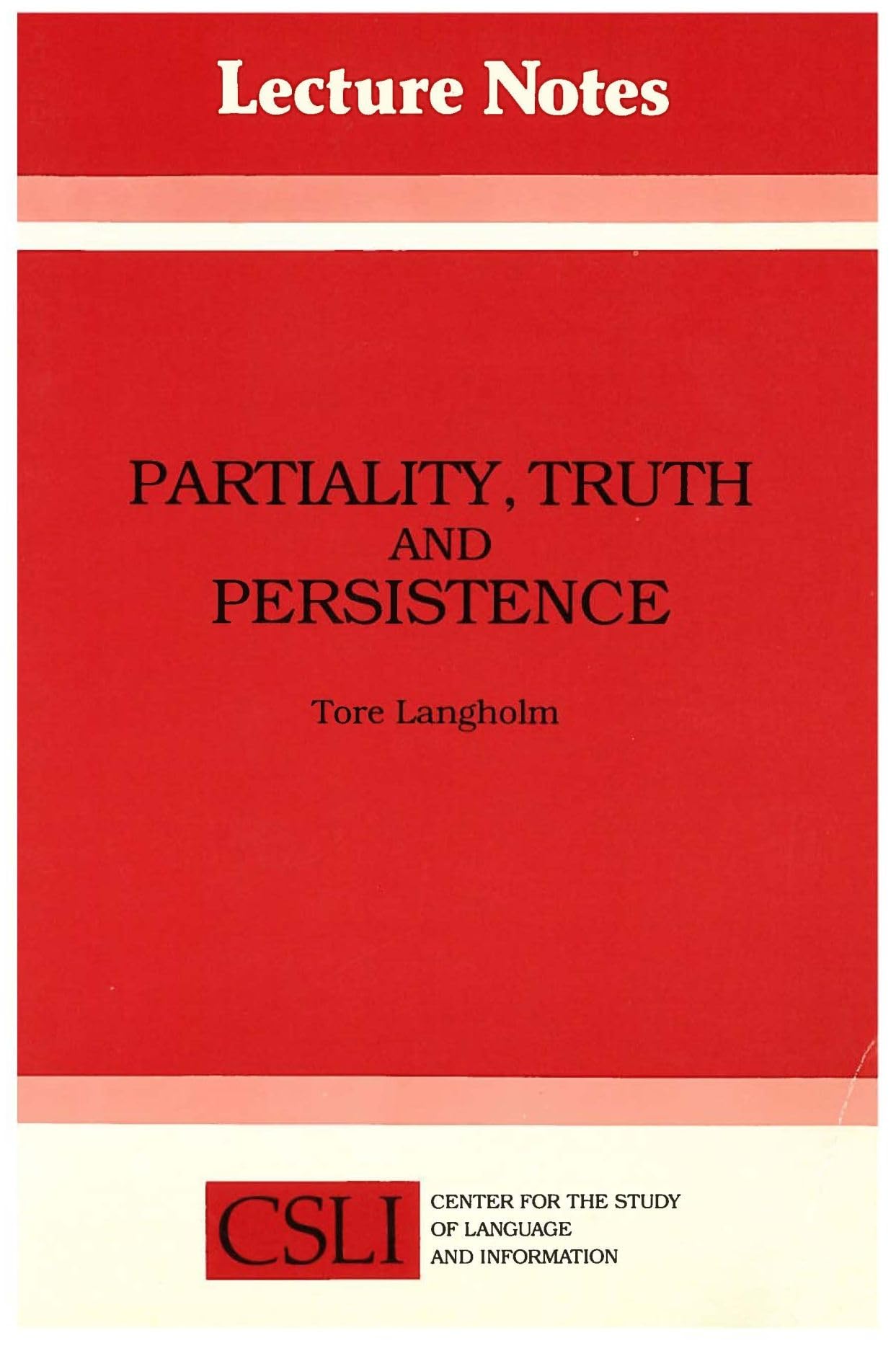
In recent years, 'semantical partiality' has emerged as an important concept in philosophical logic as well as in the study of natural language semantics. Despite the many applications, however, a number of mathematically intriguing questions associated with this concept have received only very limited attention. Partiality, Truth, and Persistence is a study in spatial model theory, the theory of partially defined models. First, with the introduction of truth value gaps in semantics, there are many ways to generalize the classical truth definition for the sentences of a first order predicate language. We know what it means for a sentence to be true or false in a classical, complete model, but how do we extend this relation when partial models are introduced? Various alternatives exist, and a detailed comparison is carried out between them. Since these studies concern a full first order predicate language, many distinctions appear that do not arise in the case of pure propositional logic. A condition of monotonicity or 'persistence' of truth relative to partial models has a prominent position among conditions that are not expressible in the framework of standard, complete model theory. The final chapter investigates the relation between such conditions and expressibility properties in general. These discussions culminate with a combined Lindstrom and persistence characterization theorem. Tore Langholm is a research fellow in mathematics at the University of Oslo. He is a coauthor of Situations, Language and Logic.
⚠️ WARNING (California Proposition 65):
This product may contain chemicals known to the State of California to cause cancer,
birth defects, or other reproductive harm.
For MAP (Minimum Advertised Price) violations and Intellectual Property (IP) or Trademark concerns, please contact:
support@ergodebooks.com
⚠️ California Proposition 65 Warning: Some products sold on this website may expose you to chemicals known to the State of California to cause cancer, birth defects, or other reproductive harm. For more information, visit www.P65Warnings.ca.gov.