
Title
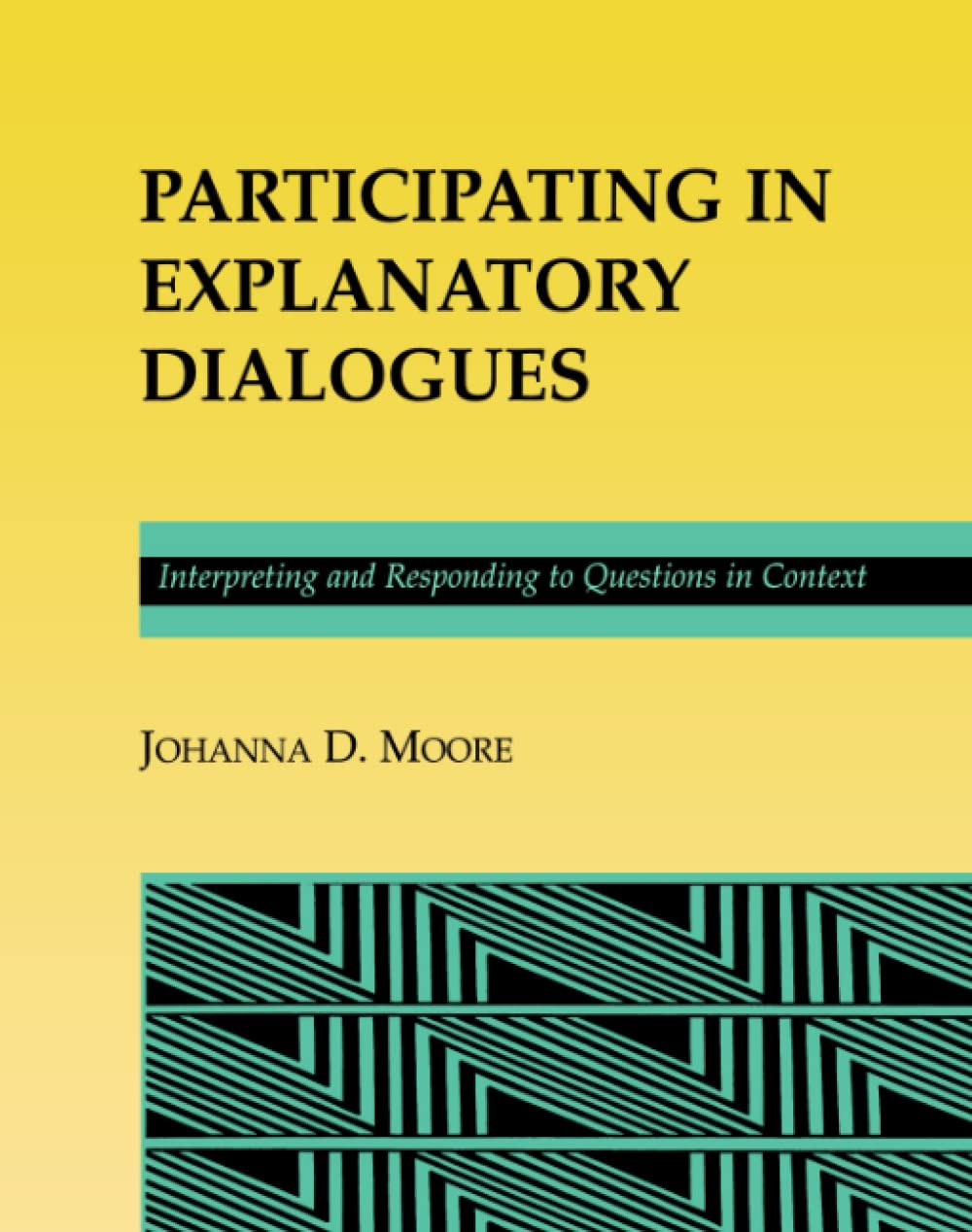
Participating In Explanatory Dialogues: Interpreting And Responding To Questions In Context,New
Sold by Ergodebooks, an authorized reseller.
Returns accepted within 30 days | support@ergodebooks.com
Shipping Information
- Free Standard Shipping — United States only
- Processing Time: 3–5 business days
- Estimated Delivery: 6–10 business days after dispatch
- Double-boxed, fully insured & discreetly packaged
- Tracking number sent via email once dispatched
Returns & Refund
Returns accepted within 30 days of delivery.
Damaged or Defective Item
Free return shipping + replacement or full refund
Wrong Item Received
Free return shipping + replacement or full refund
Change of Mind
Return shipping at customer's expense · 25% restocking fee applies
Payment Option

Product Description While much has been written about the areas of text generation, text planning, discourse modeling, and user modeling, Johanna Moore's book is one of the first to tackle modeling the complex dynamics of explanatory dialogues. It describes an explanationplanning architecture that enables a computational system to participate in an interactive dialogue with its users, focusing on the knowledge structures that a system must build in order to elaborate or clarify prior utterances, or to answer followup questions in the context of an ongoing dialogue. Moore develops a model of explanation generation and describes a fully implemented naturallanguage system that is embedded in an existing expert system and that includes a generation component. Her main thesis is that shallow approaches to explanation such as paraphrasing the expert system's line of reasoning or filling in an explanation 'schema' are not adequate for supporting dialogue, and that a more flexible approach is needed, one that is adaptive to context, aware of what is being said, and of what has gone before in the user's dialogue with the expert system. She argues that the problem with prior approaches is that they do not provide a representation of the intended effects of the components of an explanation, nor how these intentions are related to one another or to the rhetorical structure of the text. She proposes a computational solution to the question of how explanations can be synthesized in such a way that a system can later reason about the explanations it has produced to affect its subsequent utterances.A.C.L.M.I.T. Series in Natural Language Processing About the Author Johanna D. Moore is Director of the Human Communication Research Centre at the University of Edinburgh.Maurice Wilkes retired from his post at Cambridge University in 1980, when he became a Senior Consulting Engineer at Digital Equipment Corporation in Massachusetts and Adjunct Professor at MIT.
⚠️ WARNING (California Proposition 65):
This product may contain chemicals known to the State of California to cause cancer, birth defects, or other reproductive harm.
For more information, please visit www.P65Warnings.ca.gov.