If you have any questions, you are always welcome to contact us. We'll get back to you as soon as possible, withing 24 hours on weekdays.
Customer service
All questions about your order, return and delivery must be sent to our customer service team by e-mail at yourstore@yourdomain.com
Sale & Press
If you are interested in selling our products, need more information about our brand or wish to make a collaboration, please contact us at press@yourdomain.com
Help
If you have any questions, you are always welcome to contact us. We'll get back to you as soon as possible, withing 24 hours on weekdays.
Customer service
All questions about your order, return and delivery must be sent to our customer service team by e-mail at yourstore@yourdomain.com
Sale & Press
If you are interested in selling our products, need more information about our brand or wish to make a collaboration, please contact us at press@yourdomain.com
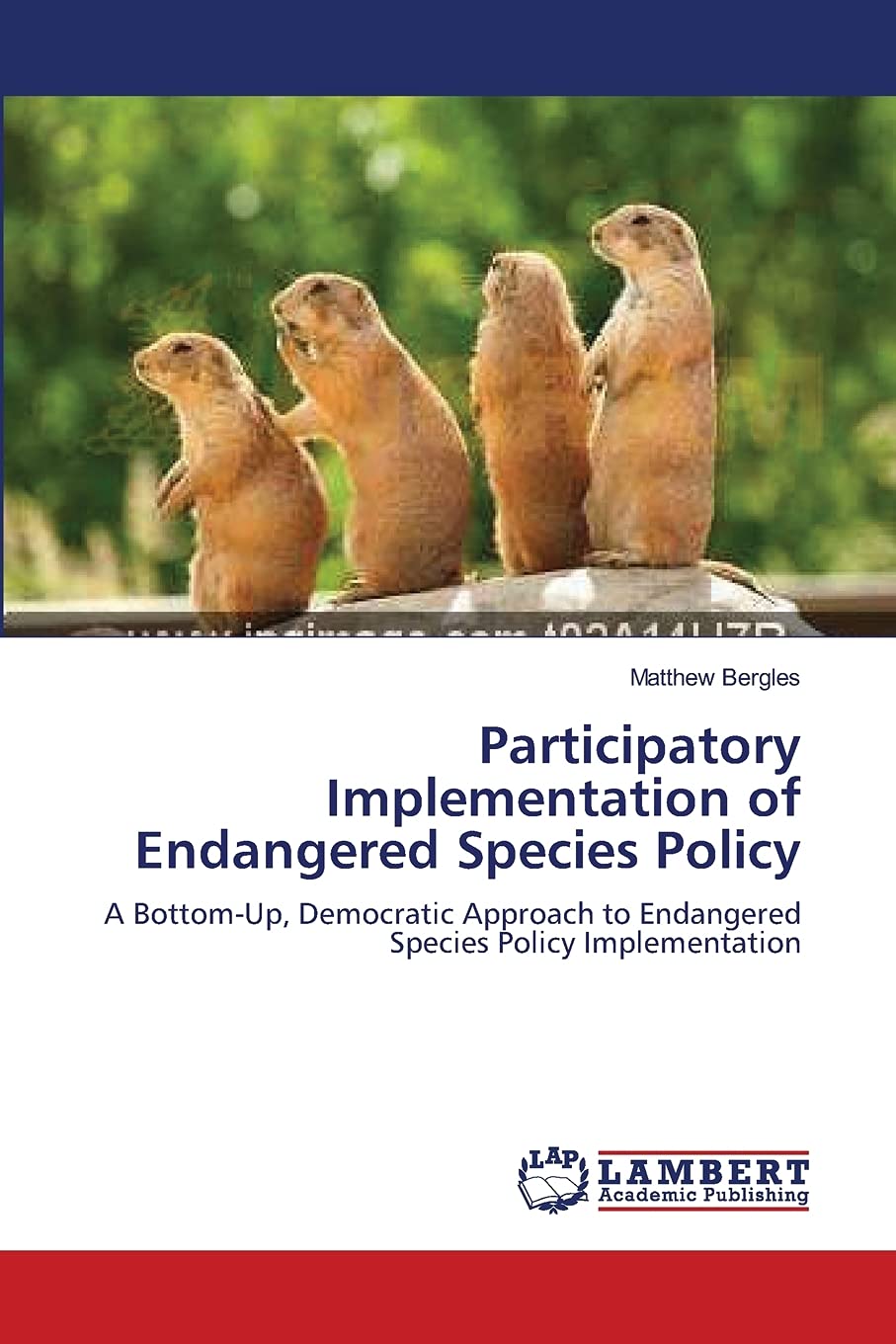
This book examines implementation of the Colorado Species Conservation Partnership (CSCP), a voluntary, landownerinitiated state endangered species program. The purpose of the study was to determine the extent of implementation success in achieving wise habitat preservation and species management agreements between landowners, the implementing agency Colorado Division of Wildlife (CDOW) and in certain cases, a third party, non governmental organization; for critical, threatened and endangered species. Since most human activities harmful to wildlife and its essential habitat occur on private land, preservation of private habitat is essential. Successful implementation of CSCP was found to be dependent on a strong bottomup, democratic approach to policy implementation by CDOW perhaps best characterized as interactive symbiosis that includes the literaturebased concepts of successful implementation: valueadded through discretion, mutual adaptation, policy learning and incentives. Additionally, CDOW understood the political, economic and social contexts that affected CSCP implementation.
⚠️ WARNING (California Proposition 65):
This product may contain chemicals known to the State of California to cause cancer,
birth defects, or other reproductive harm.
For MAP (Minimum Advertised Price) violations and Intellectual Property (IP) or Trademark concerns, please contact:
support@ergodebooks.com
⚠️ California Proposition 65 Warning: Some products sold on this website may expose you to chemicals known to the State of California to cause cancer, birth defects, or other reproductive harm. For more information, visit www.P65Warnings.ca.gov.