
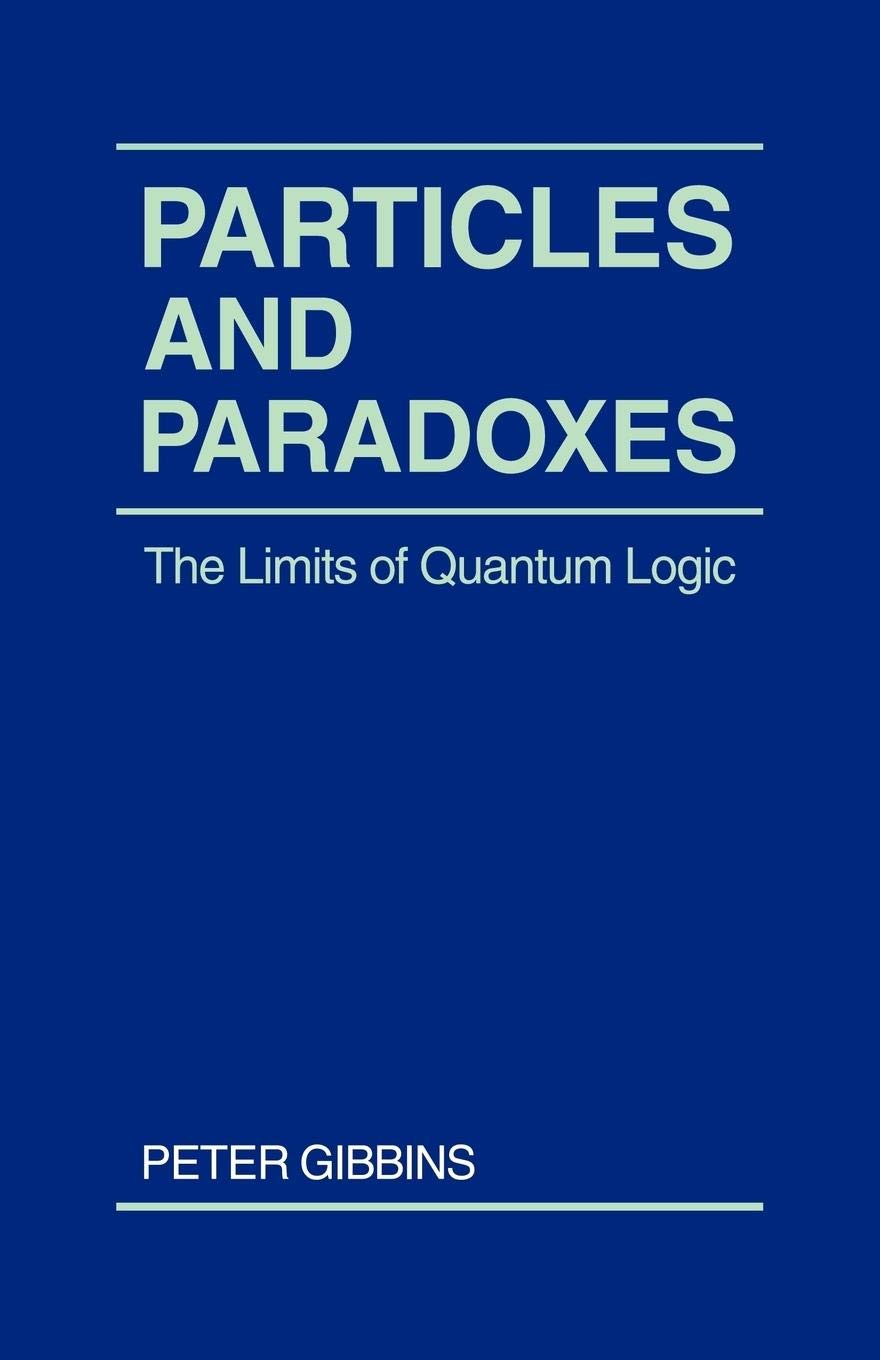
Title
Particles And Paradoxes: The Limits Of Quantum Logic
Sold by Ergodebooks, an authorized reseller.
Returns accepted within 30 days | support@ergodebooks.com
Shipping Information
- Free Standard Shipping — United States only
- Processing Time: 3–5 business days
- Estimated Delivery: 6–10 business days after dispatch
- Double-boxed, fully insured & discreetly packaged
- Tracking number sent via email once dispatched
Returns & Refund
Returns accepted within 30 days of delivery.
Damaged or Defective Item
Free return shipping + replacement or full refund
Wrong Item Received
Free return shipping + replacement or full refund
Change of Mind
Return shipping at customer's expense · 25% restocking fee applies
Payment Option

Quantum Theory Is Our Deepest Theory Of The Nature Of Matter. It Is A Theory That, Notoriously, Produces Results Which Challenge The Laws Of Classical Logic And Suggests That The Physical World Is Illogical. This Book Gives A Critical Review Of Work On The Foundations Of Quantum Mechanics At A Level Accessible To Nonexperts. Assuming His Readers Have Some Background In Mathematics And Physics, Peter Gibbins Focuses On The Questions Of Whether The Results Of Quantum Theory Require Us To Abandon Classical Logic And Whether Quantum Logic Can Resolve The Paradoxes Produced By Quantum Mechanics. He Argues That Quantum Logic Does Not Dispose Of The Problems Faced By Classical Logic, That No Reasonable Interpretation Of Quantum Mechanics In Terms Of 'Hidden Variables' Can Be Found, And That After All These Years Quantum Mechanics Remains A Mystery To Us. Particles And Paradoxes Provides A Muchneeded And Valuable Introduction To The Philosophy Of Quantum Mechanics And, At The Same Time, An Example Of Just What It Is To Do The Philosophy Of Physics.
⚠️ WARNING (California Proposition 65):
This product may contain chemicals known to the State of California to cause cancer, birth defects, or other reproductive harm.
For more information, please visit www.P65Warnings.ca.gov.
- Q: How many pages does this book have? A: This book has one hundred ninety-six pages. It's a concise exploration of quantum mechanics suitable for both beginners and those with some background.
- Q: What is the binding type of the book? A: The book is available in paperback binding. This makes it lightweight and easy to handle for reading.
- Q: What are the dimensions of the book? A: The dimensions of the book are five point five one inches in length, zero point four nine inches in width, and eight point five inches in height. These measurements make it portable for readers.
- Q: Who is the author of this book? A: The author of the book is Peter Gibbins. He provides insights into the foundations of quantum mechanics and its philosophical implications.
- Q: What topics does the book cover? A: The book covers the limits of quantum logic and its implications for classical logic. It also addresses the paradoxes in quantum mechanics.
- Q: Is this book suitable for beginners? A: Yes, this book is suitable for beginners with a basic understanding of mathematics and physics. It is designed to be accessible to non-experts.
- Q: How do I care for this paperback book? A: To care for this paperback book, keep it in a dry place and avoid exposure to direct sunlight. This will help preserve its condition.
- Q: Can I read this book if I have no background in physics? A: Yes, you can read this book even without a background in physics. The author aims to explain complex topics in an understandable way.
- Q: Is this book safe for young readers? A: Yes, the book is safe for young readers. However, it is recommended for those who have some level of interest in science and philosophy.
- Q: What if the book arrives damaged? A: If the book arrives damaged, you should contact the seller for a return or exchange. Most reputable sellers will assist you with the process.
- Q: Does the book have any illustrations or diagrams? A: No, the book does not include illustrations or diagrams. It primarily presents theoretical concepts through text.
- Q: Is this book part of a series? A: No, this book is not part of a series. It stands alone as an exploration of quantum logic and philosophy.
- Q: What is the main argument presented in the book? A: The main argument is that quantum logic does not resolve the issues faced by classical logic. Gibbins discusses the persistent mysteries of quantum mechanics.
- Q: Where is this book published? A: This book is published by Cambridge University Press. It is a reputable publisher known for academic and educational materials.
- Q: Can I find this book in libraries? A: Yes, you can often find this book in university and public libraries. It is a valuable resource for those studying philosophy and physics.