
Title
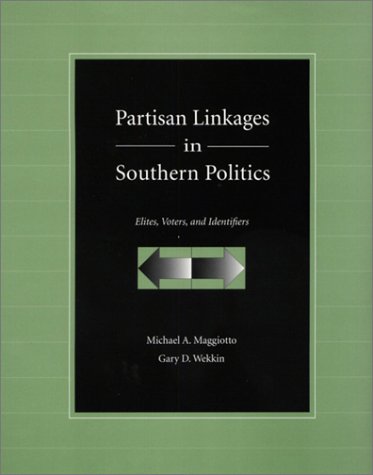
Partisan Linkages in Southern Politics: Elites, Voters, and Identifiers,Used
Sold by Ergodebooks, an authorized reseller.
Returns accepted within 30 days | support@ergodebooks.com
Shipping Information
- Free Standard Shipping — United States only
- Processing Time: 3–5 business days
- Estimated Delivery: 6–10 business days after dispatch
- Double-boxed, fully insured & discreetly packaged
- Tracking number sent via email once dispatched
Returns & Refund
Returns accepted within 30 days of delivery.
Damaged or Defective Item
Free return shipping + replacement or full refund
Wrong Item Received
Free return shipping + replacement or full refund
Change of Mind
Return shipping at customer's expense · 25% restocking fee applies
Payment Option

Interpreting extensive data gathered in eleven southern states during the 1992 presidential election, this book addresses a critical question about the democratic Do political parties still have a meaningful role to play in linking government and the governed? While some observers have written off modern partiesarguing that they have been supplanted by political action committees, social movements, candidate organizations, and the likeMichael Maggiotto and Gary Wekkin find that parties remain viable mediators between the wishes and values of the electorate and the policy behavior of those whom they elect. The authors base their conclusions on surveys conducted among a wide range of southern political participants in the 1992 electionfrom the eligible electorate to those constituting the various party elites, such as chairs and members of party committees and delegates to the national conventions. In analyzing the data, the authors proceed in three steps. First, they define party masses by party identification and expected vote and compare them to party elites using demographic, socioeconomic, and ideological factors. Second, they identify issue and ideological connections between party elites and masses. Third, they contextualize their findings by exploring the various political and socioeconomic environments within which elitemass interaction occurs. This study is valuable for several reasons. Its southern focus adds to our understanding of a dynamic political culture in which patterns of party competition and loyalty have changed rapidly in recent decades. Also, it is the first such study to take into account the influence of demographic, institutional, and cultural variables on the ways in which parties cohere on issues. Finally, it reaches some intriguing conclusions. The authors find, for example, that issuecongruence within parties often has as much to do with internal factors, such as the strength of the party organization, as it does with external variables, such as race, religion, or level of education.In illuminating the continuing vitality of partisanship in American political life, this book will be studied and debated for years to come. The Michael A. Maggiotto is professor of political science and dean of the School of Letters and Sciences at the State University of New York, Brockport. He is coeditor (with Gary D. Wekkin, Donald E. Whistler, and Michael A. Kelley) of Building Democracy in OneParty Systems. Gary D. Wekkin is professor of political science at the University of Central Arkansas and author of Democrat versus The National Party's Campaign to Close the Wisconsin Primary.
⚠️ WARNING (California Proposition 65):
This product may contain chemicals known to the State of California to cause cancer, birth defects, or other reproductive harm.
For more information, please visit www.P65Warnings.ca.gov.