If you have any questions, you are always welcome to contact us. We'll get back to you as soon as possible, withing 24 hours on weekdays.
Customer service
All questions about your order, return and delivery must be sent to our customer service team by e-mail at yourstore@yourdomain.com
Sale & Press
If you are interested in selling our products, need more information about our brand or wish to make a collaboration, please contact us at press@yourdomain.com
Help
If you have any questions, you are always welcome to contact us. We'll get back to you as soon as possible, withing 24 hours on weekdays.
Customer service
All questions about your order, return and delivery must be sent to our customer service team by e-mail at yourstore@yourdomain.com
Sale & Press
If you are interested in selling our products, need more information about our brand or wish to make a collaboration, please contact us at press@yourdomain.com
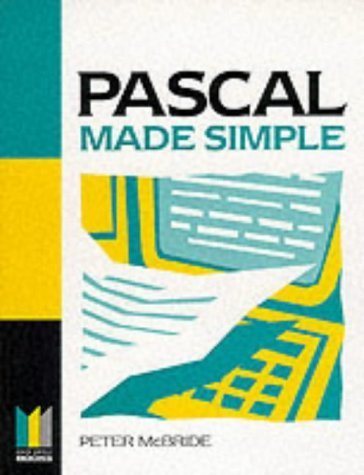
Pascal has become well established as a language for students. It is one of the easiest to learn, lends itself naturally to a structured approach to programming and produces clear and readable code. Though it is little used for the production of commercial software, it provides an excellent base for learning other languages. C and C++, for example, are the languages of choice for applications, operating systems, games and other programs where speed is needed. Both are difficult to learn as a first language, but do not prove half so impenetrable if you have cut your programming teeth on Pascal. Borland's Delphi, which is currently finding favour with developers of databases and other commercial applications, is another language that would be easier to learn if you already have a grasp of Pascal.This Made Simple book does not attempt to give a complete coverage of the language. The aim is to provide clear and concise explanations with plenty of simple examples of the words that create the program structures, and of the key procedures and functions.For most of the book, the focus is on that central core of Pascal that is common to all versions of the language. The techniques and programs given in the first seven chapters should work on any computer, from PC to multiuser system, that has a Pascal compiler. Chapter 8 gives an introduction to Turbo Pascal, in its Windows version, and Turbo appears again in the summary of the language in Chapter 10. You can only learn programming by doing it. With this in mind, there are exercises at the end of each of the first seven chapters, with answers in Chapter 9.
⚠️ WARNING (California Proposition 65):
This product may contain chemicals known to the State of California to cause cancer,
birth defects, or other reproductive harm.
For MAP (Minimum Advertised Price) violations and Intellectual Property (IP) or Trademark concerns, please contact:
support@ergodebooks.com
⚠️ California Proposition 65 Warning: Some products sold on this website may expose you to chemicals known to the State of California to cause cancer, birth defects, or other reproductive harm. For more information, visit www.P65Warnings.ca.gov.