If you have any questions, you are always welcome to contact us. We'll get back to you as soon as possible, withing 24 hours on weekdays.
Customer service
All questions about your order, return and delivery must be sent to our customer service team by e-mail at yourstore@yourdomain.com
Sale & Press
If you are interested in selling our products, need more information about our brand or wish to make a collaboration, please contact us at press@yourdomain.com
Help
If you have any questions, you are always welcome to contact us. We'll get back to you as soon as possible, withing 24 hours on weekdays.
Customer service
All questions about your order, return and delivery must be sent to our customer service team by e-mail at yourstore@yourdomain.com
Sale & Press
If you are interested in selling our products, need more information about our brand or wish to make a collaboration, please contact us at press@yourdomain.com
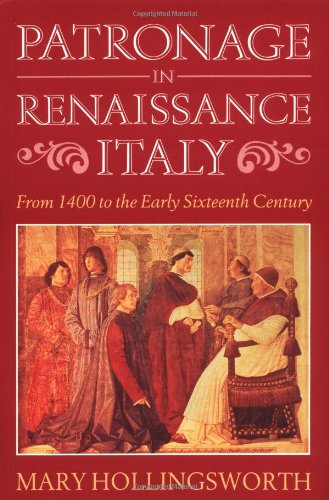
In this first comprehensive study of patrons in the Italian quattrocento, Mary Hollingsworth shows how the patronrather than the artistcarefully controlled both subject and medium in artistic creation. In a competitive and violent age, she explains, image and ostentation were essential statements of the patron's power. As a result, perceived cost became more important than artistic quality (and buildings, bronze, or tapestry were considered more eloquent statements than cheaper marble or fresco). Artists in the early Renaissance were employed as craftsmen, Hollingsworth concludes, and only late in the century did their relations with patrons start to adopt a pattern we might recognize today.'Many readers, specialists and nonspecialists alike, will welcome this book as a reliable and straightforward introduction to an important and interesting subject.'Literary Review'A synthesis of the current state of knowledge about Renaissance patronage... The author is particularly well qualified to assess the amount of personal involvement of patrons, and she emphasizes the extent to which Lorenzo de Medici, Ercole d'Este, and Federigo da Montefeltro, as well as several Popes, can be considered their own 'architects.''Apollo
⚠️ WARNING (California Proposition 65):
This product may contain chemicals known to the State of California to cause cancer,
birth defects, or other reproductive harm.
For MAP (Minimum Advertised Price) violations and Intellectual Property (IP) or Trademark concerns, please contact:
support@ergodebooks.com
⚠️ California Proposition 65 Warning: Some products sold on this website may expose you to chemicals known to the State of California to cause cancer, birth defects, or other reproductive harm. For more information, visit www.P65Warnings.ca.gov.