
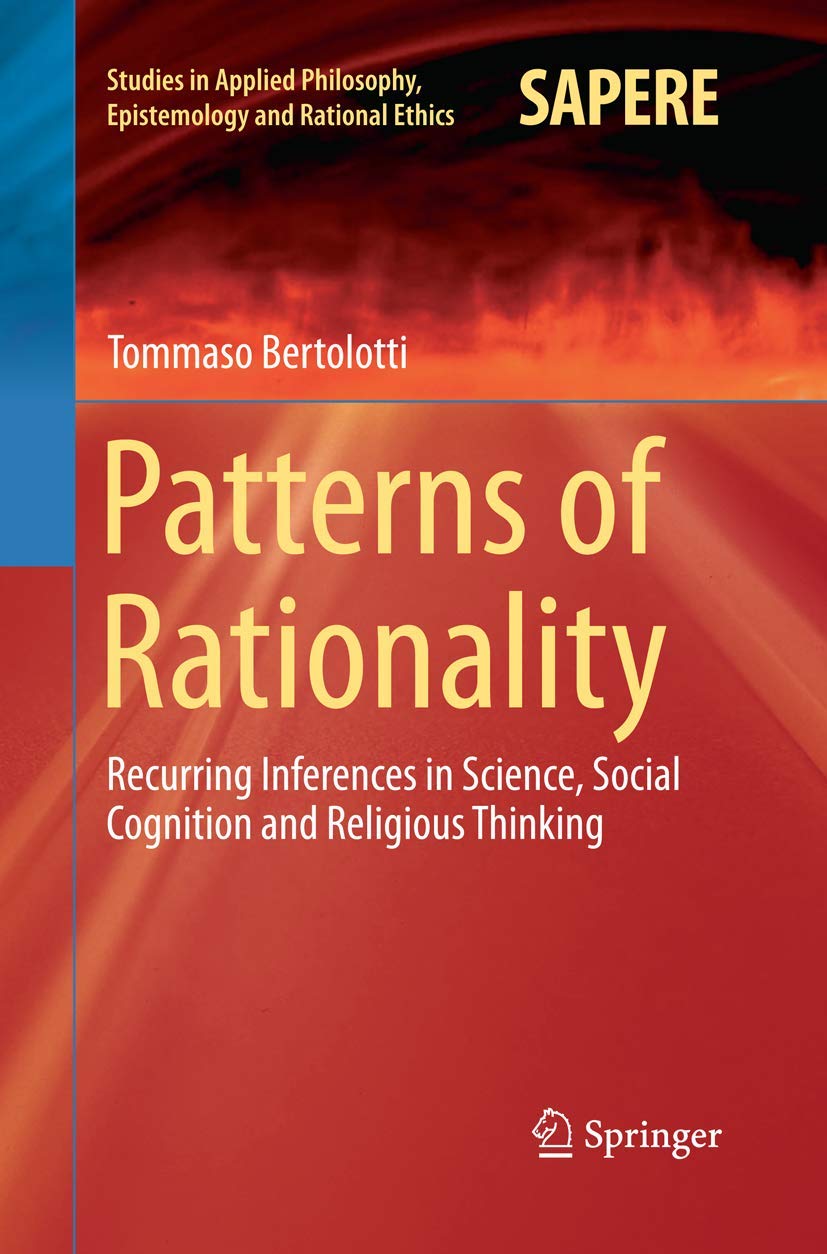
Title
Patterns of Rationality: Recurring Inferences in Science, Social Cognition and Religious Thinking (Studies in Applied Philosophy,Used
Sold by Ergodebooks, an authorized reseller.
Returns accepted within 30 days | support@ergodebooks.com
Shipping Information
- Free Standard Shipping — United States only
- Processing Time: 3–5 business days
- Estimated Delivery: 6–10 business days after dispatch
- Double-boxed, fully insured & discreetly packaged
- Tracking number sent via email once dispatched
Returns & Refund
Returns accepted within 30 days of delivery.
Damaged or Defective Item
Free return shipping + replacement or full refund
Wrong Item Received
Free return shipping + replacement or full refund
Change of Mind
Return shipping at customer's expense · 25% restocking fee applies
Payment Option

This book proposes an applied epistemological framework for investigating science, social cognition and religious thinking based on inferential patterns that recur in the different domains. It presents human rationality as a tool that allows us to make sense of our (physical or social) surroundings. It shows that the resulting cognitive activity produces a broad spectrum of outputs, such as scientific models and experimentation, gossip and social networks, but also ancient and contemporary deities. The book consists of three parts, the first of which addresses scientific modeling and experimentation, and their application to the analysis of scientific rationality. Thus, this part continues the tradition of ecocognitive epistemology and abduction studies. The second part deals with the relationship between social cognition and cognitive niche construction, i.e. the evolutionarily relevant externalization of knowledge onto the environment, while the third part focuses on what is commonly defined as irrational, thus being in a way dialectically opposed to the first part. Here, the author demonstrates that the irrational can be analyzed by applying the same epistemological approach used to study scientific rationality and social cognition; also in this case, we see the emergence of patterns of rationality that regulate the relationships between agents and their environment. All in all, the book offers a coherent and unitary account of human rationality, providing a basis for new conceptual connections and theoretical speculations.
⚠️ WARNING (California Proposition 65):
This product may contain chemicals known to the State of California to cause cancer, birth defects, or other reproductive harm.
For more information, please visit www.P65Warnings.ca.gov.