
Title
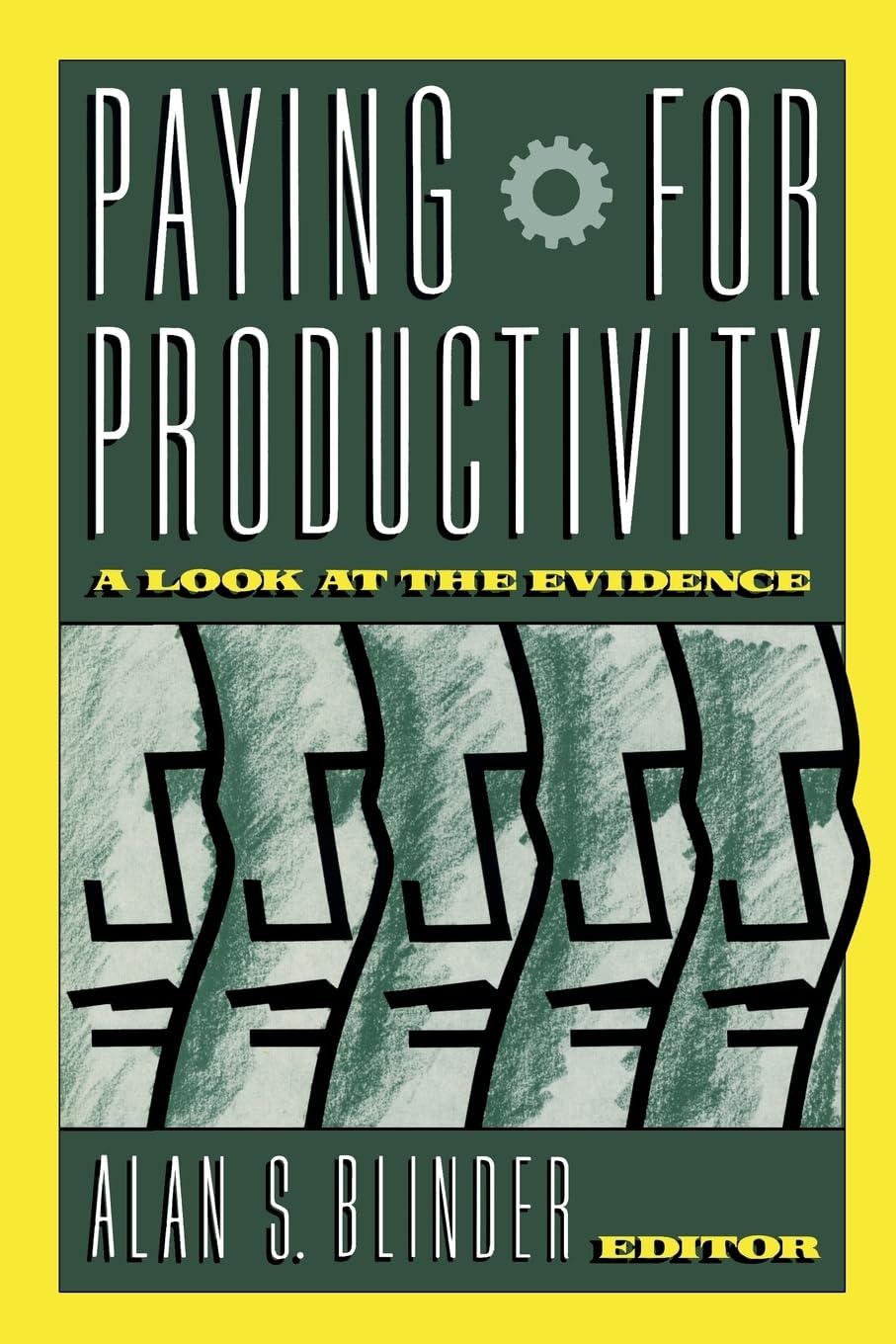
Paying For Productivity: A Look At The Evidence (Studies In Defense Policy),New
Sold by Ergodebooks, an authorized reseller.
Returns accepted within 30 days | support@ergodebooks.com
Shipping Information
- Free Standard Shipping — United States only
- Processing Time: 3–5 business days
- Estimated Delivery: 6–10 business days after dispatch
- Double-boxed, fully insured & discreetly packaged
- Tracking number sent via email once dispatched
Returns & Refund
Returns accepted within 30 days of delivery.
Damaged or Defective Item
Free return shipping + replacement or full refund
Wrong Item Received
Free return shipping + replacement or full refund
Change of Mind
Return shipping at customer's expense · 25% restocking fee applies
Payment Option

Will higher pay provide an incentive for better work? Can productivity be increased by changing the way workers are compensated? In response to the urgent need to improve productivity performance in American industry, leading economists examine alternative compensation schemes to assess their efficiency in raising productivity.Over the years a number of suggestions have been made for improving labor productivity by changing the manner in which laborers are compensated for their efforts. The ideas presented and analyzed in this volume have all been put into practice, in modified form or on a small scale, in the United States or elsewhere. Some are new; others quite old.David I. Levine and Laura D'Andrea Tyson consider the effects of employee participation in decisionmaking on firm performance, and Martin L. Weitzman and Douglas L. Kruse discuss the implications of profit sharing and related forms of pay for group performance. Michael A. Conte and Jan Svejnar analyze employee stock ownership plans in the United States and other forms of worker ownership in Europe; Masanore Hashimoto uses a transactioncost perspective to assess Japanese employment and wage systems. Daniel J. B. Mitchell, David Lewin, and Edward E. Lawler III give an overall analysis of traditional and alternative pay systems, their history, development, and curent use, and recommend further experimentation with alternative compensation plans to ensure more adaptability on the part of U.S. firms. Blinder provides an overview of the findings and conclusions.'
⚠️ WARNING (California Proposition 65):
This product may contain chemicals known to the State of California to cause cancer, birth defects, or other reproductive harm.
For more information, please visit www.P65Warnings.ca.gov.