
Title
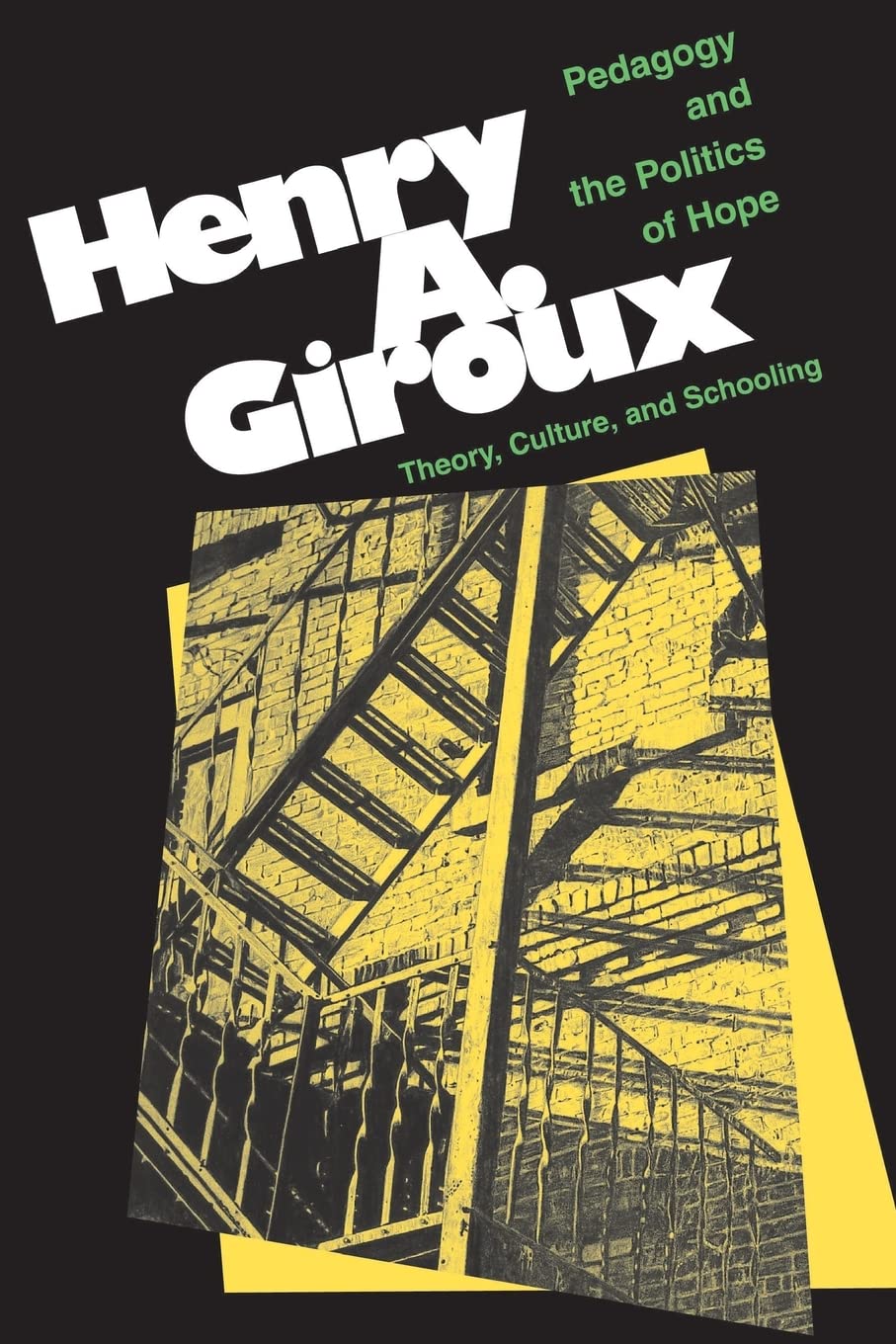
Pedagogy And The Politics Of Hope: Theory, Culture, And Schooling, A Critical Reader,Used
Sold by Ergodebooks, an authorized reseller.
Returns accepted within 30 days | support@ergodebooks.com
Shipping Information
- Free Standard Shipping — United States only
- Processing Time: 3–5 business days
- Estimated Delivery: 6–10 business days after dispatch
- Double-boxed, fully insured & discreetly packaged
- Tracking number sent via email once dispatched
Returns & Refund
Returns accepted within 30 days of delivery.
Damaged or Defective Item
Free return shipping + replacement or full refund
Wrong Item Received
Free return shipping + replacement or full refund
Change of Mind
Return shipping at customer's expense · 25% restocking fee applies
Payment Option

Henry A. Giroux is one of the most respected and wellknown critical education scholars, social critics, and astute observers of popular culture in the modern world. For those who follow his considerably influential work in critical pedagogy and social criticism, this firstever collection of his classic writings, augmented by a new essay, is a musthave volume that reveals his evolution as a scholar. In it, he takes on three major considerations central to pedagogy and schooling.The first section offers Giroux's most widely read theoretical critiques on the culture of positivism and technocratic rationality. He contends that by emphasizing the logic of science and rationality rather than taking a holistic worldview, these approaches fail to take account of connections among social, political, and historical forces or to consider the importance of such connections for the process of schooling.In the second section, Giroux expands the theoretical framework for conceptualizing and implementing his version of critical pedagogy. His theory of border pedagogy advocates a democratic public philosophy that embraces the notion of difference as part of a common struggle to extend the quality of public life. For Giroux, a student must function as a bordercrosser, as a person moving in and out of physical, cultural, and social borders. He uses the popular medium of Hollywood film to show students how they might understand their own position as partly constructed within a dominant Eurocentric tradition and how power and authority relate to the wider society as well as to the classroom.In the last section, Giroux explores a number of contemporary traditions and issues, including modernism, postmodernism, and feminism, and discusses the matter of cultural difference in the classroom. Finally, in an essay written especially for this volume, Giroux analyzes the assault on education and teachers as public intellectuals that began in the ReaganBush era and continues today.
⚠️ WARNING (California Proposition 65):
This product may contain chemicals known to the State of California to cause cancer, birth defects, or other reproductive harm.
For more information, please visit www.P65Warnings.ca.gov.