

Title
Penal Theories and Institutions (Michel Foucault Lectures at the Collge de France, 13),Used
Sold by Ergodebooks, an authorized reseller.
Returns accepted within 30 days | support@ergodebooks.com
Shipping Information
- Free Standard Shipping — United States only
- Processing Time: 3–5 business days
- Estimated Delivery: 6–10 business days after dispatch
- Double-boxed, fully insured & discreetly packaged
- Tracking number sent via email once dispatched
Returns & Refund
Returns accepted within 30 days of delivery.
Damaged or Defective Item
Free return shipping + replacement or full refund
Wrong Item Received
Free return shipping + replacement or full refund
Change of Mind
Return shipping at customer's expense · 25% restocking fee applies
Payment Option

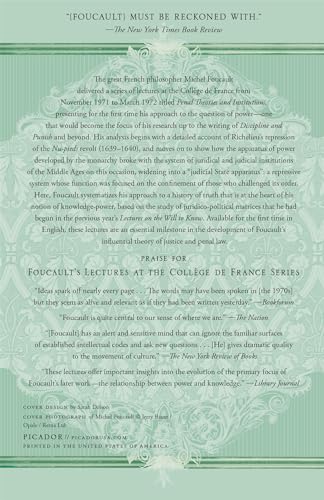
The thirteenth and final English volume of Michel Foucaults Lectures at the Collge de FranceWhat characterizes the act of justice is not resort to a court and to judges; it is not the intervention of magistrates (even if they had to be simple mediators or arbitrators). What characterizes the juridical act, the process or the procedure in the broad sense, is the regulated development of a dispute. And the intervention of judges, their opinion or decision, is only an episode in this development. What defines the juridical order is the way in which one confronts one another, the way in which one struggles. The rule and the struggle, the rule in the struggle, this is the juridical. Michel FoucaultThe great French philosopher Michel Foucault delivered a series of lectures at the Collge de France from November 1971 to March 1972, entitled Penal Theories and Institutions. Within them, he presented for the first time his approach to the question of power, one that would become the focus of his research up to the writing of Discipline and Punish and beyond. His analysis begins with a detailed account of Richelieus repression of the Nupieds Revolt (16391640) and moves on to show how the apparatus of power developed by the monarchy on this occasion broke with the system of juridical and judicial institutions of the Middle Ages, widening into a judicial State apparatusa repressive system, whose function was focused on the confinement of those who challenged its order.Here, Foucault systematizes his approach to a history of truth which is at the heart of his notion of knowledgepower, based on the study of juridicopolitical matrices that he had begun in the previous years Lectures on the Will to Know. Available for the first time in English, these lectures are an essential milestone in the development of Foucaults influential theory of justice and penal law.
⚠️ WARNING (California Proposition 65):
This product may contain chemicals known to the State of California to cause cancer, birth defects, or other reproductive harm.
For more information, please visit www.P65Warnings.ca.gov.