If you have any questions, you are always welcome to contact us. We'll get back to you as soon as possible, withing 24 hours on weekdays.
Customer service
All questions about your order, return and delivery must be sent to our customer service team by e-mail at yourstore@yourdomain.com
Sale & Press
If you are interested in selling our products, need more information about our brand or wish to make a collaboration, please contact us at press@yourdomain.com
Help
If you have any questions, you are always welcome to contact us. We'll get back to you as soon as possible, withing 24 hours on weekdays.
Customer service
All questions about your order, return and delivery must be sent to our customer service team by e-mail at yourstore@yourdomain.com
Sale & Press
If you are interested in selling our products, need more information about our brand or wish to make a collaboration, please contact us at press@yourdomain.com
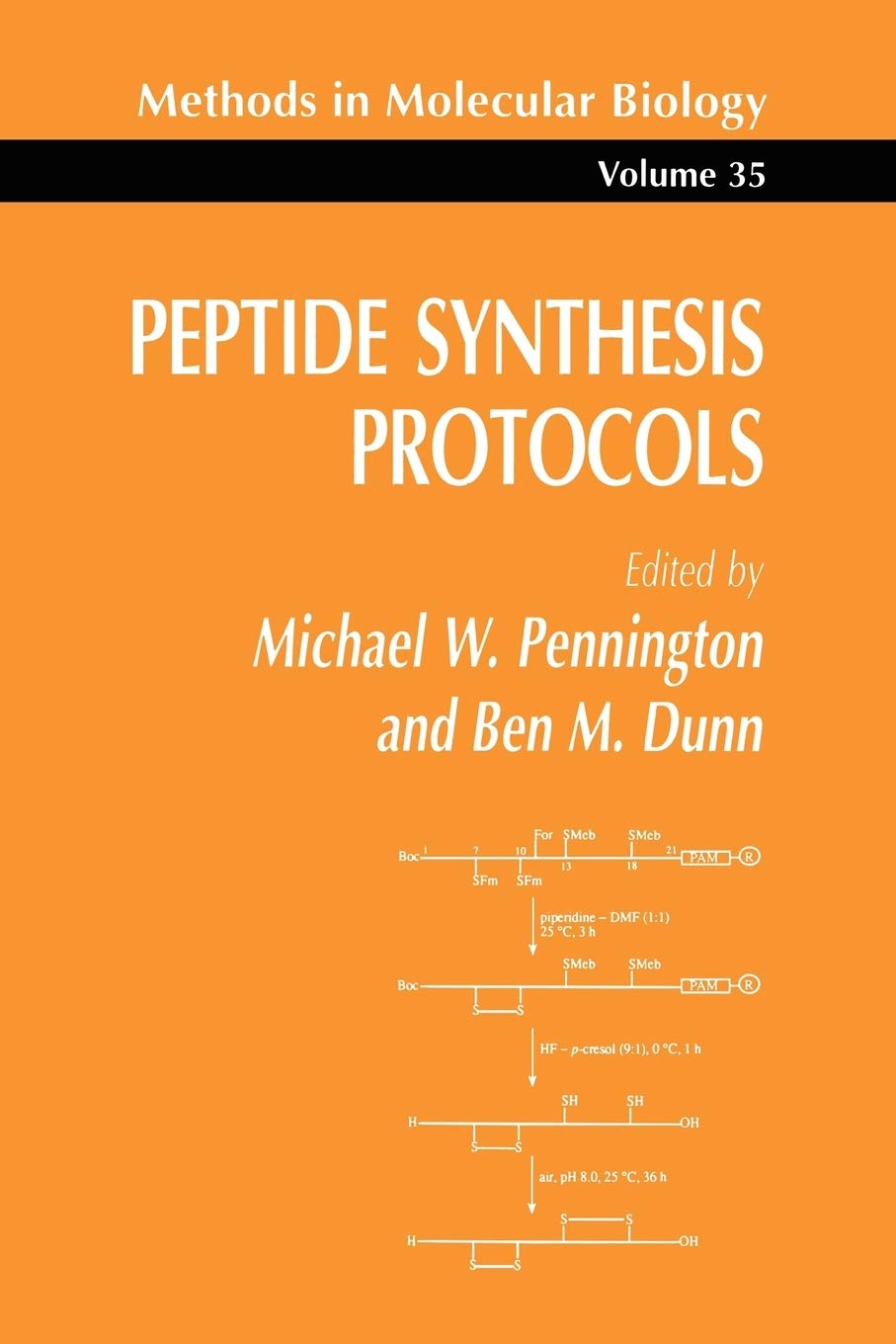
Peptide synthesis has emerged as one of the most powerful tools in biochemical, pharmacological, immunological, and biophysical la ratories. Recent improvements include general solidphase method ogy, new protecting groups, and automated equipment. These advances have allowed the facile synthesis of increasingly more complex p tides. Many of these new and improved methods for the synthesis of peptides and peptiderelated substances have been reported in various publications, but never compiled in a convenient handbook. Like other volumes in this series, Peptide Synthesis Protocols concentrates on the practical aspects of these procedures, providing the researcher with detailed descriptions and helpful tips about potential problems. This volume is not intended to serve as a basic guide to standard Merrifie type solidphase strategy, but rather to provide the researcher with some of the most recent applications in the field of peptide science. A c panion volume, Peptide Analysis Protocols, will detail methodology for the charaterization of new synthetic peptides. Development of new methods and applications has continued actively even as this volume was in preparation. Owing to the number of contributors to this volume, it was necessary to establish a cutoff for publication purposes. We feel that all of the protocols presented are timely and uptodate. Several promising new strategies, such as allyloxycarbonylbased syntheses, were being developed at the time this volume was in the editing stages and will be included in future editions.
⚠️ WARNING (California Proposition 65):
This product may contain chemicals known to the State of California to cause cancer,
birth defects, or other reproductive harm.
For MAP (Minimum Advertised Price) violations and Intellectual Property (IP) or Trademark concerns, please contact:
support@ergodebooks.com
⚠️ California Proposition 65 Warning: Some products sold on this website may expose you to chemicals known to the State of California to cause cancer, birth defects, or other reproductive harm. For more information, visit www.P65Warnings.ca.gov.