
Title
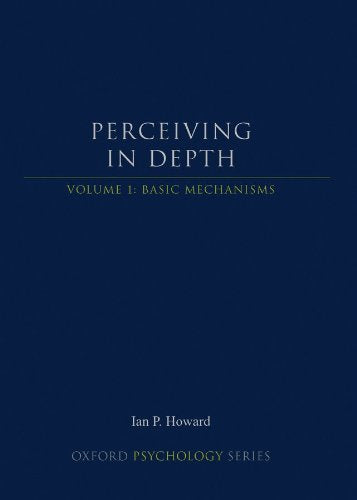
Perceiving in Depth, Volume 1: Basic Mechanisms (Oxford Psychology Series),Used
Sold by Ergodebooks, an authorized reseller.
Returns accepted within 30 days | support@ergodebooks.com
Shipping Information
- Free Standard Shipping — United States only
- Processing Time: 3–5 business days
- Estimated Delivery: 6–10 business days after dispatch
- Double-boxed, fully insured & discreetly packaged
- Tracking number sent via email once dispatched
Returns & Refund
Returns accepted within 30 days of delivery.
Damaged or Defective Item
Free return shipping + replacement or full refund
Wrong Item Received
Free return shipping + replacement or full refund
Change of Mind
Return shipping at customer's expense · 25% restocking fee applies
Payment Option

The threevolume work Perceiving in Depth is a sequel to Binocular Vision and Stereopsis and to Seeing in Depth, both by Ian P. Howard and Brian J. Rogers. This work is much broader in scope than the previous books and includes mechanisms of depth perception by all senses, including aural, electrosensory organs, and the somatosensory system. Volume 1 reviews sensory coding, psychophysical and analytic procedures, and basic visual mechanisms. Volume 2 reviews stereoscopic vision. Volume 3 reviews all mechanisms of depth perception other than stereoscopic vision. The three volumes are extensively illustrated and referenced and provide the most detailed review of all aspects of perceiving the threedimensional world.Volume 1 starts with a review of the history of visual science from the ancient Greeks to the early 20th century with special attention devoted to the discovery of the principles of perspective and stereoscopic vision. The first chapter also contains an account of early visual display systems, such as panoramas and peepshows, and the development of stereoscopes and stereophotography. A chapter on the psychophysical and analytic procedures used in investigations of depth perception is followed by a chapter on sensory coding and the geometry of visual space. An account of the structure and physiology of the primate visual system proceeds from the eye through the LGN to the visual cortex and higher visual centers. This is followed by a review of the evolution of visual systems and of the development of the mammalian visual system in the embryonic and postnatal periods, with an emphasis on experiencedependent neural plasticity. An account of the development of perceptual functions, especially depth perception, is followed by a review of the effects of early visual deprivation during the critical period of neural plasticity on amblyopia and other defects in depth perception. Volume 1 ends with accounts of the accommodation mechanism of the human eye and vergence eye movements.
⚠️ WARNING (California Proposition 65):
This product may contain chemicals known to the State of California to cause cancer, birth defects, or other reproductive harm.
For more information, please visit www.P65Warnings.ca.gov.