
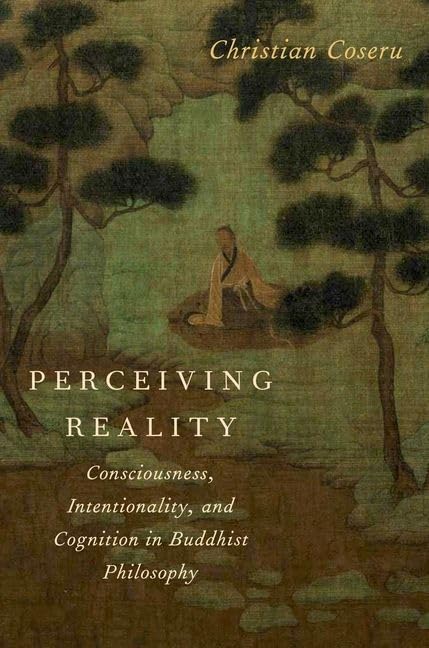
Title
Perceiving Reality: Consciousness, Intentionality, And Cognition In Buddhist Philosophy,New
Sold by Ergodebooks, an authorized reseller.
Returns accepted within 30 days | support@ergodebooks.com
Shipping Information
- Free Standard Shipping — United States only
- Processing Time: 3–5 business days
- Estimated Delivery: 6–10 business days after dispatch
- Double-boxed, fully insured & discreetly packaged
- Tracking number sent via email once dispatched
Returns & Refund
Returns accepted within 30 days of delivery.
Damaged or Defective Item
Free return shipping + replacement or full refund
Wrong Item Received
Free return shipping + replacement or full refund
Change of Mind
Return shipping at customer's expense · 25% restocking fee applies
Payment Option

What turns the continuous flow of experience into perceptually distinct objects? Can our verbal descriptions unambiguously capture what it is like to see, hear, or feel? How might we reason about the testimony that perception alone discloses? Christian Coseru proposes a rigorous and highly original way to answer these questions by developing a framework for understanding perception as a mode of apprehension that is intentionally constituted, pragmatically oriented, and causally effective. By engaging with recent discussions in phenomenology and analytic philosophy of mind, but also by drawing on the work of Husserl and MerleauPonty, Coseru offers a sustained argument that Buddhist philosophers, in particular those who follow the tradition of inquiry initiated by Dign?ga and Dharmak?rti, have much to offer when it comes to explaining why epistemological disputes about the evidential role of perceptual experience cannot satisfactorily be resolved without taking into account the structure of our cognitive awareness.Perceiving Reality examines the function of perception and its relation to attention, language, and discursive thought, and provides new ways of conceptualizing the Buddhist defense of the reflexivity thesis of consciousnessnamely, that each cognitive event is to be understood as involving a prereflective implicit awareness of its own occurrence. Coseru advances an innovative approach to Buddhist philosophy of mind in the form of phenomenological naturalism, and moves beyond comparative approaches to philosophy by emphasizing the continuity of concerns between Buddhist and Western philosophical accounts of the nature of perceptual content and the character of perceptual consciousness.
⚠️ WARNING (California Proposition 65):
This product may contain chemicals known to the State of California to cause cancer, birth defects, or other reproductive harm.
For more information, please visit www.P65Warnings.ca.gov.