
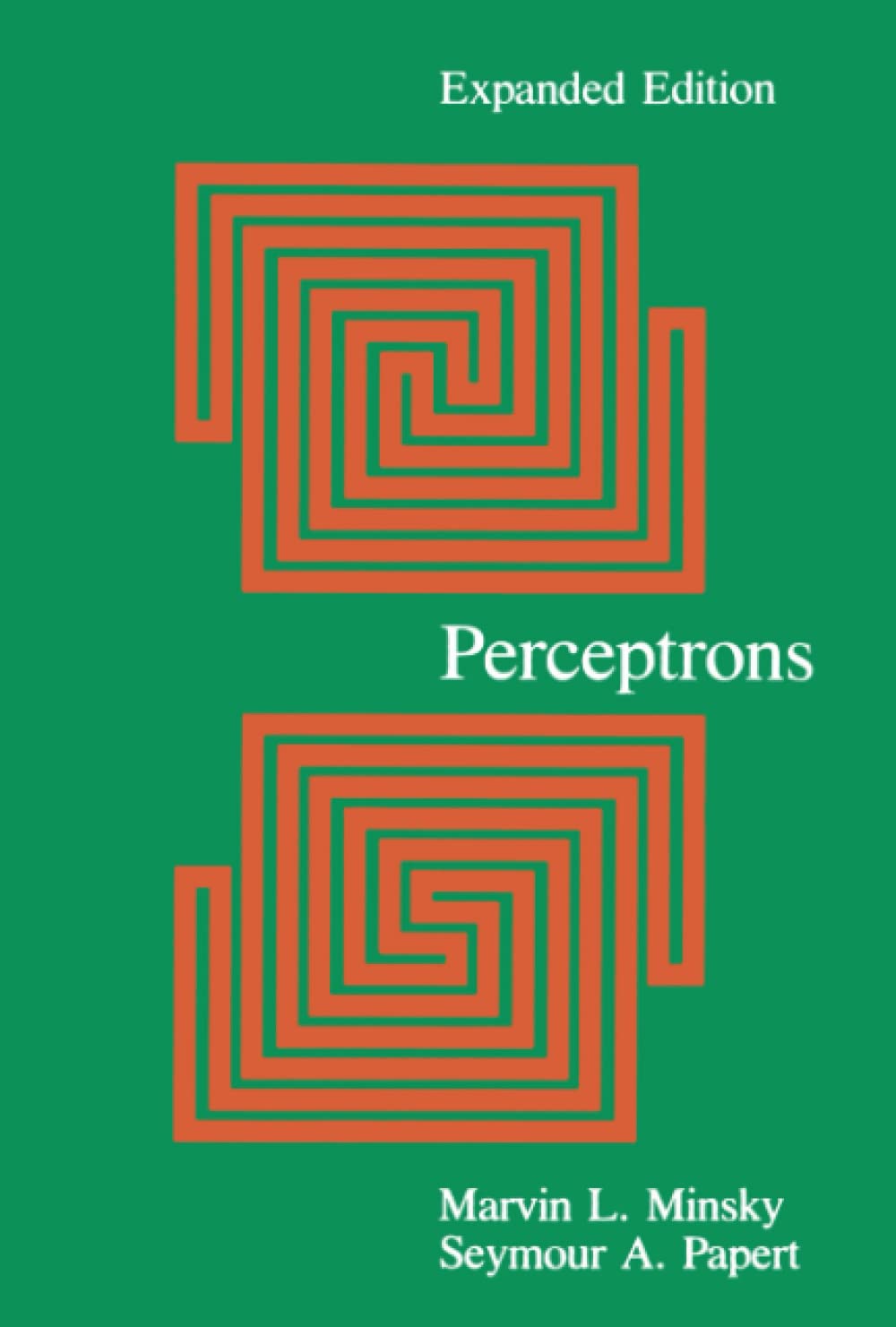
Title
Perceptrons: An Introduction To Computational Geometry, Expanded Edition,New
Sold by Ergodebooks, an authorized reseller.
Returns accepted within 30 days | support@ergodebooks.com
Shipping Information
- Free Standard Shipping — United States only
- Processing Time: 3–5 business days
- Estimated Delivery: 6–10 business days after dispatch
- Double-boxed, fully insured & discreetly packaged
- Tracking number sent via email once dispatched
Returns & Refund
Returns accepted within 30 days of delivery.
Damaged or Defective Item
Free return shipping + replacement or full refund
Wrong Item Received
Free return shipping + replacement or full refund
Change of Mind
Return shipping at customer's expense · 25% restocking fee applies
Payment Option

Perceptrons The First Systematic Study Of Parallelism In Computation Has Remained A Classical Work On Threshold Automata Networks For Nearly Two Decades. It Marked A Historical Turn In Artificial Intelligence, And It Is Required Reading For Anyone Who Wants To Understand The Connectionist Counterrevolution That Is Going On Today. Artificialintelligence Research, Which For A Time Concentrated On The Programming Of Ton Neumann Computers, Is Swinging Back To The Idea That Intelligence Might Emerge From The Activity Of Networks Of Neuronlike Entities. Minsky And Papert'S Book Was The First Example Of A Mathematical Analysis Carried Far Enough To Show The Exact Limitations Of A Class Of Computing Machines That Could Seriously Be Considered As Models Of The Brain. Now The New Developments In Mathematical Tools, The Recent Interest Of Physicists In The Theory Of Disordered Matter, The New Insights Into And Psychological Models Of How The Brain Works, And The Evolution Of Fast Computers That Can Simulate Networks Of Automata Have Given Perceptrons New Importance.Witnessing The Swing Of The Intellectual Pendulum, Minsky And Papert Have Added A New Chapter In Which They Discuss The Current State Of Parallel Computers, Review Developments Since The Appearance Of The 1972 Edition, And Identify New Research Directions Related To Connectionism. They Note A Central Theoretical Challenge Facing Connectionism: The Challenge To Reach A Deeper Understanding Of How 'Objects' Or 'Agents' With Individuality Can Emerge In A Network. Progress In This Area Would Link Connectionism With What The Authors Have Called 'Society Theories Of Mind.' Marvin L. Minsky Is Donner Professor Of Science In M.I.T.'S Electrical Engineering And Computer Science Department. Seymour A. Papert Is Professor Of Media Technology At M.I.T. .
⚠️ WARNING (California Proposition 65):
This product may contain chemicals known to the State of California to cause cancer, birth defects, or other reproductive harm.
For more information, please visit www.P65Warnings.ca.gov.
- Q: What are the dimensions of the book? A: The book measures six inches in length, zero point seventy-one inches in width, and eight point nine inches in height. It's a standard paperback size, making it easy to handle and read.
- Q: How many pages does the book have? A: The book contains three hundred eight pages. This length allows for an in-depth exploration of computational geometry and connectionism.
- Q: What type of binding does the book have? A: The book is bound in paperback. This type of binding is lightweight and flexible, suitable for easy reading.
- Q: Who are the authors of this book? A: The authors are Marvin L. Minsky and Seymour A. Papert. Both are renowned figures in artificial intelligence and computational theory.
- Q: What is the main topic of the book? A: The book primarily discusses computational geometry and neural networks. It delves into the historical significance and development of connectionist theories.
- Q: What is the reading level of this book? A: This book is suitable for advanced readers interested in artificial intelligence and computational theory. It is often used in academic settings.
- Q: How should I care for this book? A: To keep the book in good condition, store it upright in a cool, dry place. Avoid exposing it to direct sunlight to prevent fading.
- Q: Is this book suitable for beginners in AI? A: No, this book is not ideal for beginners. It is recommended for those with prior knowledge of computational concepts and theories.
- Q: Does the book contain illustrations? A: Yes, the book includes illustrations. These visuals help clarify complex concepts related to neural networks and computational geometry.
- Q: What if my book arrives damaged? A: If your book arrives damaged, contact customer support for a return or exchange. Ensure to have your order details ready for a smooth process.
- Q: What genre does this book fall under? A: The book falls under the genre of artificial intelligence and computational theory. It is a significant work in the field of neural networks.
- Q: What additional content is included in the expanded edition? A: The expanded edition includes a new chapter discussing recent developments in parallel computers and new research directions in connectionism.
- Q: Is this book part of a series? A: No, this book is not part of a series. It is a standalone work that has garnered significant attention in the field of AI.
- Q: Can this book be used as a textbook? A: Yes, this book is often used as a textbook in university courses on artificial intelligence and computational geometry.
- Q: Are there exercises or problems in this book? A: No, this book does not include exercises or problems. It focuses on theoretical concepts and historical context.