If you have any questions, you are always welcome to contact us. We'll get back to you as soon as possible, withing 24 hours on weekdays.
Customer service
All questions about your order, return and delivery must be sent to our customer service team by e-mail at yourstore@yourdomain.com
Sale & Press
If you are interested in selling our products, need more information about our brand or wish to make a collaboration, please contact us at press@yourdomain.com
Help
If you have any questions, you are always welcome to contact us. We'll get back to you as soon as possible, withing 24 hours on weekdays.
Customer service
All questions about your order, return and delivery must be sent to our customer service team by e-mail at yourstore@yourdomain.com
Sale & Press
If you are interested in selling our products, need more information about our brand or wish to make a collaboration, please contact us at press@yourdomain.com
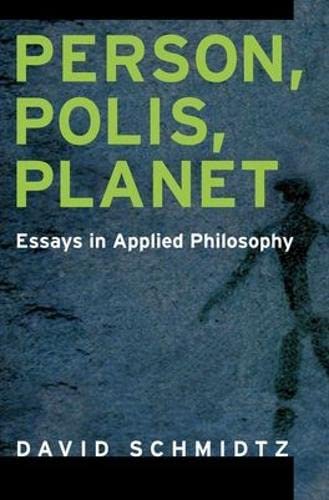
This volume collects thirteen of David Schmidtz's essays on the question of what it takes to live a good life, given that we live in a social and natural world. Part One defends a nonmaximizing conception of rational choice, explains how even ultimate goals can be rationally chosen, defends the rationality of concern and regard for others (even to the point of being willing to die for a cause), and explains why decision theory is necessarily incomplete as a tool for addressing such issues.Part Two uses the tools of analytic philosophy to explain what we can do to be deserving ,what is wrong with the idea that we ought to do as much good as we can, why mutual aid is good, but why the welfare state does not work as a way of institutionalizing mutual aid, and why transferring wealth from those who need it less to those who need it more can be a bad idea even from a utilitarian perspective. Most ambitiously, Part Two offers an overarching, pluralistic moral theory that defines the nature and limits of our obligations to each other and to our individual selves.Part Three discusses the history and economic logic of alternative property institutions, both private and communal, and explains why economic logic is an indispensable tool in the field of environmental conflict resolution. In the final essay, Schmidtz brings the volume full circle by considering the nature and limits of our obligations to nonhuman species, and how the status of nonhuman species ought to enter into our deliberations about what sort of life is worth living.
⚠️ WARNING (California Proposition 65):
This product may contain chemicals known to the State of California to cause cancer,
birth defects, or other reproductive harm.
For MAP (Minimum Advertised Price) violations and Intellectual Property (IP) or Trademark concerns, please contact:
support@ergodebooks.com
⚠️ California Proposition 65 Warning: Some products sold on this website may expose you to chemicals known to the State of California to cause cancer, birth defects, or other reproductive harm. For more information, visit www.P65Warnings.ca.gov.