
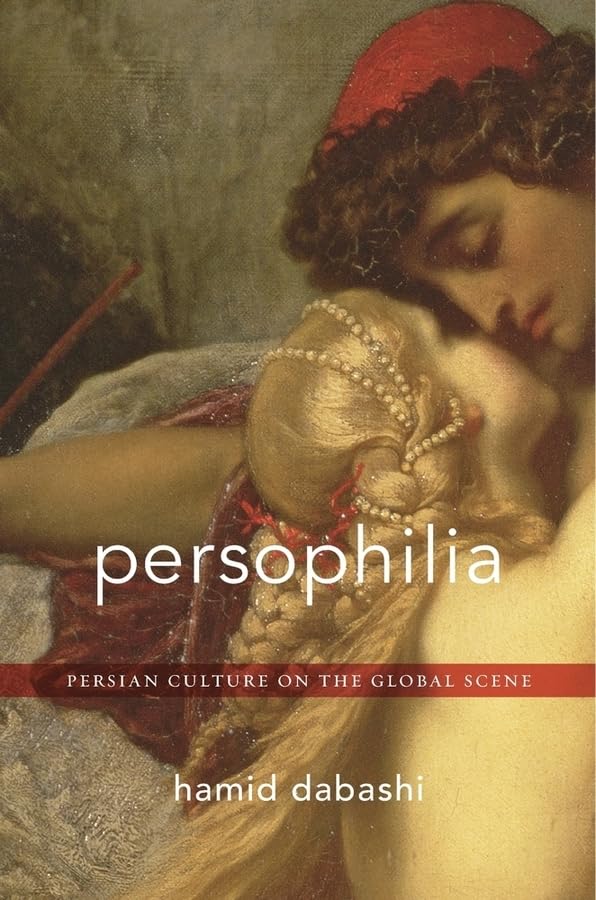
Title
Persophilia: Persian Culture on the Global Scene,New
Sold by Ergodebooks, an authorized reseller.
Returns accepted within 30 days | support@ergodebooks.com
Shipping Information
- Free Standard Shipping — United States only
- Processing Time: 3–5 business days
- Estimated Delivery: 6–10 business days after dispatch
- Double-boxed, fully insured & discreetly packaged
- Tracking number sent via email once dispatched
Returns & Refund
Returns accepted within 30 days of delivery.
Damaged or Defective Item
Free return shipping + replacement or full refund
Wrong Item Received
Free return shipping + replacement or full refund
Change of Mind
Return shipping at customer's expense · 25% restocking fee applies
Payment Option

From the Biblical period and Classical Antiquity to the rise of the Renaissance and the Enlightenment, aspects of Persian culture have been integral to European history. A diverse constellation of European artists, poets, and thinkers have looked to Persia for inspiration, finding there a rich cultural counterpoint and frame of reference. Interest in all things Persian was no passing fancy but an enduring fascination that has shaped not just Western views but the selfimage of Iranians up to the present day. Persophilia maps the changing geography of connections between Persia and the West over the centuries and shows that traffic in ideas about Persia and Persians did not travel on a oneway street.How did Iranians respond when they saw themselves reflected in Western mirrors? Expanding on Jrgen Habermass theory of the public sphere, and overcoming the limits of Edward Said, Hamid Dabashi answers this critical question by tracing the formation of a civic discursive space in Iran, seeing it as a prime example of a modern nationstate emerging from an ancient civilization in the context of European colonialism. The modern Iranian public sphere, Dabashi argues, cannot be understood apart from this dynamic interaction.Persophilia takes into its purview works as varied as Xenophons Cyropaedia and Nietzsches Thus Spoke Zarathustra, Handels Xerxes and Puccinis Turandot, and Gauguin and Matisses fascination with Persian art. The result is a provocative reading of world history that dismantles normative historiography and alters our understanding of postcolonial nations.
⚠️ WARNING (California Proposition 65):
This product may contain chemicals known to the State of California to cause cancer, birth defects, or other reproductive harm.
For more information, please visit www.P65Warnings.ca.gov.
- Q: What is the main theme of 'Persophilia: Persian Culture on the Global Scene'? A: The main theme of 'Persophilia' is the exploration of how Persian culture has influenced European history from ancient times through the Renaissance and Enlightenment, highlighting the interactions between Persia and the West.
- Q: Who is the author of this book? A: The author of 'Persophilia' is Hamid Dabashi, a prominent scholar known for his work on Persian culture and its global significance.
- Q: What type of binding does this book have? A: This book is published in a hardcover binding, which provides durability and a premium feel.
- Q: How many pages are in 'Persophilia'? A: The book contains 296 pages, providing a comprehensive exploration of its subject matter.
- Q: When was 'Persophilia' published? A: 'Persophilia' was published on October 12, 2015.
- Q: What is the condition of the book? A: 'Persophilia' is offered in new condition, ensuring that it is in pristine shape for readers.
- Q: What category does this book fall under? A: 'Persophilia' is categorized under Comparative Literature, making it suitable for readers interested in cultural studies.
- Q: Is there a specific edition of this book? A: Yes, this is the First Edition of 'Persophilia'.
- Q: What are some key topics discussed in 'Persophilia'? A: Key topics include the historical connections between Persia and the West, the influence of Persian culture on European artists and thinkers, and the evolution of Iran's civic discursive space.
- Q: Does 'Persophilia' reference any notable works or authors? A: Yes, the book references notable works such as Xenophon’s 'Cyropaedia', Nietzsche’s 'Thus Spoke Zarathustra', and the artistic works of Gauguin and Matisse.