
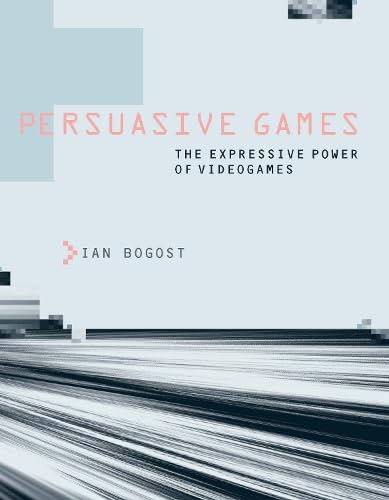
Title
Persuasive Games: The Expressive Power of Videogames,Used
Sold by Ergodebooks, an authorized reseller.
Returns accepted within 30 days | support@ergodebooks.com
Shipping Information
- Free Standard Shipping — United States only
- Processing Time: 3–5 business days
- Estimated Delivery: 6–10 business days after dispatch
- Double-boxed, fully insured & discreetly packaged
- Tracking number sent via email once dispatched
Returns & Refund
Returns accepted within 30 days of delivery.
Damaged or Defective Item
Free return shipping + replacement or full refund
Wrong Item Received
Free return shipping + replacement or full refund
Change of Mind
Return shipping at customer's expense · 25% restocking fee applies
Payment Option

An exploration of the way videogames mount arguments and make expressive statements about the world that analyzes their unique persuasive power in terms of their computational properties.Videogames are an expressive medium, and a persuasive medium; they represent how real and imagined systems work, and they invite players to interact with those systems and form judgments about them. In this innovative analysis, Ian Bogost examines the way videogames mount arguments and influence players. Drawing on the 2,500year history of rhetoric, the study of persuasive expression, Bogost analyzes rhetoric's unique function in software in general and videogames in particular. The field of media studies already analyzes visual rhetoric, the art of using imagery and visual representation persuasively. Bogost argues that videogames, thanks to their basic representational mode of procedurality (rulebased representations and interactions), open a new domain for persuasion; they realize a new form of rhetoric. Bogost calls this new form 'procedural rhetoric,' a type of rhetoric tied to the core affordances of computers: running processes and executing rulebased symbolic manipulation. He argues further that videogames have a unique persuasive power that goes beyond other forms of computational persuasion. Not only can videogames support existing social and cultural positions, but they can also disrupt and change these positions themselves, leading to potentially significant longterm social change. Bogost looks at three areas in which videogame persuasion has already taken form and shows considerable potential: politics, advertising, and learning.
⚠️ WARNING (California Proposition 65):
This product may contain chemicals known to the State of California to cause cancer, birth defects, or other reproductive harm.
For more information, please visit www.P65Warnings.ca.gov.
- Q: How many pages does the book have? A: This book has four hundred fifty pages. It offers an in-depth exploration of videogame persuasion and its implications.
- Q: What are the dimensions of the book? A: The book measures seven point twenty-five inches in length, one point twenty-six inches in width, and nine point twenty-five inches in height.
- Q: What type of binding does this book have? A: The book is hardcover bound. This durable binding is ideal for frequent handling and long-term use.
- Q: Who is the author of the book? A: The author is Ian Bogost. He is a prominent scholar in media studies and game design.
- Q: What genre does this book belong to? A: This book is categorized under Games and Strategy Guides. It delves into the persuasive aspects of videogames.
- Q: What is the main focus of the book? A: The main focus is on procedural rhetoric in videogames. It explores how games can mount arguments and influence players.
- Q: How can I apply the concepts from the book? A: You can apply these concepts by analyzing how videogames convey messages and influence opinions. It encourages critical thinking about games.
- Q: Is this book suitable for beginners in game studies? A: Yes, the book is suitable for beginners. It provides foundational insights into videogame rhetoric and persuasion.
- Q: What is procedural rhetoric? A: Procedural rhetoric is a form of persuasion unique to videogames. It involves rule-based representations that engage players in decision-making.
- Q: How should I store the book to maintain its condition? A: Store the book upright in a cool, dry place. This helps prevent damage to the binding and pages over time.
- Q: How do I clean the book if it gets dirty? A: To clean the book, gently wipe the cover with a soft, dry cloth. Avoid using water or cleaning solutions directly on the book.
- Q: Is the book appropriate for all ages? A: The book is intended for an adult audience. It discusses complex themes that may not be suitable for younger readers.
- Q: Can I return the book if I don't like it? A: Yes, you can return the book within the retailer's return policy period. Ensure it is in original condition for a full refund.
- Q: What if the book arrives damaged? A: If the book arrives damaged, contact the retailer's customer service. They can assist you with a replacement or refund.
- Q: Is there a warranty for the book? A: No, there is typically no warranty for books. However, you should check the return policy for any specific terms.
- Q: How is this book different from other game studies texts? A: This book focuses specifically on the persuasive power of videogames, offering a unique perspective on rhetoric in the medium.