
Title
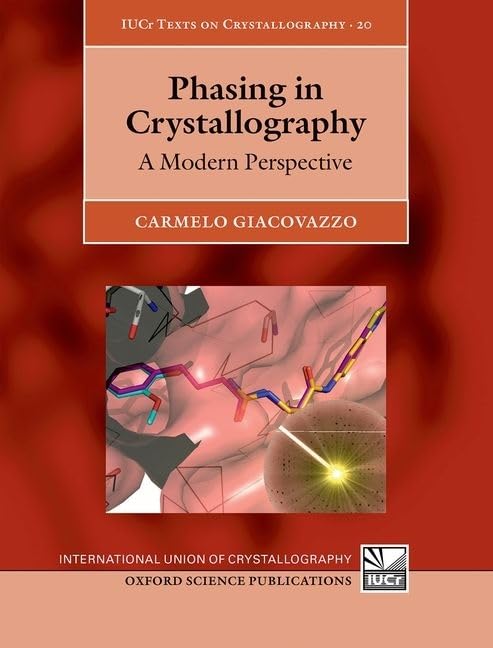
Phasing in Crystallography: A Modern Perspective (International Union of Crystallography Texts on Crystallography),Used
Sold by Ergodebooks, an authorized reseller.
Returns accepted within 30 days | support@ergodebooks.com
Shipping Information
- Free Standard Shipping — United States only
- Processing Time: 3–5 business days
- Estimated Delivery: 6–10 business days after dispatch
- Double-boxed, fully insured & discreetly packaged
- Tracking number sent via email once dispatched
Returns & Refund
Returns accepted within 30 days of delivery.
Damaged or Defective Item
Free return shipping + replacement or full refund
Wrong Item Received
Free return shipping + replacement or full refund
Change of Mind
Return shipping at customer's expense · 25% restocking fee applies
Payment Option

Modern crystallographic methods originate from the synergy of two main research streams, the smallmolecule and the macromolecular streams. The first stream was able to definitively solve the phase problem for molecules up to 200 atoms in the asymmetric unit. The achievements obtained by the macromolecular stream are also impressive. A huge number of protein structures have been deposited in the Protein Data Bank. The solution of them is no longer reserved to an elite group of scientists, but may be attained in a large number of laboratories around the world, even by young scientists.New probabilistic approaches have been tailored to deal with larger structures, errors in the experimental data, and modest data resolution. Traditional phasing techniques like ab initio, molecular replacement, isomorphous replacement, and anomalous dispersion techniques have been revisited. The new approaches have been implemented in robust phasing programs, which have been organized in automatic pipelines usable even by nonexperts. Protein structures, which 50 years ago could take months or even years to solve, can now be solved in a matter of hours, partly also due to technological advances in computer science.This book describes all modern crystallographic phasing methods, and introduces a new rational classification of them. A didactic approach is used, with the techniques described simply and logically in the main text, and further mathematical details confined to the Appendices for motivated readers. Numerous figures and applicative details illustrate the text.
⚠️ WARNING (California Proposition 65):
This product may contain chemicals known to the State of California to cause cancer, birth defects, or other reproductive harm.
For more information, please visit www.P65Warnings.ca.gov.