

Title

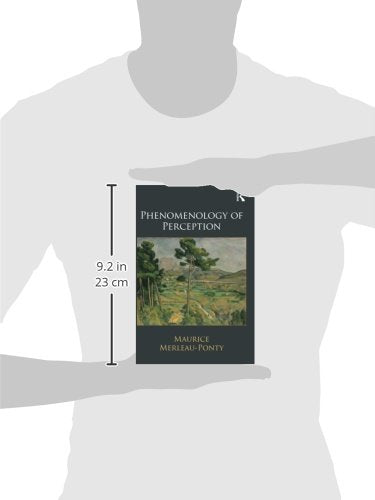
Phenomenology Of Perception,Used
Sold by Ergodebooks, an authorized reseller.
Returns accepted within 30 days | support@ergodebooks.com
Shipping Information
- Free Standard Shipping — United States only
- Processing Time: 3–5 business days
- Estimated Delivery: 6–10 business days after dispatch
- Double-boxed, fully insured & discreetly packaged
- Tracking number sent via email once dispatched
Returns & Refund
Returns accepted within 30 days of delivery.
Damaged or Defective Item
Free return shipping + replacement or full refund
Wrong Item Received
Free return shipping + replacement or full refund
Change of Mind
Return shipping at customer's expense · 25% restocking fee applies
Payment Option

First Published In 1945, Maurice Merleaupontys Monumental Phnomnologie De La Perception Signalled The Arrival Of A Major New Philosophical And Intellectual Voice In Postwar Europe. Breaking With The Prevailing Picture Of Existentialism And Phenomenology At The Time, It Has Become One Of The Landmark Works Of Twentiethcentury Thought. This New Translation, The First For Over Fifty Years, Makes This Classic Work Of Philosophy Available To A New Generation Of Readers.Phenomenology Of Perception Stands In The Great Phenomenological Tradition Of Husserl, Heidegger, And Sartre. Yet Merleaupontys Contribution Is Decisive, As He Brings This Tradition And Other Philosophical Predecessors, Particularly Descartes And Kant, To Confront A Neglected Dimension Of Our Experience: The Lived Body And The Phenomenal World. Charting A Bold Course Between The Reductionism Of Science On The One Hand And Intellectualism On The Other, Merleauponty Argues That We Should Regard The Body Not As A Mere Biological Or Physical Unit, But As The Body Which Structures Ones Situation And Experience Within The World.Merleauponty Enriches His Classic Work With Engaging Studies Of Famous Cases In The History Of Psychology And Neurology As Well As Phenomena That Continue To Draw Our Attention, Such As Phantom Limb Syndrome, Synaesthesia, And Hallucination. This New Translation Includes Many Helpful Features Such As The Reintroduction Of Merleaupontys Discursive Table Of Contents As Subtitles Into The Body Of The Text, A Comprehensive Translators Introduction To Its Main Themes, Essential Notes Explaining Key Terms Of Translation, An Extensive Index, And An Important Updating Of Merleaupontys References To Now Available English Translations.Also Included Is A New Foreword By Taylor Carman And An Introduction To Merleaupontyby Claude Lefort.Translated By Donald A. Landes.
⚠️ WARNING (California Proposition 65):
This product may contain chemicals known to the State of California to cause cancer, birth defects, or other reproductive harm.
For more information, please visit www.P65Warnings.ca.gov.
- Q: How many pages does 'Phenomenology of Perception' have? A: This book has six hundred ten pages. It provides an in-depth exploration of phenomenology and perception.
- Q: What is the binding type of 'Phenomenology of Perception'? A: The book is available in paperback binding. This makes it more flexible and easier to handle.
- Q: Who is the author of 'Phenomenology of Perception'? A: The author is Maurice Merleau-Ponty. He was a significant figure in twentieth-century philosophy.
- Q: What is the size of 'Phenomenology of Perception'? A: The dimensions are six point fourteen inches in length, one point fifty-seven inches in width, and nine point twenty-five inches in height. These dimensions make it a standard-sized book for reading.
- Q: Is 'Phenomenology of Perception' suitable for beginners? A: Yes, it can be suitable for beginners. However, it delves into complex philosophical themes that may require careful reading.
- Q: What themes does 'Phenomenology of Perception' cover? A: The book explores themes like perception, the lived body, and the relationship between body and experience. These themes are central to understanding Merleau-Ponty's philosophy.
- Q: How should I care for my copy of 'Phenomenology of Perception'? A: To keep it in good condition, store it in a cool, dry place and avoid exposure to direct sunlight. Regularly check for any signs of wear.
- Q: Can I read 'Phenomenology of Perception' in a group setting? A: Yes, it is suitable for group discussions. The text prompts deep philosophical inquiries that can foster engaging conversations.
- Q: Is there any additional content in 'Phenomenology of Perception'? A: Yes, it includes a new foreword by Taylor Carman and an introduction by Claude Lefort. These additions provide context and insights into the text.
- Q: What is the main focus of 'Phenomenology of Perception'? A: The main focus is on the relationship between perception and the body. Merleau-Ponty emphasizes the importance of the lived body in shaping our experiences.
- Q: How do I read 'Phenomenology of Perception' effectively? A: To read it effectively, take notes and reflect on key concepts. Engaging with the text critically can enhance your understanding.
- Q: Is 'Phenomenology of Perception' an adult book? A: Yes, it is primarily aimed at adults. The philosophical concepts may be challenging for younger audiences.
- Q: What is unique about the translation of 'Phenomenology of Perception'? A: This translation is the first in over fifty years and includes updated references and key term explanations. It makes the classic text accessible to contemporary readers.
- Q: Can 'Phenomenology of Perception' be used in academic settings? A: Yes, it is widely used in academic courses on philosophy and phenomenology. Its comprehensive exploration makes it a valuable resource for students.
- Q: What philosophical tradition does 'Phenomenology of Perception' belong to? A: It belongs to the phenomenological tradition, referencing thinkers like Husserl, Heidegger, and Sartre. Merleau-Ponty builds upon and critiques these foundations.