If you have any questions, you are always welcome to contact us. We'll get back to you as soon as possible, withing 24 hours on weekdays.
Customer service
All questions about your order, return and delivery must be sent to our customer service team by e-mail at yourstore@yourdomain.com
Sale & Press
If you are interested in selling our products, need more information about our brand or wish to make a collaboration, please contact us at press@yourdomain.com
Help
If you have any questions, you are always welcome to contact us. We'll get back to you as soon as possible, withing 24 hours on weekdays.
Customer service
All questions about your order, return and delivery must be sent to our customer service team by e-mail at yourstore@yourdomain.com
Sale & Press
If you are interested in selling our products, need more information about our brand or wish to make a collaboration, please contact us at press@yourdomain.com
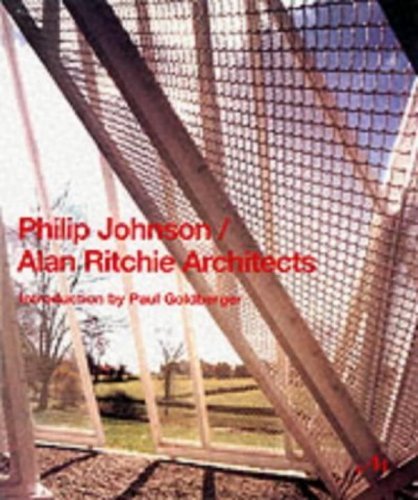
Philip Johnson, who died in 2005, was a towering figure in American architecture, both sensing and establishing new directions and stylistic trends. This monograph covers the last decade of his professional life, as he and partner Alan Ritchie collaborated on projects of striking creativity and originality. Ritchie, born in England, worked with Johnson for over twenty years and continues as president of Philip Johnson/Alan Ritchie Architects. This volume includes work built and unbuilt, largescale and small, designed by the firm throughout the 1990s. Two important themes identified by Paul Goldberger in his perceptive introductory essay are evident throughout the office's oeuvre. An interest in sculptural form or the way in which sculptural form translates into architectural presence led Johnson and Ritchie to designs that involve both new kinds of shapes and new ways of using classical architectural form. Such sculptural works include Da Monsta, the new visitor's pavilion at Johnson's famed Glass House in New Canaan, Connecticut, and a spectacular folly consisting of four pyramids made of chainlink fencing at a private residence in upstate New York. Simultaneously, the firm has continued to design larger projects, for which it has been well known since the 1980s. A twentysevenstory apartment tower for Hudson Square in lower Manhattan, the Cathedral of Hope in Dallas, and an addition to the Amon Carter Museum (originally designed by Johnson in 1961) in Fort Worth show Johnson and Ritchie's skillful commingling of the modernist and the classicist, the contextual and the unique.
⚠️ WARNING (California Proposition 65):
This product may contain chemicals known to the State of California to cause cancer,
birth defects, or other reproductive harm.
For MAP (Minimum Advertised Price) violations and Intellectual Property (IP) or Trademark concerns, please contact:
support@ergodebooks.com
⚠️ California Proposition 65 Warning: Some products sold on this website may expose you to chemicals known to the State of California to cause cancer, birth defects, or other reproductive harm. For more information, visit www.P65Warnings.ca.gov.