
Title
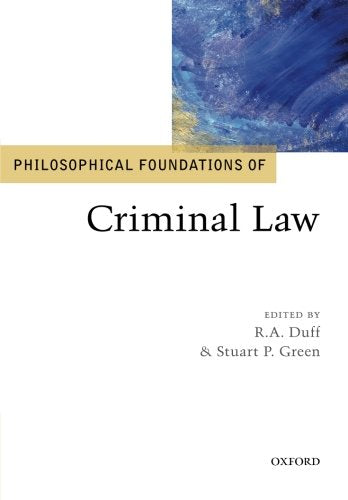
Philosophical Foundations of Criminal Law (Philosophical Foundations of Law),Used
Sold by Ergodebooks, an authorized reseller.
Returns accepted within 30 days | support@ergodebooks.com
Shipping Information
- Free Standard Shipping — United States only
- Processing Time: 3–5 business days
- Estimated Delivery: 6–10 business days after dispatch
- Double-boxed, fully insured & discreetly packaged
- Tracking number sent via email once dispatched
Returns & Refund
Returns accepted within 30 days of delivery.
Damaged or Defective Item
Free return shipping + replacement or full refund
Wrong Item Received
Free return shipping + replacement or full refund
Change of Mind
Return shipping at customer's expense · 25% restocking fee applies
Payment Option

25 leading contemporary theorists of criminal law tackle a range of foundational issues about the proper aims and structure of the criminal law in a liberal democracy.The challenges facing criminal law are many. There are crises of overcriminalization and overimprisonment; penal policy has become so politicized that it is difficult to find any clear consensus on what aims the criminal law can properly serve; governments seeking to protect their citizens in the face of a range of perceived threats have pushed the outer limits of criminal law and blurred its boundaries. To think clearly about the future of criminal law, and its role in a liberal society, foundational questions about its proper scope, structure, and operations must be reexamined. What kinds of conduct should be criminalized? What are the principles of criminal responsibility? How should offences and defences be defined? The criminal process and the criminal trial need to be studied closely, and the purposes and modes of punishment should be scrutinized.Such a reexamination must draw on the resources of various disciplinesnotably law, political and moral philosophy, criminology and history; it must examine both the inner logic of criminal law and its place in a larger legal and political structure; it must attend to the growing field of international criminal law, it must consider how the criminal law can respond to the challenges of a changing world.Topics covered in this volume include the question of criminalization and the proper scope of the criminal law; the grounds of criminal responsibility; the ways in which offences and defences should be defined; the criminal process and its values; criminal punishment; the relationship between international criminal law and domestic criminal law. Together, the essays provide a picture of the exciting state of criminal law theory today, and the basis for further research and debate in the coming years.
⚠️ WARNING (California Proposition 65):
This product may contain chemicals known to the State of California to cause cancer, birth defects, or other reproductive harm.
For more information, please visit www.P65Warnings.ca.gov.