
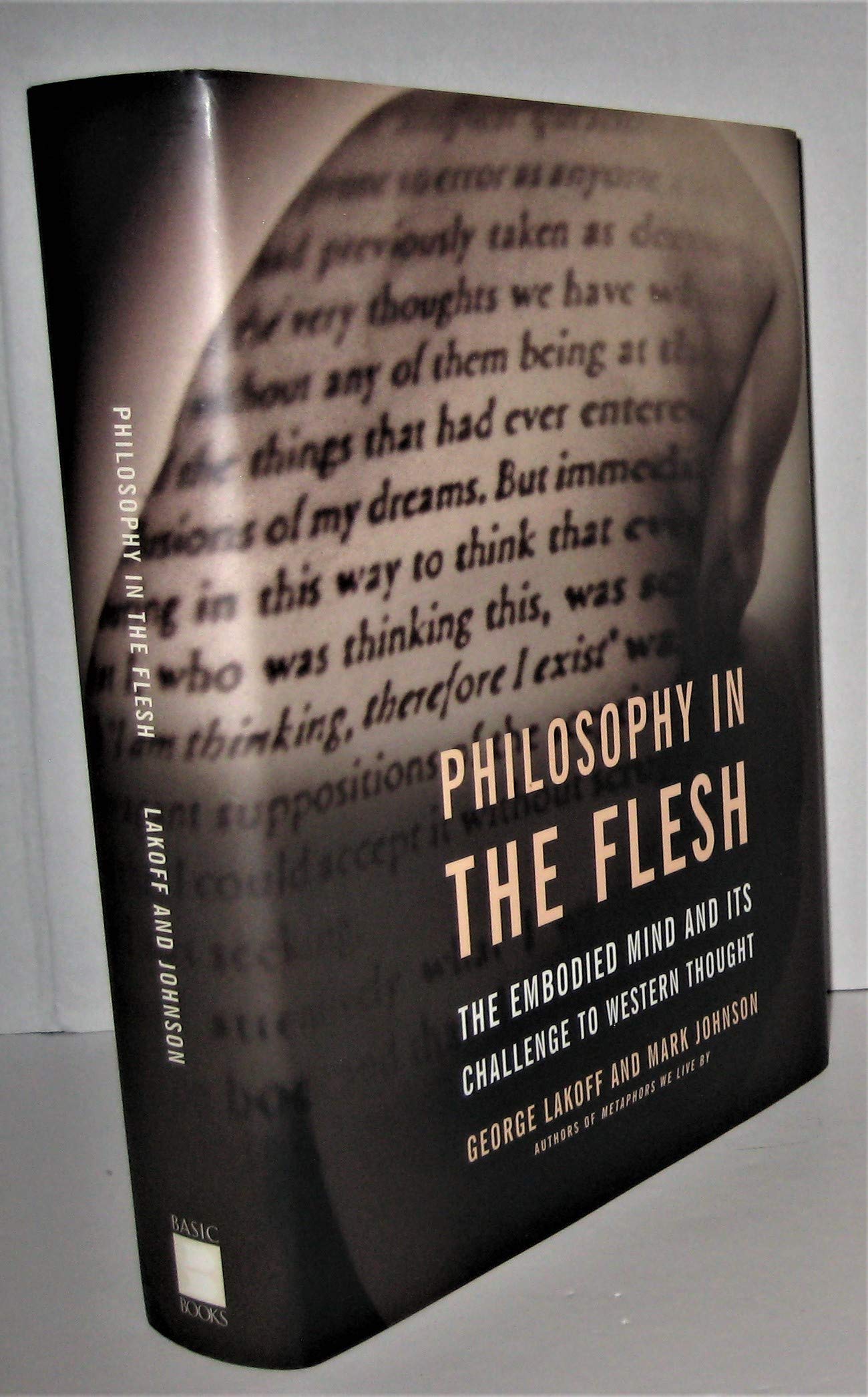
Title
Philosophy In The Flesh: The Embodied Mind And Its Challenge To Western Thought,New
Sold by Ergodebooks, an authorized reseller.
Returns accepted within 30 days | support@ergodebooks.com
Shipping Information
- Free Standard Shipping — United States only
- Processing Time: 1–3 business days
- Estimated Delivery: 3–5 business days after dispatch
- Double-boxed, fully insured & discreetly packaged
- Tracking number sent via email once dispatched
- Orders over $250 require signature upon delivery. Taxes calculated at checkout.
Returns & Refund
Returns accepted within 30 days of delivery.
Damaged or Defective Item
Free return shipping + replacement or full refund
Wrong Item Received
Free return shipping + replacement or full refund
Change of Mind
Return shipping at customer's expense · 25% restocking fee applies
Payment Option

What Are Human Beings Like? How Is Knowledge Possible? What Is Truth? Where Do Moral Values Come From? Questions Like These Have Stood At The Center Of Western Philosophy For Centuries. In Addressing Them, Philosophers Have Made Certain Fundamental Assumptionsthat We Can Know Our Own Minds By Introspection, That Most Of Our Thinking About The World Is Literal, And That Reason Is Disembodied And Universalthat Are Now Called Into Question By Wellestablished Results Of Cognitive Science. It Has Been Shown Empirically That:Most Thought Is Unconscious. We Have No Direct Conscious Access To The Mechanisms Of Thought And Language. Our Ideas Go By Too Quickly And At Too Deep A Level For Us To Observe Them In Any Simple Way.Abstract Concepts Are Mostly Metaphorical. Much Of The Subject Matter Of Philosopy, Such As The Nature Of Time, Morality, Causation, The Mind, And The Self, Relies Heavily On Basic Metaphors Derived From Bodily Experience. What Is Literal In Our Reasoning About Such Concepts Is Minimal And Conceptually Impoverished. All The Richness Comes From Metaphor. For Instance, We Have Two Mutually Incompatible Metaphors For Time, Both Of Which Represent It As Movement Through Space: In One It Is A Flow Past Us And In The Other A Spatial Dimension We Move Along.Mind Is Embodied. Thought Requires A Bodynot In The Trivial Sense That You Need A Physical Brain To Think With, But In The Profound Sense That The Very Structure Of Our Thoughts Comes From The Nature Of The Body. Nearly All Of Our Unconscious Metaphors Are Based On Common Bodily Experiences.Most Of The Central Themes Of The Western Philosophical Tradition Are Called Into Question By These Findings. The Cartesian Person, With A Mind Wholly Separate From The Body, Does Not Exist. The Kantian Person, Capable Of Moral Action According To The Dictates Of A Universal Reason, Does Not Exist. The Phenomenological Person, Capable Of Knowing His Or Her Mind Entirely Through Introspection Alone, Does Not Exist. The Utilitarian Person, The Chomskian Person, The Poststructuralist Person, The Computational Person, And The Person Defined By Analytic Philosopy All Do Not Exist.Then What Does?Lakoff And Johnson Show That A Philosopy Responsible To The Science Of Mind Offers Radically New And Detailed Understandings Of What A Person Is. After First Describing The Philosophical Stance That Must Follow From Taking Cognitive Science Seriously, They Reexamine The Basic Concepts Of The Mind, Time, Causation, Morality, And The Self: Then They Rethink A Host Of Philosophical Traditions, From The Classical Greeks Through Kantian Morality Through Modern Analytic Philosopy. They Reveal The Metaphorical Structure Underlying Each Mode Of Thought And Show How The Metaphysics Of Each Theory Flows From Its Metaphors. Finally, They Take On Two Major Issues Of Twentiethcentury Philosopy: How We Conceive Rationality, And How We Conceive Language. Philosopy In The Flesh Reveals A Radically New Understanding Of What It Means To Be Human And Calls For A Thorough Rethinking Of The Western Philosophical Tradition. This Is Philosopy As It Has Never Been Seen Before.
⚠️ WARNING (California Proposition 65):
This product may contain chemicals known to the State of California to cause cancer, birth defects, or other reproductive harm.
For more information, please visit www.P65Warnings.ca.gov.
- Q: What is the page count of this book? A: This book has six hundred forty pages. It provides an in-depth exploration of philosophy and cognitive science.
- Q: What are the dimensions of the book? A: The book measures seven point seventy-six inches in length, one point seventy-five inches in width, and nine point five inches in height.
- Q: What type of binding does this book have? A: This book is bound in hardcover. This ensures durability and a premium feel when reading.
- Q: Who is the author of this book? A: The author is George Lakoff. He is a prominent figure in cognitive science and philosophy.
- Q: What is the main theme of this book? A: The main theme addresses the intersection of cognitive science and Western philosophical thought. It challenges traditional views of the mind and reasoning.
- Q: How should I read this book? A: You can read this book at your own pace. It is suitable for anyone interested in philosophy and cognitive science.
- Q: Is this book suitable for beginners in philosophy? A: Yes, this book is suitable for beginners. It presents complex ideas in an accessible manner.
- Q: What are the key concepts discussed in this book? A: Key concepts include the nature of thought, morality, causation, and the self. These are explored through the lens of cognitive science.
- Q: How do I care for this hardcover book? A: To care for this book, keep it in a dry place and avoid direct sunlight. This will help preserve its condition.
- Q: Is this book safe for young readers? A: No, this book is not specifically aimed at young readers. It deals with complex philosophical themes that may not be suitable for children.
- Q: Can I find a summary of the key ideas in this book? A: Yes, many resources provide summaries of key ideas. They explore the main arguments and themes presented by the author.
- Q: What if my book arrives damaged? A: If your book arrives damaged, you should contact customer support for return or exchange options. Ensure you keep the original packaging.
- Q: Does this book come with a warranty? A: No, this book does not come with a warranty. However, you can return it if it is defective upon arrival.
- Q: How do I store this book properly? A: Store this book upright on a shelf, away from moisture. This helps maintain its shape and condition.
- Q: What makes this book different from other philosophy books? A: This book uniquely integrates cognitive science with philosophical inquiry, challenging longstanding assumptions in Western thought.
- Q: Is this book part of a series? A: No, this book is not part of a series. It stands alone in its exploration of embodied philosophy.