
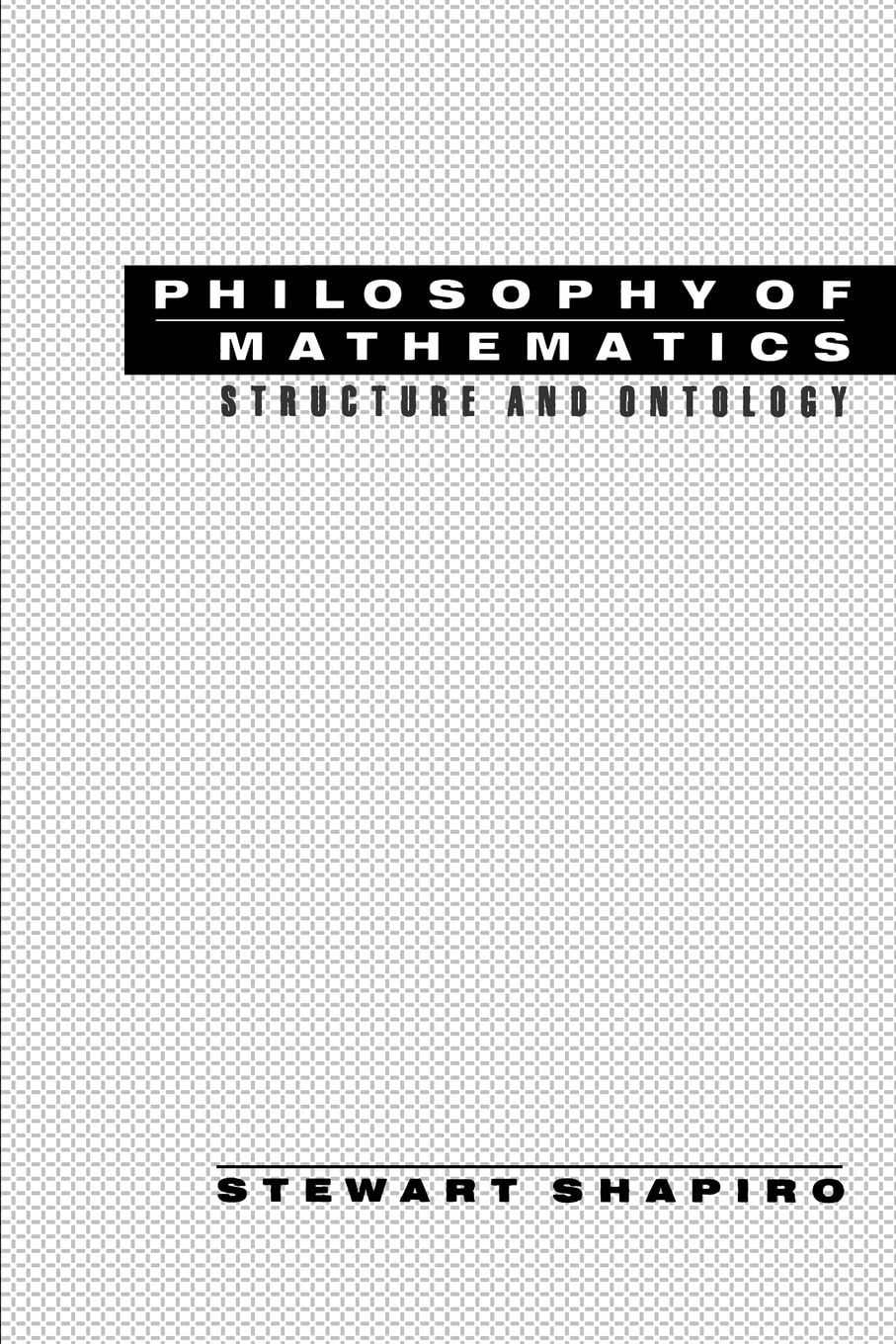
Title
Philosophy of Mathematics: Structure and Ontology,Used
Sold by Ergodebooks, an authorized reseller.
Returns accepted within 30 days | support@ergodebooks.com
Shipping Information
- Free Standard Shipping — United States only
- Processing Time: 3–5 business days
- Estimated Delivery: 6–10 business days after dispatch
- Double-boxed, fully insured & discreetly packaged
- Tracking number sent via email once dispatched
Returns & Refund
Returns accepted within 30 days of delivery.
Damaged or Defective Item
Free return shipping + replacement or full refund
Wrong Item Received
Free return shipping + replacement or full refund
Change of Mind
Return shipping at customer's expense · 25% restocking fee applies
Payment Option

Do numbers, sets, and so forth, exist? What do mathematical statements mean? Are they literally true or false, or do they lack truth values altogether? Addressing questions that have attracted lively debate in recent years, Stewart Shapiro contends that standard realist and antirealist accounts of mathematics are both problematic.As Benacerraf first noted, we are confronted with the following powerful dilemma. The desired continuity between mathematical and, say, scientific language suggests realism, but realism in this context suggests seemingly intractable epistemic problems. As a way out of this dilemma, Shapiro articulates a structuralist approach. On this view, the subject matter of arithmetic, for example, is not a fixed domain of numbers independent of each other, but rather is the natural number structure, the pattern common to any system of objects that has an initial object and successor relation satisfying the induction principle. Using this framework, realism in mathematics can be preserved without troublesome epistemic consequences.Shapiro concludes by showing how a structuralist approach can be applied to wider philosophical questions such as the nature of an 'object' and the Quinean nature of ontological commitment. Clear, compelling, and tautly argued, Shapiro's work, noteworthy both in its attempt to develop a fulllength structuralist approach to mathematics and to trace its emergence in the history of mathematics, will be of deep interest to both philosophers and mathematicians.
⚠️ WARNING (California Proposition 65):
This product may contain chemicals known to the State of California to cause cancer, birth defects, or other reproductive harm.
For more information, please visit www.P65Warnings.ca.gov.