
Title
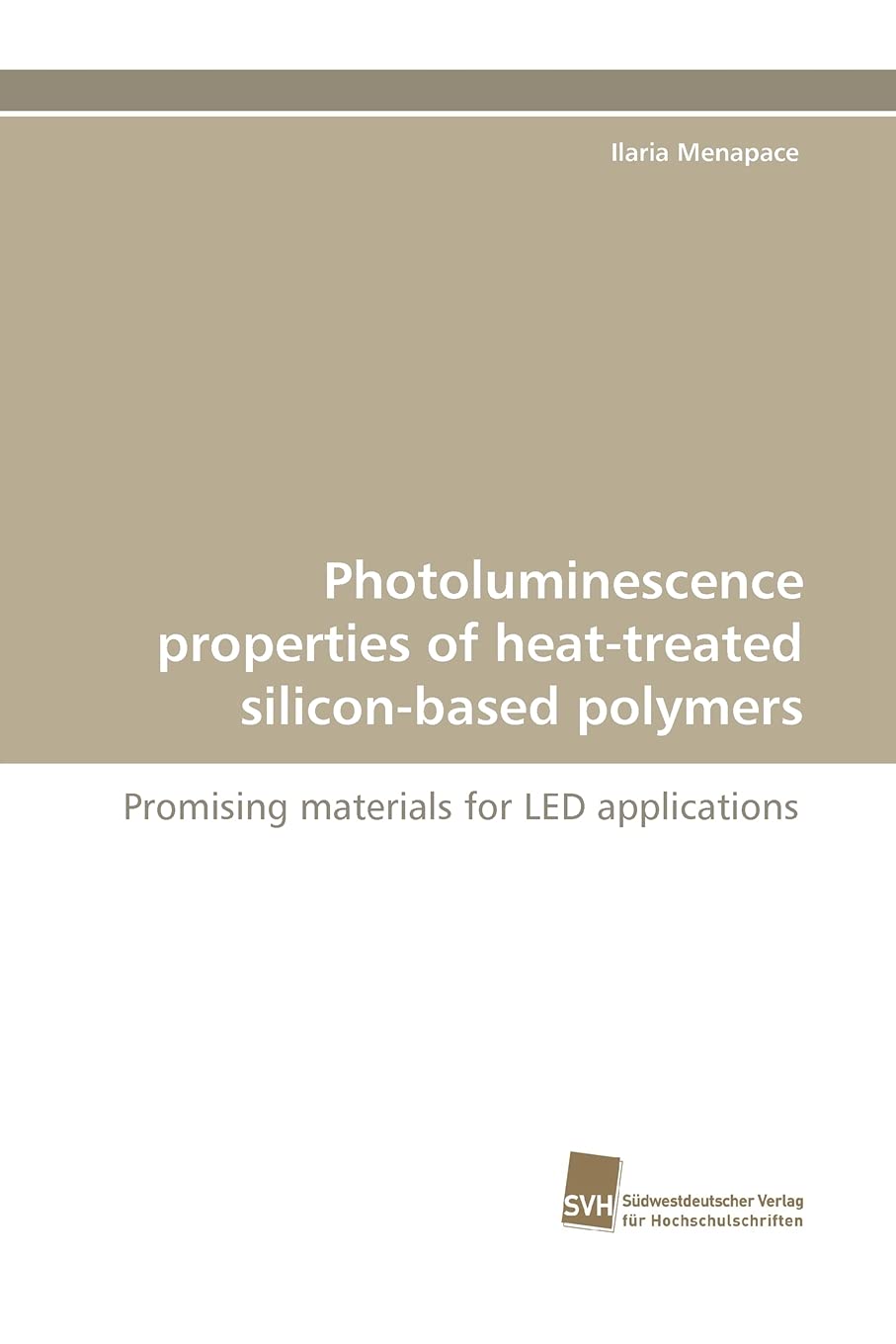
Photoluminescence properties of heattreated siliconbased polymers: Promising materials for LED applications,Used
Sold by Ergodebooks, an authorized reseller.
Returns accepted within 30 days | support@ergodebooks.com
Shipping Information
- Free Standard Shipping — United States only
- Processing Time: 3–5 business days
- Estimated Delivery: 6–10 business days after dispatch
- Double-boxed, fully insured & discreetly packaged
- Tracking number sent via email once dispatched
Returns & Refund
Returns accepted within 30 days of delivery.
Damaged or Defective Item
Free return shipping + replacement or full refund
Wrong Item Received
Free return shipping + replacement or full refund
Change of Mind
Return shipping at customer's expense · 25% restocking fee applies
Payment Option

In the present work, a new approach to obtain homogeneous, thermally stable and formable photoluminescent materials for LED applications is presented, starting from siliconbased polymers and through heattreatment at low temperatures (200700 C). These commercially available or laboratory synthesized polymers are usually employed in the PDC route and annealed at temperatures beyond 1000 C. Here, polysiloxanes, polysilazanes, polysilylcarbodiimides and a copolymer polysilazanepolysilylcarbodiimide were heattreated up to 700 C for 2 h under Ar atmosphere. The annealing is effective in order to develop materials with tunable photoluminescence properties. The maximum emission spectra of many of the polymers investigated show a bathochromic shift as the annealing temperature increases, indicating the development of new luminescent centers with smaller band gap. Our studies have shown that the luminescence properties are related to structural rearrangements occurring during the polymer to ceramic transformation, namely crosslinking and formation of sp2 carbon.
⚠️ WARNING (California Proposition 65):
This product may contain chemicals known to the State of California to cause cancer, birth defects, or other reproductive harm.
For more information, please visit www.P65Warnings.ca.gov.