
Title
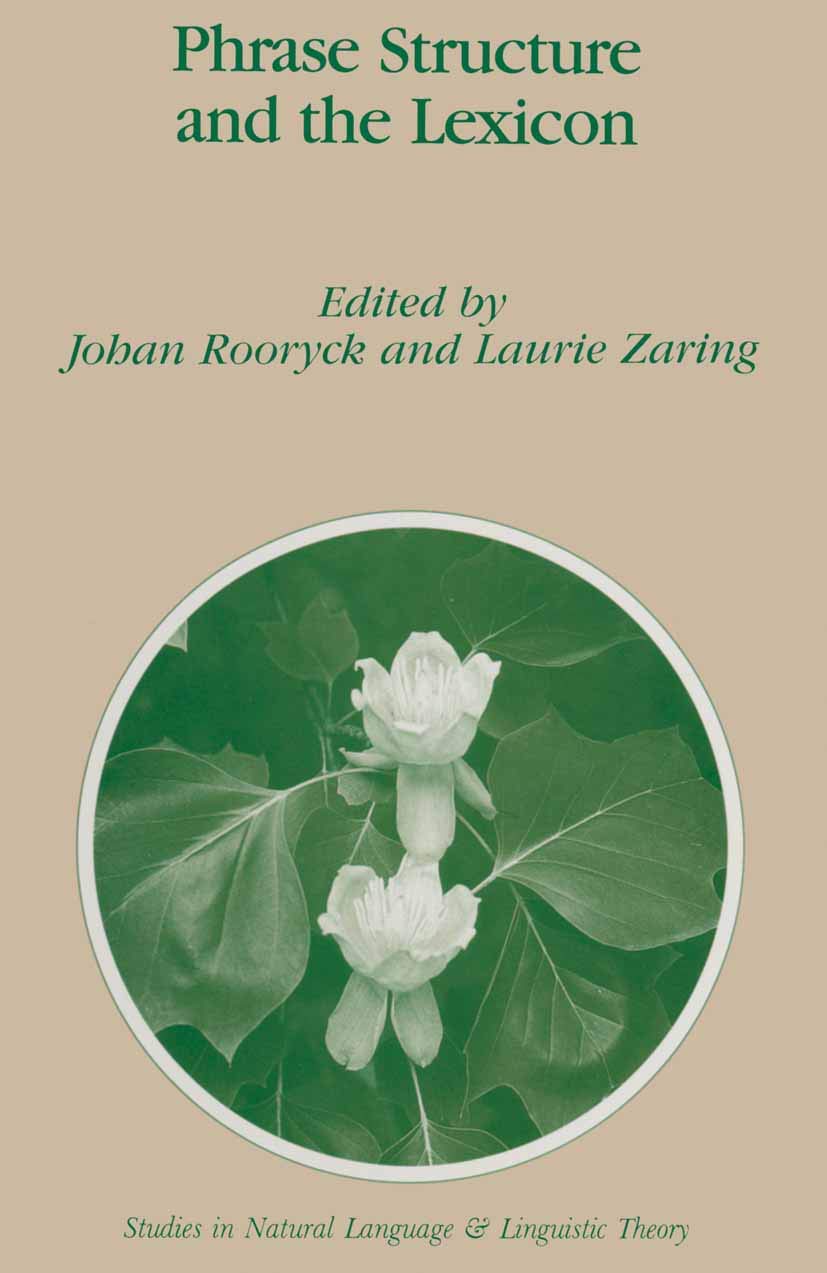
Phrase Structure and the Lexicon (Studies in Natural Language and Linguistic Theory, 33),Used
Sold by Ergodebooks, an authorized reseller.
Returns accepted within 30 days | support@ergodebooks.com
Shipping Information
- Free Standard Shipping — United States only
- Processing Time: 3–5 business days
- Estimated Delivery: 6–10 business days after dispatch
- Double-boxed, fully insured & discreetly packaged
- Tracking number sent via email once dispatched
Returns & Refund
Returns accepted within 30 days of delivery.
Damaged or Defective Item
Free return shipping + replacement or full refund
Wrong Item Received
Free return shipping + replacement or full refund
Change of Mind
Return shipping at customer's expense · 25% restocking fee applies
Payment Option

V, ThemelPatients to the lowest specifier of V', and Agents to a position outside the minimal VP. Again, thematic information is encoded in terms of configurational properties. Addressing the issue of phrase structure in another domain, Margaret Speas investigates the status of null pronominal objects in Navajo. Following Rizzi (1986), she assumes that null pronouns must meet both a licensing and an identification condition. More specifically, she demonstrates that distributional restrictions on null pronominal objects in Navajo can be explained if it is assumed that null objects obey the identification condition expressed by the Generalized Control Rule of Huang (1984). Distinguishing three types of null objects, she argues that relevant licensing condition on two subtypes of null objects involves rich agreement. However, it appears that there are languages lacking rich agreement but with pro in object position. Speas accounts for these phenomena by a rule of economy of projection. A second series of papers is concerned with the way in which functional categories derive aspects of sentential interpretation. Three issues in this research program are investigated here: external arguments as arguments of functional projections (Kratzer), the specificity interpretation of clitics (Sportiche), and the interpretation of tense (Stowell). In all three cases, phrase structure is put to use to derive interpretive effects. Angelika Kratzer proposes that external arguments are not part of the verb.
⚠️ WARNING (California Proposition 65):
This product may contain chemicals known to the State of California to cause cancer, birth defects, or other reproductive harm.
For more information, please visit www.P65Warnings.ca.gov.