
Title
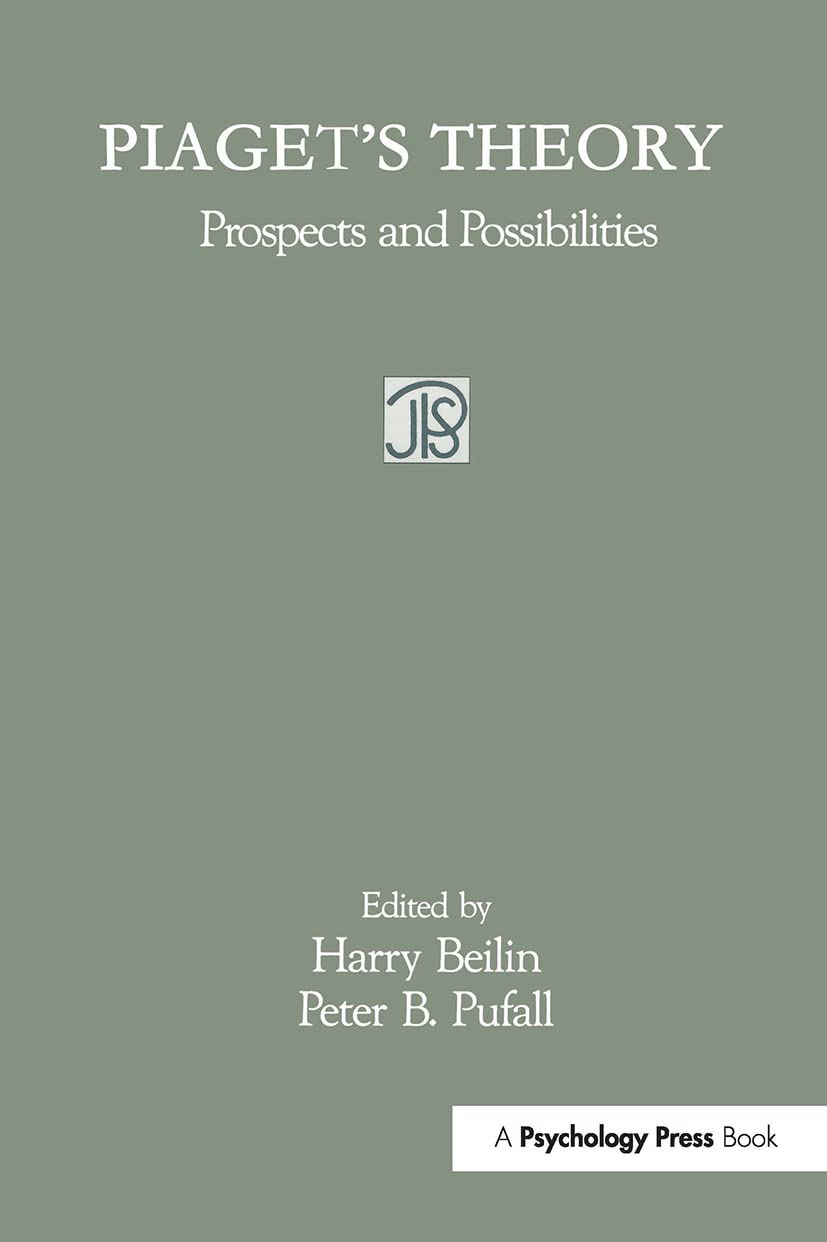
Piaget'S Theory: Prospects And Possibilities (Jean Piaget Symposia Series),Used
Sold by Ergodebooks, an authorized reseller.
Returns accepted within 30 days | support@ergodebooks.com
Shipping Information
- Free Standard Shipping — United States only
- Processing Time: 3–5 business days
- Estimated Delivery: 6–10 business days after dispatch
- Double-boxed, fully insured & discreetly packaged
- Tracking number sent via email once dispatched
Returns & Refund
Returns accepted within 30 days of delivery.
Damaged or Defective Item
Free return shipping + replacement or full refund
Wrong Item Received
Free return shipping + replacement or full refund
Change of Mind
Return shipping at customer's expense · 25% restocking fee applies
Payment Option

This volume marks the 20th Anniversary Symposium of the Jean Piaget Society. Some of the American contributors were among the first to introduce Piaget to developmental and educational psychology in the United States, while some of the international contributors worked with Piaget to develop his program of genetic epistemology and continue to make significant contributions to it.Within this volume the possibility of Piaget's paradigm is reviewed not only as the stuff of normal science, yielding fascinating empirical questions that linger within it, but also, and more importantly, as the stuff of revolutionary science, with continuing potential to comprehensively structure our thinking about developmental theory.The constructive contribution Piaget's theory has for developmental theory emerges as four central themes in the volume: understanding the intentional or semantic aspect of mental life without abandoning the Piagetian assumption that is rational and committed to truth testing; examining mental life and its development as a dialectical relation of function and structurea relation Piaget introduced in his study of the developmental relation between procedural and operational knowledge; exploring new and interdisciplinary perspectives on equilibration as the driving force of constructive adaptive processes; understanding social and historical forces in individual and cultural developmentnot necessarily as forces antithetical to Piaget's perspective but as forces that take on new meaning within his framework which avoids erroneous dichotomies such as the distinction between subjective and objective knowledge.
⚠️ WARNING (California Proposition 65):
This product may contain chemicals known to the State of California to cause cancer, birth defects, or other reproductive harm.
For more information, please visit www.P65Warnings.ca.gov.