
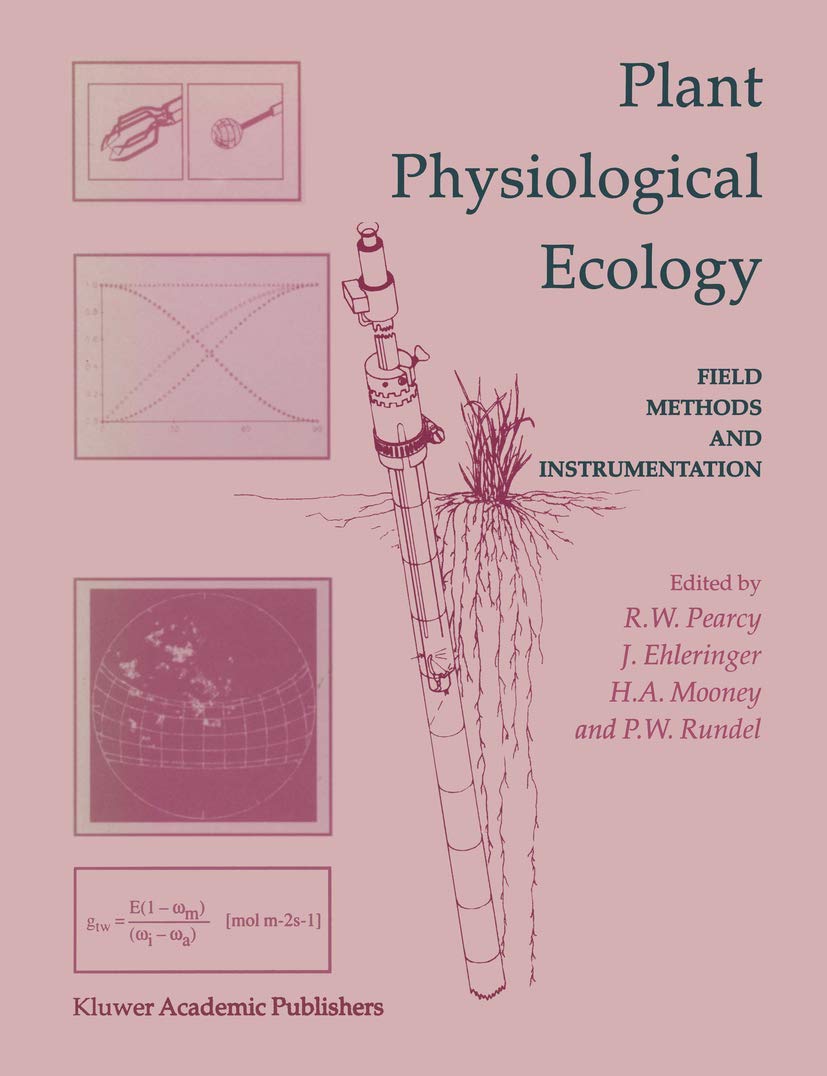
Title
Plant Physiological Ecology: Field Methods And Instrumentation,Used
Processing time: 1-3 days
US Orders Ships in: 3-5 days
International Orders Ships in: 8-12 days
Return Policy: 15-days return on defective items
Payment Option

capable of providing at least a relative measure of stomatal aperture were first used shortly thereafter (Darwin and Pertz, 1911). The Carnegie Institution of Washington's Desert Research Laboratory in Tucson from 1905 to 1927 was the first effort by plant physiologists and ecologists to conduct team research on the water relations of desert plants. Measurements by Stocker in the North African deserts and Indonesia (Stocker, 1928, 1935) and by Lundegardh (1922) in forest understories were pioneering attempts to understand the environmental controls on photosynthesis in the field. While these early physiological ecologists were keen observers and often posed hypotheses still relevant today they were strongly limited by the methods and technologies available to them. Their measurements provided only rough approximations of the actual plant responses. The available laboratory equip ment was either unsuited or much more difficult to operate under field than laboratory conditions. Laboratory physiologists distrusted the results and ecologists were largely not persuaded of its relevance. Consequently, it was not until the 1950s and 1960s that physiological ecology began its current resurgence. While the reasons for this are complicated, the development and application of more sophisticated instruments such as the infrared gas analyzer played a major role. In addition, the development of micrometeorology led to new methods of characterizing the plant environments.
⚠️ WARNING (California Proposition 65):
This product may contain chemicals known to the State of California to cause cancer, birth defects, or other reproductive harm.
For more information, please visit www.P65Warnings.ca.gov.
- Q: How many pages does this book have? A: This book has four hundred seventy-two pages. It provides an in-depth exploration of plant physiological ecology.
- Q: What is the binding type of this book? A: The binding type of this book is paperback. This makes it lightweight and easy to carry.
- Q: What are the dimensions of this book? A: The dimensions of this book are seven point forty-six inches in length, one point one inches in width, and nine point seven inches in height.
- Q: Who is the author of this book? A: The author of this book is Robert W. Pearcy. He is recognized for his contributions to the field of plant physiology.
- Q: What category does this book fall under? A: This book falls under the Anatomy category. It discusses various aspects of plant physiological ecology.
- Q: Is this book suitable for beginners? A: Yes, this book is suitable for beginners. It covers fundamental concepts in plant physiology and ecology.
- Q: Can I use this book for academic purposes? A: Yes, this book is ideal for academic purposes. It provides comprehensive research and methodologies relevant to plant studies.
- Q: Is this book appropriate for children? A: No, this book is not specifically designed for children. It is more suitable for college students and professionals.
- Q: What features does this book offer? A: This book is a used book in good condition. It retains its educational value despite being previously owned.
- Q: How should I store this book? A: Store this book in a cool, dry place. Avoid exposure to direct sunlight to preserve its condition.
- Q: Can I return this book if I am not satisfied? A: Yes, you can typically return this book if you are not satisfied. Check the retailer's return policy for specifics.
- Q: Is this book safe to use? A: Yes, this book is safe to use. It does not contain any hazardous materials.
- Q: How do I clean this book? A: To clean this book, gently wipe the cover with a soft, dry cloth. Avoid using water or cleaning solutions.
- Q: What makes this book unique? A: This book is unique due to its detailed historical context and methodologies in plant physiological ecology.
- Q: How does this book compare to other ecology books? A: This book offers a specific focus on physiological aspects, making it suitable for readers interested in plant ecology.
- Q: What should I do if the book arrives damaged? A: If the book arrives damaged, contact the seller immediately. Most retailers have policies for damaged goods.