
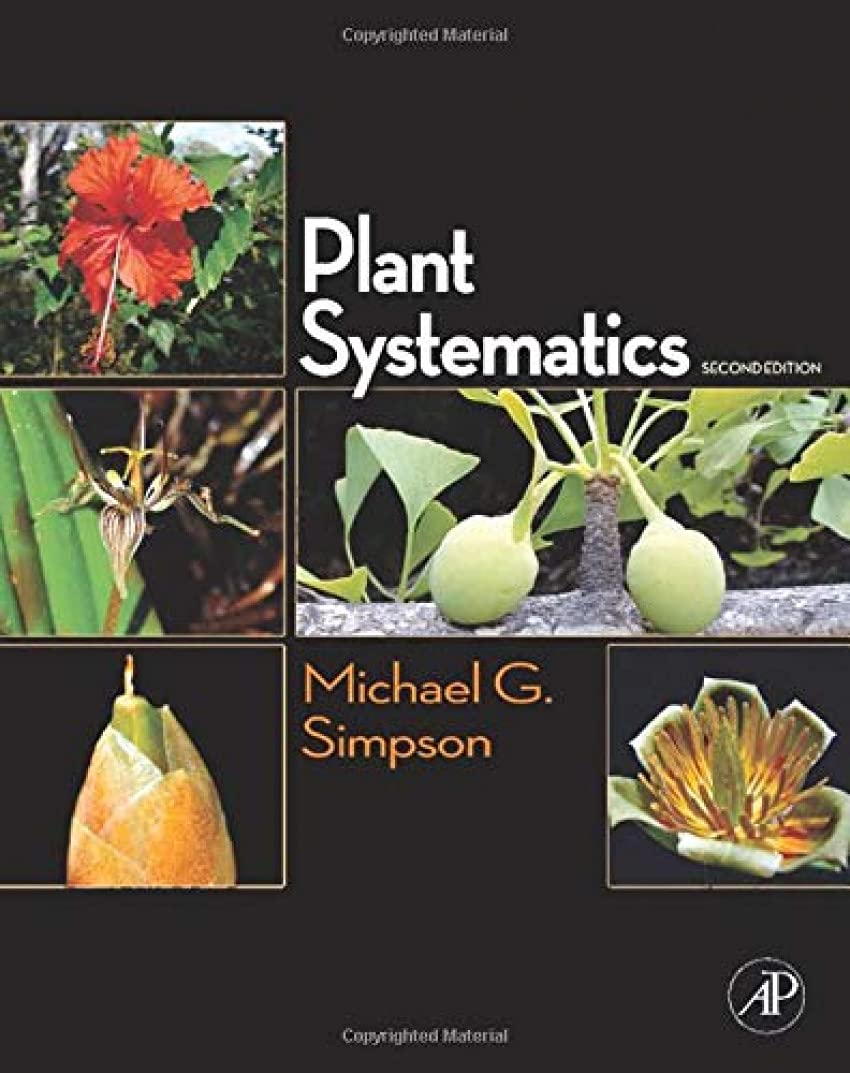
Title
Plant Systematics
Sold by Ergodebooks, an authorized reseller.
Returns accepted within 30 days | support@ergodebooks.com
Shipping Information
- Free Standard Shipping — United States only
- Processing Time: 3–5 business days
- Estimated Delivery: 6–10 business days after dispatch
- Double-boxed, fully insured & discreetly packaged
- Tracking number sent via email once dispatched
Returns & Refund
Returns accepted within 30 days of delivery.
Damaged or Defective Item
Free return shipping + replacement or full refund
Wrong Item Received
Free return shipping + replacement or full refund
Change of Mind
Return shipping at customer's expense · 25% restocking fee applies
Payment Option

Plant Systematics, Second Edition, Provides The Basis For Teaching An Introduction To The Morphology, Evolution, And Classification Of Land Plants.It Presents A Foundation Of The Approach, Methods, Research Goals, Evidence, And Terminology Of Plant Systematics, Along With The Most Recent Knowledge Of Evolutionary Relationships Of Plants And Practical Information Vital To The Field. This Updated Edition Has Been Expanded To Include 15 Fern Families, 9 Gymnosperm Families, And Increased Angiosperm Family Treatments From 100 To 129. Each Family Description Includes A Plate Of Full Color Photographs, Illustrating Exemplars Of The Group Along With Dissected And Labeled Material To Show Diagnostic Features.The Book Includes A New Chapter On Species Concepts And The Role And Impact Of Plant Systematics In Conservation Biology, And A New Appendix On Statistical And Morphometric Techniques In Plant Systematics. It Also Contains More Detailed Explanations Of Maximum Likelihood And Bayesian Phylogeny Inference Methods, An Expanded Coverage And Glossary Of Morphological Terms, And An Updated Chapter On Botanical Nomenclature.This Book Is Recommended For Graduate And Undergraduate Students In Botany, Plant Taxonomy, Plant Systematics, Plant Pathology, Plant Anatomy, And Ecology As Well As Scientists And Researchers In Any Of The Plant Sciences. Fifteen Fern Families, 9 Gymnosperm Families, And An Increase Of Angiosperm Family Treatments From 100 To 129. Each Family Description Includes A Plate Of Full Color Photographs, Illustrating Exemplars Of The Group Along With Dissected And Labeled Material To Show Diagnostic Features A New Chapter On Species Concepts And The Role And Impact Of Plant Systematics In Conservation Biology A New Appendix On Statistical And Morphometric Techniques In Plant Systematics In Addition, The Second Edition Contains More Detailed Explanations Of Maximum Likelihood And Bayesian Phylogeny Inference Methods, An Expanded Coverage And Glossary Of Morphological Terms, And An Updated Chapter On Botanical Nomenclature
⚠️ WARNING (California Proposition 65):
This product may contain chemicals known to the State of California to cause cancer, birth defects, or other reproductive harm.
For more information, please visit www.P65Warnings.ca.gov.
- Q: What are the dimensions of the book Plant Systematics? A: The book measures nine point twenty-five inches in length, one point five inches in width, and eleven point five inches in height.
- Q: How many pages does Plant Systematics have? A: This book contains seven hundred fifty-two pages, providing extensive information on plant systematics.
- Q: What type of binding does Plant Systematics have? A: Plant Systematics is bound in hardcover, ensuring durability and a professional appearance.
- Q: What is the main focus of Plant Systematics? A: The main focus of Plant Systematics is the morphology, evolution, and classification of land plants.
- Q: Who is the author of Plant Systematics? A: The book is authored by Michael G. Simpson, a recognized expert in the field.
- Q: Is Plant Systematics suitable for beginners? A: Yes, it is suitable for both graduate and undergraduate students, as well as beginners interested in plant sciences.
- Q: Can I use Plant Systematics for research purposes? A: Yes, this book is highly recommended for scientists and researchers in various plant science disciplines.
- Q: What types of plants does Plant Systematics cover? A: The book covers fifteen fern families, nine gymnosperm families, and angiosperm family treatments from one hundred to one hundred twenty-nine.
- Q: Does Plant Systematics include illustrations? A: Yes, each family description includes full color photographs and labeled material to illustrate diagnostic features.
- Q: Are there any new chapters in the second edition of Plant Systematics? A: Yes, the second edition includes a new chapter on species concepts and conservation biology.
- Q: How should I care for Plant Systematics? A: To keep Plant Systematics in good condition, store it in a cool, dry place and avoid exposing it to direct sunlight.
- Q: Is Plant Systematics safe for all ages? A: Yes, it is appropriate for students and professionals, but parental guidance is recommended for younger readers.
- Q: What should I do if my copy of Plant Systematics arrives damaged? A: If your copy arrives damaged, contact the retailer to initiate a return or exchange process.
- Q: Does Plant Systematics provide statistical techniques? A: Yes, it includes an appendix on statistical and morphometric techniques used in plant systematics.
- Q: What glossary features does Plant Systematics offer? A: The book has an expanded glossary of morphological terms to aid understanding of the content.
- Q: What is the role of Plant Systematics in conservation? A: Plant Systematics plays a crucial role in conservation biology by providing insights into evolutionary relationships.