
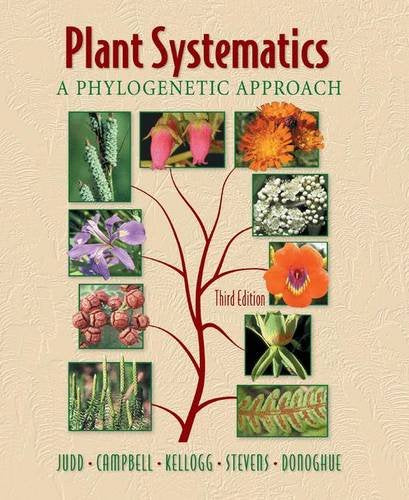
Title
Plant Systematics: A Phylogenetic Approach
Sold by Ergodebooks, an authorized reseller.
Returns accepted within 30 days | support@ergodebooks.com
Shipping Information
- Free Standard Shipping — United States only
- Processing Time: 3–5 business days
- Estimated Delivery: 6–10 business days after dispatch
- Double-boxed, fully insured & discreetly packaged
- Tracking number sent via email once dispatched
Returns & Refund
Returns accepted within 30 days of delivery.
Damaged or Defective Item
Free return shipping + replacement or full refund
Wrong Item Received
Free return shipping + replacement or full refund
Change of Mind
Return shipping at customer's expense · 25% restocking fee applies
Payment Option

A Comprehensive Introduction To Vascular Plant Phylogeny, The Third Edition Of Plant Systematics Reflects Changes In The Circumscription Of Many Orders And Families To Represent Monophyletic Groups, Following The Most Recent Classification Of The Angiosperm Phylogeny Group. The Taxonomic Evidence Described Includes Data From Morphology, Anatomy, Embryology, Chromosomes, Palynology, Secondary Plant Compounds, Proteins, And Dna. Molecular Taxonomic Methods Are Fully Presented, As Are The Results Of Many Recent Studies, Both Molecular And Morphological. A Chapter On The History Of Plant Classification Puts Current Systematic Methods Into Historical Context. Issues Relating To Variation In Plant Populations And Species, Including Speciation And Species Concepts, Polyploidy, Hybridization, Breeding Systems, And Introgression Are Carefully Considered. Appendices Cover Botanical Nomenclature As Well As Field And Herbarium Methodology. The Text Is Copiously Illustrated, Using In Large Part The Informative Analytical Drawings Developed As Part Of The Generic Flora Of The Southeastern United States Project.
⚠️ WARNING (California Proposition 65):
This product may contain chemicals known to the State of California to cause cancer, birth defects, or other reproductive harm.
For more information, please visit www.P65Warnings.ca.gov.
- Q: What is the page count of this book? A: This book has six hundred eleven pages. It provides an extensive overview of plant systematics and phylogeny.
- Q: What type of binding does this book have? A: This book is hardcover bound. This ensures durability and longevity for frequent use.
- Q: What are the dimensions of this book? A: This book measures eight point two seven inches in length, zero point nine eight inches in width, and ten point seven five inches in height. These dimensions make it suitable for shelving.
- Q: Who is the author of this book? A: The author is Walter S. Judd. He is a well-respected figure in the field of plant systematics.
- Q: What is the main focus of this book? A: The main focus is on vascular plant phylogeny. It reflects the latest classifications and taxonomic evidence in the field.
- Q: What kind of illustrations can I expect in this book? A: The book includes copious illustrations, primarily analytical drawings. These visuals enhance the understanding of complex concepts.
- Q: Is this book suitable for beginners? A: Yes, this book is suitable for beginners. It provides a comprehensive introduction to plant systematics.
- Q: Can I use this book for advanced studies? A: Yes, this book is also appropriate for advanced studies. It covers recent findings in molecular and morphological taxonomic methods.
- Q: What topics does this book cover? A: This book covers topics like speciation, polyploidy, and hybridization. It thoroughly discusses the history and methodology of plant classification.
- Q: How should I store this book? A: Store this book in a cool, dry place. Avoid direct sunlight to prevent fading and damage to the cover.
- Q: Is there a chapter that discusses the history of plant classification? A: Yes, there is a dedicated chapter on the history of plant classification. It contextualizes current systematic methods historically.
- Q: Are there any appendices in this book? A: Yes, there are appendices covering botanical nomenclature and field methodology. These are useful for practical applications.
- Q: What is the publisher of this book? A: The publisher is Sinauer Associates Inc. They are known for academic and scientific publications.
- Q: Does this book include any molecular taxonomic methods? A: Yes, it fully presents molecular taxonomic methods. This includes data from DNA and other molecular studies.
- Q: Is this book part of a series? A: No, this book is not part of a series. It stands alone as a comprehensive resource on plant systematics.