If you have any questions, you are always welcome to contact us. We'll get back to you as soon as possible, withing 24 hours on weekdays.
Customer service
All questions about your order, return and delivery must be sent to our customer service team by e-mail at yourstore@yourdomain.com
Sale & Press
If you are interested in selling our products, need more information about our brand or wish to make a collaboration, please contact us at press@yourdomain.com
Help
If you have any questions, you are always welcome to contact us. We'll get back to you as soon as possible, withing 24 hours on weekdays.
Customer service
All questions about your order, return and delivery must be sent to our customer service team by e-mail at yourstore@yourdomain.com
Sale & Press
If you are interested in selling our products, need more information about our brand or wish to make a collaboration, please contact us at press@yourdomain.com
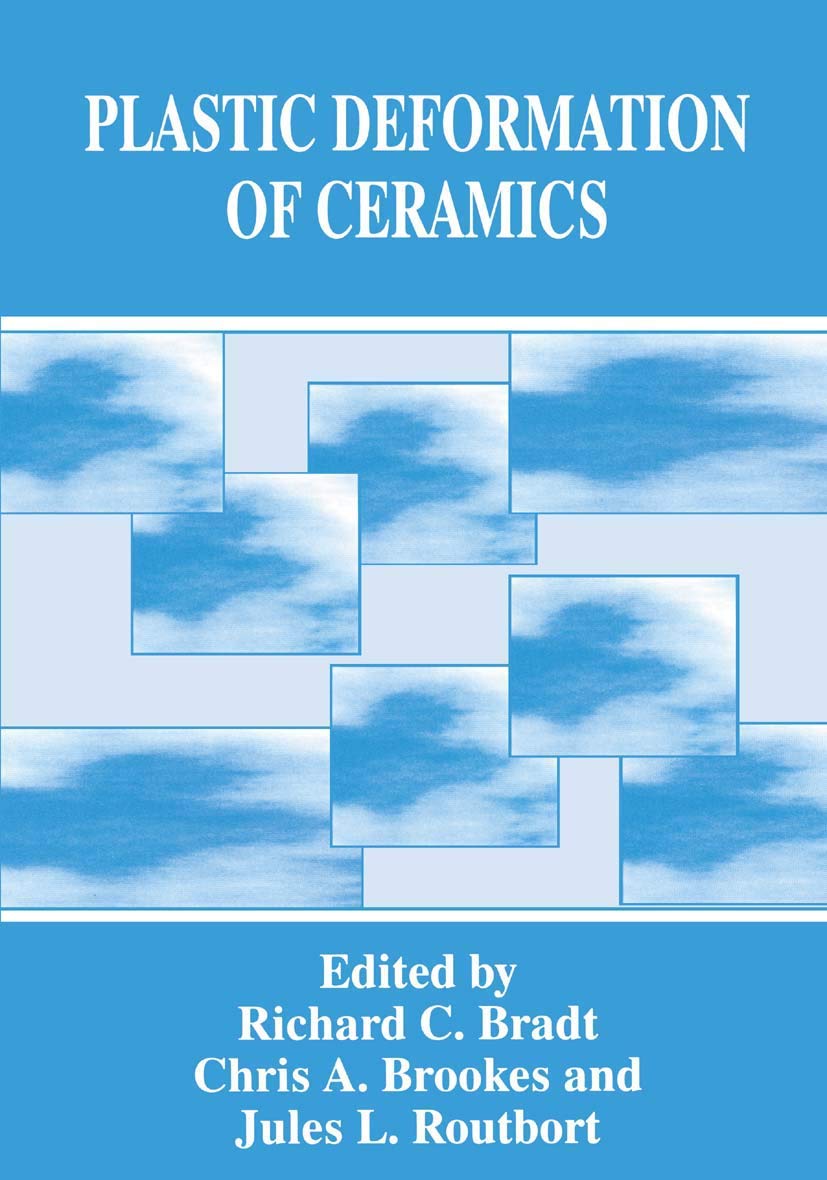
This proceedings volume, "Plastic Deformation of Ceramics," constitutes the papers of an international symposium held at Snowbird, Utah from August 712, 1994. It was attended by nearly 100 scientists and engineers from more than a dozen countries representing academia, national laboratories, and industry. Two previous conferences on this topic were held at The Pennsylvania State University in 1974 and 1983. Therefore, the last major international conference focusing on the deformation of ceramic materials was held more than a decade ago. Since the early 1980s, ceramic materials have progressed through an evolutionary period of development and advancement. They are now under consideration for applications in engineering structures. The contents of the previous conferences indicate that considerable effort was directed towards a basic understanding of deformation processes in covalently bonded or simple oxide ceramics. However, now, more than a decade later, the focus has completely shifted. In particular, the drive for more efficient heat engines has resulted in the development of siliconbased ceramics and composite ceramics. The discovery of hightemperature cupric oxidebased superconductors has created a plethora of interesting perovskiteIike structured ceramics. Additionally, nanophase ceramics, ceramic thin films, and various forms of toughened ceramics have potential applications and, hence, their deformation has been investigated. Finally, new and exciting areas of research have attracted interest since 1983, including fatigue, nanoindentation techniques, and superplasticity.
⚠️ WARNING (California Proposition 65):
This product may contain chemicals known to the State of California to cause cancer,
birth defects, or other reproductive harm.
For MAP (Minimum Advertised Price) violations and Intellectual Property (IP) or Trademark concerns, please contact:
support@ergodebooks.com
⚠️ California Proposition 65 Warning: Some products sold on this website may expose you to chemicals known to the State of California to cause cancer, birth defects, or other reproductive harm. For more information, visit www.P65Warnings.ca.gov.