If you have any questions, you are always welcome to contact us. We'll get back to you as soon as possible, withing 24 hours on weekdays.
Customer service
All questions about your order, return and delivery must be sent to our customer service team by e-mail at yourstore@yourdomain.com
Sale & Press
If you are interested in selling our products, need more information about our brand or wish to make a collaboration, please contact us at press@yourdomain.com
Help
If you have any questions, you are always welcome to contact us. We'll get back to you as soon as possible, withing 24 hours on weekdays.
Customer service
All questions about your order, return and delivery must be sent to our customer service team by e-mail at yourstore@yourdomain.com
Sale & Press
If you are interested in selling our products, need more information about our brand or wish to make a collaboration, please contact us at press@yourdomain.com
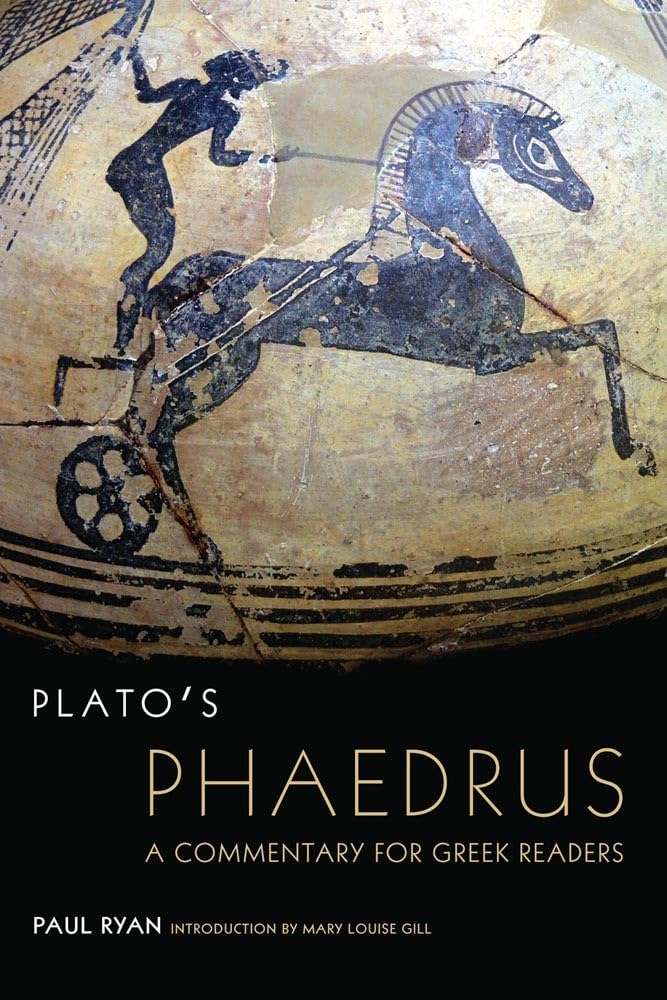
Composed in the fourth century b.c., the Phaedrusa dialogue between Phaedrus and Socratesdeals ostensibly with love but develops into a wideranging discussion of such subjects as the pursuit of beauty, the nature of humanity, the immortality of the soul, and the attainment of truth, ending with an indepth discussion of the principles of rhetoric. This erudite commentary, which also includes the original Greek text, is designed to help intermediatelevel students of Greek read, understand, and enjoy Platos magnificent work.Drawing on his extensive classroom experience and linguistic expertise, Paul Ryan offers a commentary that is both rich in detail andin contrast to earlier, more austere commentaries on the Phaedrusfully engaging. Line by line, he explains subtle points of language, explicates difficulties of syntax, and brings out nuances of tone and meaning that students might not otherwise notice or understand. Ryan sections his commentary into units of convenient length for classroom use, with short summaries at the head of each section to orient the reader.Never straying far from the text itself, Ryan provides useful historical glosses and annotations for the student, introducing information ranging from the architecture of the Lyceum to Athenian politics. Further historical and philosophical context is provided in the introduction by Mary Louise Gill, who outlines the issues addressed in the Phaedrus and situates it in relation to Platos other dialogues.
⚠️ WARNING (California Proposition 65):
This product may contain chemicals known to the State of California to cause cancer,
birth defects, or other reproductive harm.
For MAP (Minimum Advertised Price) violations and Intellectual Property (IP) or Trademark concerns, please contact:
support@ergodebooks.com
⚠️ California Proposition 65 Warning: Some products sold on this website may expose you to chemicals known to the State of California to cause cancer, birth defects, or other reproductive harm. For more information, visit www.P65Warnings.ca.gov.