If you have any questions, you are always welcome to contact us. We'll get back to you as soon as possible, withing 24 hours on weekdays.
Customer service
All questions about your order, return and delivery must be sent to our customer service team by e-mail at yourstore@yourdomain.com
Sale & Press
If you are interested in selling our products, need more information about our brand or wish to make a collaboration, please contact us at press@yourdomain.com
Help
If you have any questions, you are always welcome to contact us. We'll get back to you as soon as possible, withing 24 hours on weekdays.
Customer service
All questions about your order, return and delivery must be sent to our customer service team by e-mail at yourstore@yourdomain.com
Sale & Press
If you are interested in selling our products, need more information about our brand or wish to make a collaboration, please contact us at press@yourdomain.com
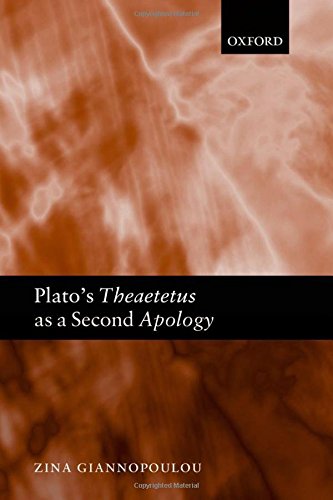
Zina Giannopoulou argues that TheaetetusPlato's most systematic examination of knowledgeis a philosophically sophisticated elaboration of Apology that successfully differentiates Socrates from the sophists. In Apology Socrates defends his philosophical activity partly by distinguishing it from sophistic practices, and in Theaetetus he enacts this distinction: the selfproclaimed ignorant and pious Socrates of Apology poses as the barren practitioner of midwifery, an art that enjoys divine support, and helps his pregnant interlocutor to engender his ideas. Whereas sophistic expertise fills others' souls with items of dubious epistemic quality, Socratic midwifery removes, tests, and discards falsities. In Theaetetus Plato drapes the Socrates of Apology with obstetric garb and stages a philosophical contest between him and the seemingly wise men with whose definitions Theaetetus' soul teems, chief among whom is Protagoras. By proving the indefensibility of these definitions, Socrates challenges their authors' wisdomsince for him no one can justifiably be said to have knowledge if he cannot give an account of knowledge. On the other hand, his own inability to procure the definition he seeks confirms his assertion that he lacks wisdom. Giannopoulou goes on to explore how in Apology Socrates claims that his wisdom consists in his awareness of his lack of wisdom, and in Theaetetus he validates this claim: his attempt to discover what knowledge is, coupled with his intellectual barrenness, shows both that he does not have what he is looking for and why this is the case.
⚠️ WARNING (California Proposition 65):
This product may contain chemicals known to the State of California to cause cancer,
birth defects, or other reproductive harm.
For MAP (Minimum Advertised Price) violations and Intellectual Property (IP) or Trademark concerns, please contact:
support@ergodebooks.com
⚠️ California Proposition 65 Warning: Some products sold on this website may expose you to chemicals known to the State of California to cause cancer, birth defects, or other reproductive harm. For more information, visit www.P65Warnings.ca.gov.